

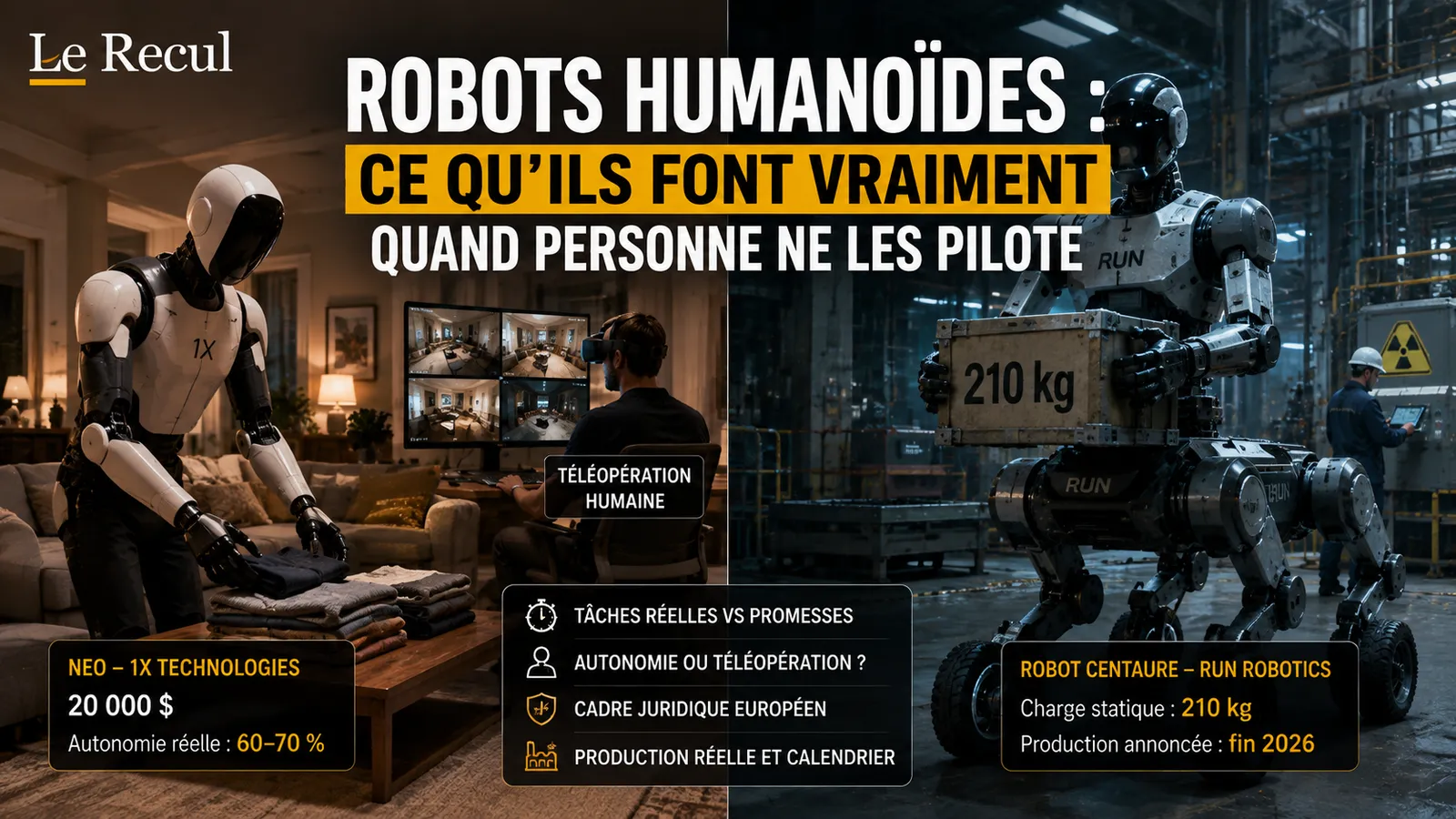
The same day, two announcements. On one side, a 1.68-metre humanoid robot moving into American homes for $20,000, tidying your living room and reminding you of birthdays. On the other, a machine presented in Shanghai as “the world’s first centaur robot”: a humanoid torso mounted on a four-wheel all-terrain chassis, able to lift 210 kilos and designed for nuclear plants, mines and disaster zones.
These two objects belong to the same underlying movement: artificial intelligence is leaving the screen. After three years spent producing text and images, it is acquiring a body. The industry now calls this “physical AI”, and it is the thesis NVIDIA’s chief executive publicly defends as the sector’s next engine of growth.
But these two robots do not tell the same story. One is sold on what it promises to do, the other on what it can carry. Only one of the two rests on a claim nobody has managed to verify — and it is the one that wants to come into your home.
Two machines, two philosophies
Let us start with the facts, separating what is documented from what is announced.
NEO, from the manufacturer 1X Technologies, is a 1.68-metre bipedal humanoid weighing about 30 kilos. Founded in Norway, the company now produces in California. The robot has hands with 22 degrees of freedom, a 0.75 kWh battery giving it up to four hours of runtime, and can carry around 25 kilos. It runs Redwood, a 160 million parameter model that executes entirely on the onboard graphics processor, with no cloud connection — a notable technical choice at a time when almost everything depends on remote servers.
Its design is deliberately neutral. No realistic face, no marked human features: the manufacturers have understood that a machine too anthropomorphic to meet in a corridor at three in the morning does not stay long in a household. That is a trade-off on acceptability, not a technical constraint.
Run Robotics’ centaur robot, presented at WAIC in Shanghai from 17 to 20 July 2026, follows the opposite logic. It is not trying to be liked. Its hybrid design — humanoid upper body with manipulator arms, four-wheel all-terrain base — aims at efficiency in environments where humans are in danger. Its specifications are announced as follows: 120 kilos dynamic payload, 210 kilos static payload, maximum torque of 830 newton-metres, dexterous hands with tactile sensors and an explosion-proof design. Declared targets: steelmaking, nuclear facilities, oil field inspection, firefighting and rescue. The company announces an automated assembly line in the fourth quarter of 2026 and commercial orders already signed.
One detail goes unnoticed and sums everything up: more than 95% of the centaur’s components are produced in China.
Note straight away that “world’s first centaur robot” is the company’s phrasing, not an independent finding — hybrid wheel-leg architectures have existed in laboratories for years. We cite it as a claim.
What NEO actually does
This is where the gap opens.
The tasks credited as autonomous are real, and they should not be downplayed: opening a door, fetching an object, switching lights on or off, emptying a dishwasher, watering plants. For a generalist machine operating in an unstructured environment — a living room is not an assembly line — that is a considerable technical achievement.
The problem is not there. It is in the gap between that list and the image being sold.
NEO’s real autonomy at delivery is estimated at around 60 to 70% of tasks. The rest — cleaning a bathroom, vacuuming, folding laundry end to end — requires a human operator to step in.
The hardest fact to get around is this one: in a supervised trial with a Wall Street Journal reporter, not one of the tasks the robot performed was done autonomously. Trial reports also converge on three points: the machine is markedly slower than a human, it sometimes falls, and it needs “a lot of human help”.
On laundry folding — the emblematic task, the one that has come back in every demonstration for ten years — observers are clear: humanoids can indeed manipulate and fold textiles, but well below human speed, and they fail on edge cases. Where a person folds a shirt in a few seconds, the machine takes far longer and gets stuck on a turned-back hem or a trapped sleeve. Several specialists put end-to-end laundry in the same difficulty class as fully autonomous driving: a task you think is simple because you do it without thinking, and which in fact concentrates an unreasonable quantity of edge cases.
This is Moravec’s paradox, stated in the 1980s and never disproved: what is hard for a human — playing chess, solving an integral — is easy for a machine, and what is trivial for a five-year-old — grabbing a sock from the bottom of a basket — remains extraordinarily hard. Forty years on, language models have settled the first half of the problem. They have not started on the second.
The human in the loop: who is watching your living room
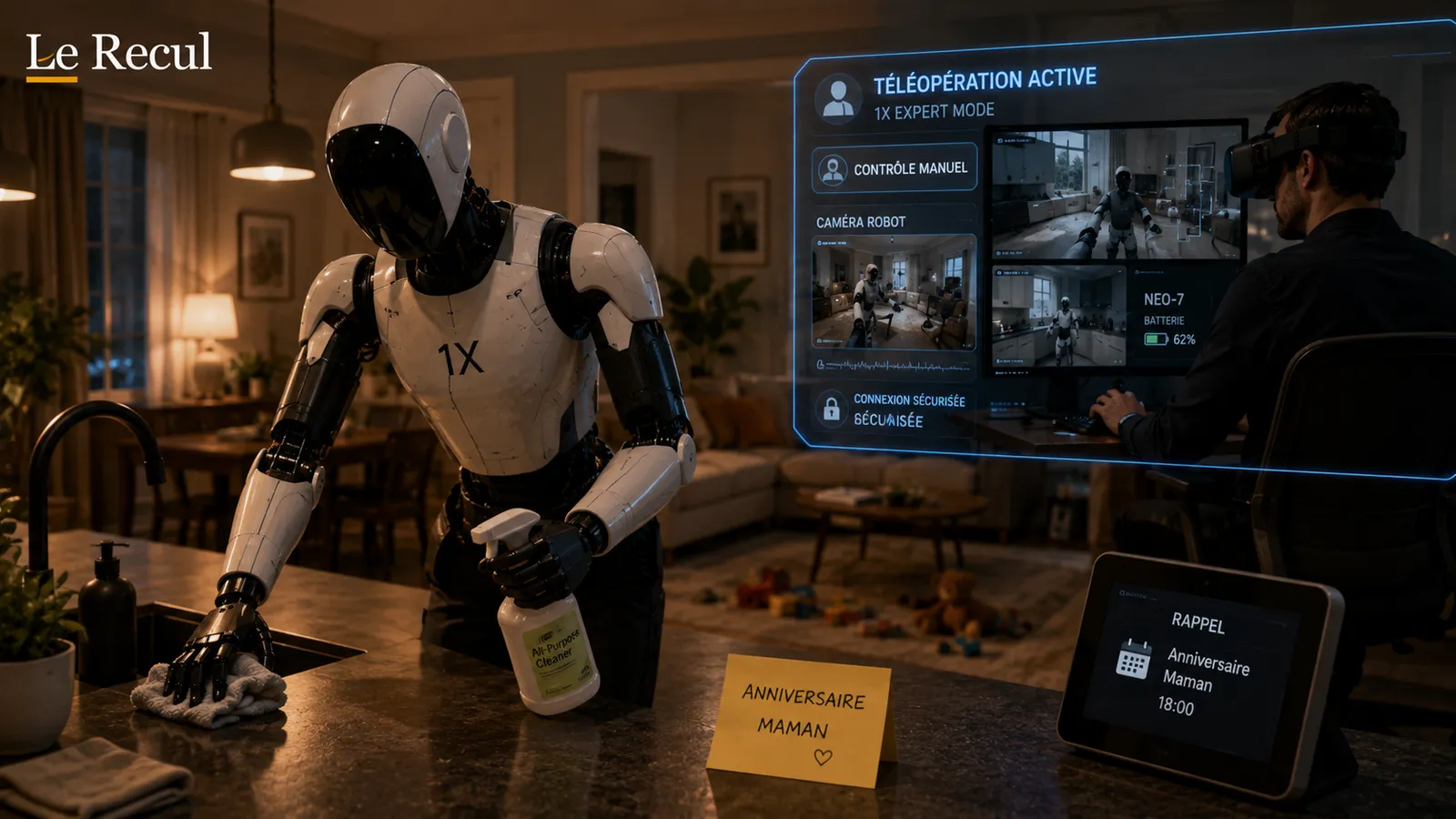
When a task exceeds the onboard model’s capability, a 1X employee — the company calls them “1X Experts” — puts on a virtual reality headset and takes remote control of the robot. They then see the inside of the home through the machine’s two 8-megapixel cameras, and guide its movements.
This is not a secret, and it is not a deception either. 1X publicly owns this approach, which it calls “human-in-the-loop”, and presents it as the fastest learning route: rather than simulating for years in a laboratory, you show the robot the right gesture in a real home, and the model learns. The specialist press summed it up bluntly: at 1X, the chosen path is teleoperation, not autonomy.
The legitimate grievance is therefore not about the method. It is about the gap between the consumer messaging — a robot that tidies your living room — and the product delivered — a robot that tidies your living room when somebody is driving it.
The safeguards announced by the manufacturer are real and deserve to be quoted: the user must explicitly authorise each session, they can define no-go zones in their home, faces are blurred, and a light signal — the robot’s ears change colour — indicates that an operator is connected.
These protections handle the buyer’s case. They do not handle anyone else’s.
There is an irony we had already documented from another angle: unable to act alone in the physical world, AI recruits humans to do it in its place. That was the principle of the platform we analysed in RentAHuman, when AI hires humans to act in the real world. Here the movement is simply reversed: the human is no longer in front of the machine, they are inside it.
You are not the customer, you are the training ground
Here is the point commercial presentations never state this clearly, and which is nonetheless at the heart of the business model.
In robotics, the scarce resource is neither compute nor models: it is real-world data. A warehouse is a standardised, clean, predictable environment — a very poor learning ground for a machine meant to work anywhere. A home, by contrast, is chaos: changing light, furniture moved around, unexpected objects, animals, children, cluttered floors.
That disorder is precisely what has value. Every variation in light, every piece of furniture out of place, every unforeseen object is a usable case. That explains 1X’s strategy, which breaks with sector practice: instead of testing for years in a factory before delivering, the company designs the product for the home from the start and delivers early.
The consequence deserves to be stated bluntly. The first buyers are not only customers: they fund the R&D to the tune of $20,000 and supply free of charge the most expensive raw material in the sector. A model trained on hundreds of different households will be worth far more than the sum of the sales that made it possible — and that value will stay entirely with the manufacturer.
This is neither illegal nor unprecedented: it is the logic of early access, applied to an object that lives in your private life rather than on your screen. The difference lies in what is captured. Beta software collects error logs. A home robot collects your interior.
What a humanoid robot really costs in 2026
Since it is the most frequently asked question, here is the state of the market to date, separating announced prices from machines actually deliverable.
| Model | Announced price | Intended use | Real availability |
|---|---|---|---|
| 1X NEO | $20,000 or $499/month | Home | Deliveries announced for late 2026, United States and Canada |
| Figure 03 | ~$30,000 | Industry | Deployed (40 units at BMW) |
| Unitree H2 | ~€27,600 | Research, industry | On sale, highest volumes on the market |
| Tesla Optimus | "under $20,000" announced | Industry then home | No consumer delivery |
For a European buyer, three obstacles come on top of the listed price, and none of them is trivial: import costs, the absence of structured after-sales service locally, and the GDPR compliance of the data collected — a point we return to below.
The subscription model deserves particular attention. At $499 a month, the machine costs $20,000 in a little over three years, which is the purchase price. The appeal of the formula is therefore not the saving: it is the absence of commitment on hardware whose real lifespan, failure rate and resale value nobody knows. On a first-generation product, that is a serious argument.
The legal problem nobody has solved
A home robot continuously capturing images and sound inside a dwelling falls squarely within the scope of the GDPR. Processing requires a clear legal basis: explicit consent, performance of a contract, or a properly assessed legitimate interest.
For the buyer, that basis is relatively simple to establish: they buy, they consent, they configure.
For everybody else, nothing is settled. Guests, children, a home help, a tradesperson passing through: none of them has consented to being filmed, nor to a remote operator observing them. French legal analyses point to this gap as the trickiest part of the file, liable to engage the manufacturer’s responsibility. Blurring faces reduces the risk, it does not cancel it — an interior, a conversation, a daily routine remain personal data.
A second text, less commented on, will weigh far more heavily on the sector.
The machinery regulation (EU) 2023/1230, published in the Union’s Official Journal on 29 June 2023, becomes mandatorily applicable on 20 January 2027. It was written precisely for the technologies the old directive ignored: connected machinery, embedded artificial intelligence, collaborative robots, autonomous mobile machinery. It requires a risk assessment that accounts for autonomy and self-evolving behaviours, as well as human-robot interaction across the product’s whole life. Above all, for certain categories of high-risk machinery, the involvement of a notified body becomes mandatory: self-certification is no longer possible.
On top of that comes a recent change in the timetable: the Digital Omnibus on artificial intelligence, which came into force on 27 July 2026, provides that for the machinery sector, the technical requirements relating to high-risk AI are integrated directly into the machinery regulation rather than applied through the AI Act. In addition, any AI built into a safety component of a machine is automatically classified as high-risk. We set out the overall architecture of this framework in our analysis of what changes with the AI Act on 2 August 2026.
Practical conclusion: a generalist home robot, with embedded AI and teleoperation, sold in Europe after January 2027, will have to clear a regulatory hurdle the American market does not have. That is no small thing at a point where deliveries so far concern only the United States and Canada.
When the investor becomes the customer
One piece of financial context sheds light on how to read the demand figures.
1X Technologies is backed by front-rank investors: EQT Ventures, which led its series B, alongside Samsung NEXT, the OpenAI Startup Fund and Tiger Global. The valuation trajectory is spectacular — $210 million after the series A2, $820 million after the series B, then open discussions in September 2025 to raise up to a billion dollars on a target valuation of at least $10 billion, more than twelve times the January 2024 value.
In December 2025, EQT took a further step: the fund moved from investor to anchor customer, committing its portfolio companies to up to 10,000 NEO units between 2026 and 2030, destined for factories and warehouses.
Let us be precise about what that fact means, and what it does not. The practice — an investor opening its portfolio as a first market for one of its holdings — is common in venture capital and perfectly legal. It implies no manoeuvring. But it has a factual consequence for how the figures read: part of the demand on display comes from the shareholder itself, and “up to 10,000 units” is a ceiling, not a firm order.
That is exactly the kind of nuance that disappears when a figure is repeated from pick-up to pick-up.
What production actually says
The humanoid sector suffers from a problem we have already met on employment and on language models: the most quoted figures are the ones no primary source confirms.
Let us go through them.
Tesla Optimus. The company has never published a production figure, audited or otherwise. It acknowledges only a few hundred units built in 2025. By mid-July 2026, production at Fremont had not started, with the company pointing towards late July or August. Elon Musk’s target — “millions of units by 2027” — is backed by no public data. Observers place a deployment of 10,000 operational units rather in a 2028-2029 window.
Figure AI. The most significant verified deployment: 40 Figure 03 units installed at BMW in Spartanburg in January 2026, billed at around $25 per robot-hour. That figure is interesting on two counts: it is verifiable, and it gives a concrete economic comparison with the cost of a human post.
Unitree and AgiBot. The two Chinese manufacturers ship more humanoids than any Western competitor: around 5,500 units for Unitree, 5,168 for AgiBot. But volume does not make profitability: Unitree’s earnings halved in the first quarter of 2026. Selling a lot of cheap robots remains a difficult trade.
Agility Robotics. Its Digit robot has moved more than 100,000 totes in the GXO warehouse at Flowery Branch. With Figure, Agility holds the best-documented deployment records in the sector — not Tesla, contrary to what media coverage suggests.
The general lesson is the same one we drew when analysing what employment studies actually measure: in 2026, the distance between an announced figure and a verified figure is the best indicator of a sector’s maturity.
$25 an hour: the only price that checks out
In this whole file, one figure allows an honest economic comparison: the $25 per robot-hour Figure bills BMW. It is worth pausing on, because it says more than fifty-year projections do.
At that rate, a robot working continuously across two eight-hour shifts would come to around $400 a day. That is the same order as an equivalent human post in the United States including payroll costs — without holidays, without absenteeism, but without the versatility either. In other words: at today’s price, the industrial humanoid is not a cost-cutting machine. It is justified on arduous, dangerous or unfillable posts, not on raw savings.
The home calculation is different and worth doing, accepting that it is an order of magnitude and not a manufacturer’s figure. At $499 a month, NEO comes to around $16 a day. Set against its real physical constraint — four hours of runtime on a 0.75 kWh battery — that puts the theoretical hourly cost at around $4. The figure looks unbeatable against a home help.
It is all the less so for being incomplete. Those four hours are a theoretical maximum, not effective working time: you have to subtract recharging, moving about, slowness of execution — a robot takes several times a human’s time on the same task. And above all, part of the work is done by a remote human operator, whose cost is today absorbed by the manufacturer because it is buying training data in exchange. Nothing guarantees that arrangement survives the learning phase. The day teleoperation has to pay for itself, the advertised price cannot stay the same.
That is the blind spot in every published comparison: you are comparing the price of a robot subsidised by its own R&D with the wage of a worker who is subsidised by nobody.
The story carrying the market
A word, finally, on the discourse, because it shapes expectations far more than the products do.
The phrase “physical AI” was not born among roboticists: it was popularised by Jensen Huang, NVIDIA’s chief executive, who has made it artificial intelligence’s announced next frontier and his company’s next engine of growth. The group has built an industrial coalition around that thesis, signing notably with Japanese giants — Toyota, Fanuc, Kawasaki Heavy Industries, Fujitsu — and devoting a large share of its GTC 2026 conference to robotics and to open models for machines.
That story is not false. It is simply interested, and should be read as such: the main promoter of the idea that robots are the next wave is also the one selling the processors needed to train them. It is exactly the configuration we noted about AI lab chiefs announcing the imminence of general intelligence — a sincere warning and a sales argument can sit in the same sentence.
The practical consequence is measurable: part of the sector’s funding rests on a market expectation built by an infrastructure supplier, relayed by banks whose projections differ by a factor of a hundred. That is not a reason to conclude there is a bubble. It is a reason to treat production announcements as intentions, until proven otherwise.
The other model: China is not selling a dream
While the West builds a domestic story, China is building an industry.
Estimates for 2026 run from 28,000 to 100,000 humanoids manufactured on Chinese soil. The width of that range is itself information: nobody really knows, and we will not pretend to settle it.
What is established, on the other hand, says more than any projection:
- The first automated production line for humanoids was inaugurated on 29 March in Guangdong, by Leju Robotics with Guangdong Dongfang Precision: more than 10,000 units a year, which is one robot every thirty minutes.
- Shanghai has allocated more than a billion yuan to robotics funds; Beijing and Shenzhen have followed with their own envelopes.
- At CES 2026, 21 of the 38 exhibitors in the humanoid category were Chinese companies — more than half.
- Over five years, China has filed more than 7,700 patents related to humanoid robotics, against 1,561 for the United States.
The centaur robot fits exactly into that logic. It was unveiled at WAIC in Shanghai, the same event where Beijing launched its own world AI governance organisation — an episode we documented in our article on WAICO and its 29 signatory countries. Same week, same city: institutions and hardware, two parts of one strategy.
That strategy has a name, and it did not come from China. A report by the US commission on economic and security review, published in March 2026, describes it as a two-loop arrangement: a digital loop — open models distributed free, whose mechanics we analysed in why China gives its best AI away for free — and a physical loop: the mass deployment of machines in industry, logistics and robotics, which produces real-world data, which in turn improves the next models.
The centaur robot is that physical loop in action. It is not seeking adoption by households: it is seeking work in steelworks and power plants, producing industrial data, and doing so with more than 95% domestic components — which makes it immune to any export restriction.
That is precisely the American report’s conclusion: export controls target the digital loop, the training chips, and are largely inoperative on the physical loop.
The forecasts, and what they are worth
These figures have to be looked at, because they feed the entire investment discourse. Above all, how far apart they are has to be looked at.
| Institution | Horizon | Forecast |
|---|---|---|
| Morgan Stanley | 2050 | $5 trillion, 1 billion robots; ~13 million units as early as 2035 |
| Bank of America | 2035 | 10 million units, annual growth of 88% |
| Goldman Sachs | 2035 | $38 billion addressable market; 502,000 deliveries by 2032 |
Put those figures side by side: Goldman Sachs announces a $38 billion market in 2035, Morgan Stanley a $5 trillion market in 2050. Same sector, same financial analysts, same supposed working method — and orders of magnitude with nothing in common.
That gap is not a methodological nuance. It is a collective admission of uncertainty. These projections should be read as investor bets, not as data. We already applied that caution to our own projections on the future of AI: separating what is measured, what is plausible and what is speculative.
One point deserves saying clearly, because it is often missing from alarmist articles: no death or serious injury involving a humanoid robot has been reported to date. The risk is not nil for all that. Analysis of American serious accident reports counts 77 accidents involving industrial robots between 2015 and 2022, causing 93 injuries, of which more than 60% were due to unexpected activation. The new generation of machines weighs between 68 and 90 kilos: a fall or a malfunction in a corridor is not science fiction. Standards exist — ISO 10218, ISO/TS 15066 for collaborative zones — but they were written for robot arms in cages, not for bipeds in a living room.
And where does Europe stand?
The answer is uncomfortable: France and Europe have remarkable teams and no industrial player of any size.
The disadvantage is structural. No historic actor in the sector, no equivalent of Boston Dynamics or Unitree, and start-ups whose means bear no comparison with the billions committed in China and the United States.
That does not prevent interesting positions, often won by refusing to imitate:
Enchanted Tools, founded in 2021 by Jerome Monceaux and Samuel Benveniste, develops Miroki and Miroka — a head, two arms, and a motorised ball for a base. The choice is not aesthetic but ergonomic and safety-driven: a spherical base does not trip. These robots are already deployed at Lyon-Saint-Exupery airport to guide travellers, and in hospitals with children being treated for leukaemia. The announced target is 600 to 1,000 sales in 2026 through a network of international partners.
Pollen Robotics develops Reachy 2 and is building a developer community, with the declared ambition of becoming “the Raspberry Pi of humanoid robotics” — which is exactly the distribution strategy China applies to language models.
Wandercraft is carrying its medical exoskeleton expertise across into industrial robotics with the Calvin-40, and probably holds the best bipedal walking technology in Europe.
Manifest, in Toulouse, founded by Charles-Henri Blanchet, targets aerospace and defence.
These companies share one characteristic: they are not trying to put a humanoid in every living room. They aim at precise uses, in sectors where certification and safety count for more than spectacle — which, with the 2027 machinery regulation on the horizon, may turn out to be less naive than it looks. That leaves the question of funding, where European dependence is the same as on language models, a subject we covered from the angle of data sovereignty.
When will you really be able to buy one?
This is the question readers care about most, and it deserves an honest answer rather than a date.
What is available in 2026: machines that walk on flat and uneven ground, climb simple stairs, lift 20 to 30 kilos, manipulate objects and hold a conversation. Sold between $20,000 and $30,000, with remote human assistance for anything outside the frame.
What is not: folding laundry end to end, preparing a varied meal, handling the unexpected. Those three limits are not a matter of tuning but of unsolved technical locks.
The horizon put forward by analysts — ARK Invest, Goldman Sachs and Morgan Stanley converge here — sits between 2028 and 2029 for a genuinely useful home robot, with prices falling below 10,000 euros on the back of Chinese production.
Our reading, in the light of the above: that timetable is plausible for a robot useful across a narrow, well-defined perimeter, not for the all-purpose assistant of the demonstrations. And it assumes the teleoperation question gets settled — either because the models will have improved enough, or because users will have accepted that a remote operator is part of the product.
One signal to watch closely: by mid-July 2026, no customer delivery of NEO had been verified, while full-scale production had started at the end of April. The manufacturer itself warns that “some will receive their NEO this year, others later”. Between a production capacity sold out in five days and robots actually installed in homes, there is a distance only the end of the year will let us measure.
What this changes in practice
If you are thinking of buying one. Ask three questions before the price: what percentage of tasks does the machine do without human intervention; who can see inside your home and under what conditions; what happens to the device if the manufacturer ceases trading. Those are the three questions no product sheet answers today.
If you run an industrial site. The calculation is simpler and more favourable: a known hourly cost, structured environments, repetitive tasks, and a standards framework that already exists. The verified deployments are there, not in living rooms. Watch the 20 January 2027 deadline, though, which will require a notified body for certain categories.
If you work in an affected sector. The signal is not the one being announced. Non-standardised physical occupations — home care, construction, maintenance — remain among the hardest to automate, and they already rank among the hardest to fill. We found that home and residential care assistants pass 72% recruitment difficulty in France, a paradox we set out when analysing what really threatens jobs. The short-term risk falls less on those posts than on standardised warehouse execution roles — and it is worth remembering that layoffs attributed to AI often rest on a declared reason rather than a verified cause.
If you follow the subject as an investor or decision-maker. The best indicator is neither price nor benchmarks: it is the gap between units announced and units delivered. Our AI ranking tracks models; for hardware, no independent equivalent exists today — and that is precisely what lets unverifiable figures circulate.
One dimension is too often missing: these machines consume. Supply chain, rare earths, batteries, training compute — a home robot is not neutral, and the environmental bill for AI does not get lighter when you give it a body.
What Le Recul takes from this
AI is leaving the screen: that is real, and 2026 is the pivotal year. But the two robots we started with are not two variants of the same phenomenon.
The Western home robot is sold on a promise of autonomy the product does not yet keep. Teleoperation is not a scandal — it is owned, documented, and probably the most effective learning route. The problem is elsewhere: in the gap between what the demonstration shows and what the machine does, in the fact that the buyer funds and feeds the training without that being clearly said, and in a privacy question — third-party consent — that no technical safeguard resolves.
The Chinese industrial robot promises nothing. It announces a payload, a torque, an explosion-proof design and a domestic integration rate above 95%. It does not need to be liked, it needs to work. Behind it, an assembly line turning out one robot every thirty minutes, municipal subsidies in billions of yuan, and five times as many patents as the United States.
These are two theories of victory. The first bets on consumer adoption and domestic data. The second on heavy industry, component sovereignty and volume.
Nothing says today which will win. But only one of the two depends on a technical capability that is not there yet — and it is the one that has already taken pre-orders.
The figure to keep
Zero. That is the number of tasks the NEO robot completed in full autonomy during a supervised trial with a Wall Street Journal reporter. For a machine sold at $20,000, presented as the first mass-produced home humanoid robot, and whose entire first-year production capacity sold out in five days.