
Section

Comparisons

Which AI for your use case? Comparisons, practical guides and reviews by need. No affiliate links, no hype.

GPT-6.1 Terra, GPT-6.1 Sol or Claude Sonnet 5.5: the cheapest per token is not always the cheapest per task

Comparisons

GPT-6.1 Terra, GPT-6.1 Sol or Claude Sonnet 5.5: the cheapest per token is not always the cheapest per task

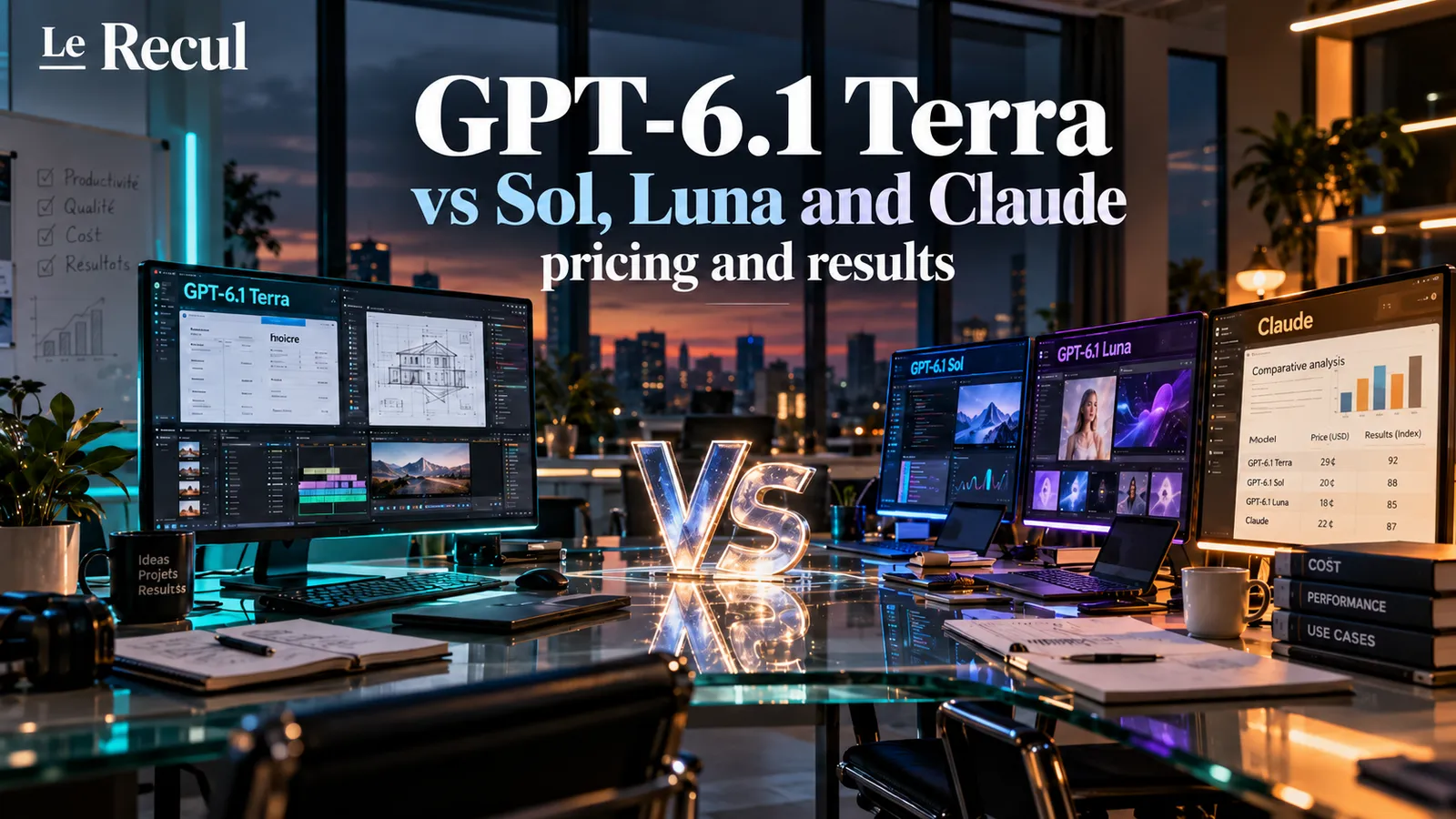
GPT-6.1 Terra, launched by OpenAI on 26 October 2026, costs $1 per million input tokens: half the price of GPT-6.1 Sol and Claude Sonnet 5.5, both listed at $2. But a model is paid by the task, not by the token. We compared all three, with GPT-6 Luna and Claude Opus 5.5 as reference points, using the detailed values of OpenAI's charts, its safety card, independent measurements from Artificial Analysis and Plotly, and early user feedback. The verdict changes with the use case, and above all with the effort level you set.
Claude Sonnet 5.5 vs Muse Wonder Full: level at 56 on paper, two very different machines in practice

Comparisons

Claude Sonnet 5.5 vs Muse Wonder Full: level at 56 on paper, two very different machines in practice

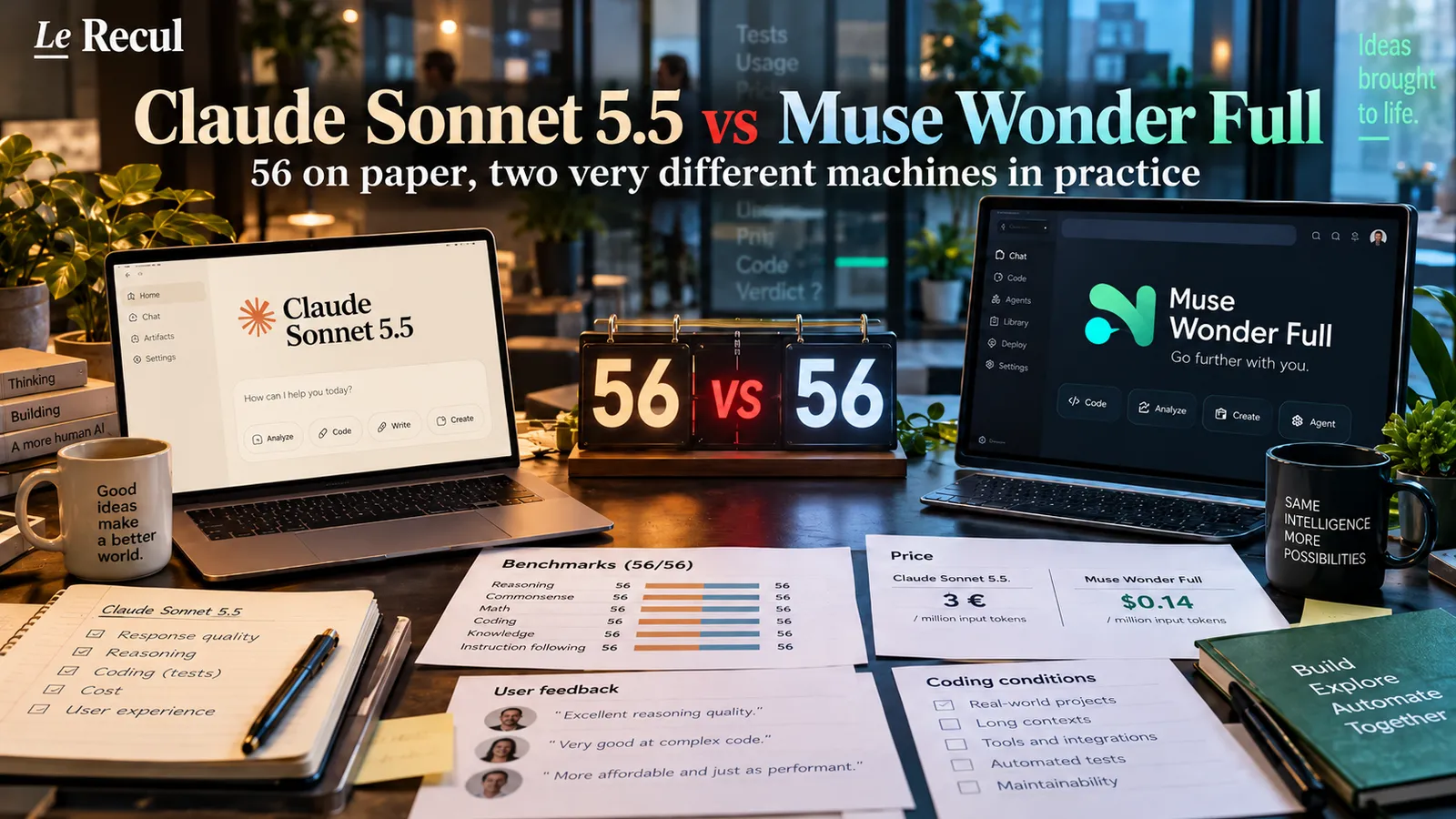
On the leading independent ranking, Anthropic's Claude Sonnet 5.5 and Meta's new Muse Wonder Full both score 56 points, and split the ten tests five wins apiece. But one is available from $20 a month, the other from $50, and not on the same terms for your code. We set the independent measurements, the first published trials and nearly a thousand user comments against each other: in practice, the two models no longer look alike at all.

Best AI for coding: Claude Opus 5.5 against GPT-6 Sol, released the same day hours apart

Comparisons

Best AI for coding: Claude Opus 5.5 against GPT-6 Sol, released the same day hours apart

On 22 September 2026 Anthropic released Claude Opus 5.5, and OpenAI answered the same day with GPT-6 Sol at half the price. Both are sold for writing code. No independent coding leaderboard has measured either of them: SWE-bench Verified stopped accepting commercial labs in November 2025, and the DeepSWE leaderboard does not contain them. We went through both announcements line by line, cross-checked the only independent measurement available, recalculated every bill, and read the pricing tables down to the thresholds. Three things come out of it that appear in neither announcement: the more expensive model at its default setting beats the cheaper one at maximum, the price gap collapses exactly where code needs it, and neither vendor compared itself to the other.

DeepSeek V4.1 Flash vs GPT-5.6 Luna: the cheaper of the two depends on what time you call it

Comparisons

DeepSeek V4.1 Flash vs GPT-5.6 Luna: the cheaper of the two depends on what time you call it

DeepSeek released V4.1 Flash on 10 September 2026, and the price everyone quotes is striking: $0.15 per million tokens. Facing it, GPT-5.6 Luna, the model behind free ChatGPT and the entry point of OpenAI's GPT-5.6 family. On the independent index, DeepSeek edges ahead, 40 to 38. But that price is the off-peak rate, and it is billed in UTC — which changes the answer completely depending on where your team sits. DeepSeek also writes twice as many tokens for the same task, and its record coding score still has not been verified by the official leaderboard. We recalculated every bill, hour by hour.

Updated
Gemini Omni 1.1 Flash VS Wan 3.0: the better of the two is half switched off, and which half depends on where you are

Comparisons

Gemini Omni 1.1 Flash VS Wan 3.0: the better of the two is half switched off, and which half depends on where you are

Google shipped Gemini Omni 1.1 Flash on 27 August 2026; Alibaba had opened Wan 3.0 a few weeks earlier. Thirty-five hundredths of a point separate them in our ranking. We read both announcements word for word, recalculated the cost of a delivered minute with the discarded takes included, gathered the reports of people running them in production, and read the documentation down to the restrictions the vendors write in small print. What comes out is in neither press release: Google's forty seconds are ten-second slices stacked end to end, its 4K is an upscale, and the feature that makes the model interesting — editing video you shot yourself — is switched off in the United Kingdom and across the European Economic Area, at API level. Meanwhile the Chinese model generates thirty seconds in one take, accepts a PDF as input, and publishes its own list of weaknesses. And one criterion flips for an English-speaking reader.

GPT-6 Astra vs Claude Fable 5.1: everyone reports a winner on a benchmark version that no longer exists

Comparisons

GPT-6 Astra vs Claude Fable 5.1: everyone reports a winner on a benchmark version that no longer exists

Anthropic shipped Claude Fable 5.1 on 1 September 2026, OpenAI answered with GPT-6 Astra on the 3rd. Every comparison since reports an Anthropic win, 66 to 61 on the reference independent index. That number comes from a retired version of that index: on the current one the two models are dead level, 53 apiece. We took the ten evaluations one by one, recalculated every billing scenario, read our own ranks reasoning level by reasoning level, and went through what both vendors write in their own help pages. Three things come out that appear in no announcement: the two models advertise the same token price but the same task costs twice as much with one of them, the maximum setting everyone benchmarks is the worst buy in either catalogue, and a $20-a-month subscription gets you normal access to neither.

Muse Glimmer vs free ChatGPT: has the AI running on your own machine caught up with the cloud?

Comparisons

Muse Glimmer vs free ChatGPT: has the AI running on your own machine caught up with the cloud?

On 10 August 2026 Meta released Muse Glimmer: a 30-billion-parameter AI under Apache 2.0 that fits on a personal computer. Four days earlier, OpenAI made ChatGPT unlimited on text for every free account. Two opposite ways of paying nothing. We put them head to head on what actually decides: intelligence measured on a common index, the machine you really have to buy, speed by hardware, what each does with your conversations, and the exact point where one becomes cheaper than the other. The result is clear, and it is not the one you expect.

Updated
Grok 4.6 vs Gemini 3.7 Flash: what the production logs say that neither xAI nor Google published

Comparisons

Grok 4.6 vs Gemini 3.7 Flash: what the production logs say that neither xAI nor Google published

xAI shipped Grok 4.6 on 12 August 2026, Google answered with Gemini 3.7 Flash on the 13th. On the coding evaluation, half a point separates them. Everywhere else the gap is wide open. We gathered the logs of people running them in production — latency, error rate, cost actually observed — recalculated every billing scenario, and read the documentation down to the warnings the vendors write about their own products. What comes out is in neither announcement: the new Gemini hallucinates more than the version it replaces, Grok answers three times faster but invents an answer one time in three when it does not know, and one billing threshold doubles the bill without warning.

Kling 3.0 vs Veo 3.1: the better generator is not the one you can publish most freely

Comparisons

Kling 3.0 vs Veo 3.1: the better generator is not the one you can publish most freely

Kling 3.0 makes clips twice as long, in native 4K at 60 frames per second, and outranks Veo 3.1 in independent leaderboards. For an English-speaking creator it wins on five criteria out of eight — and still loses the three that decide whether you can actually use the file: machine-readable marking mandatory in the EU since 2 August 2026, commercial rights reserved to paying members, and a licence you grant the vendor over everything you produce. Real prices, credits, durations, generation times and content policy: the full comparison.

ChatGPT against Grok: the assistant France uses most against the one Brussels put under investigation

Comparisons

ChatGPT against Grok: the assistant France uses most against the one Brussels put under investigation

ChatGPT has 662 million monthly users worldwide, still holds 46% of the AI assistant market, and has just filed to go public on an $852 billion valuation. Grok is the third most used chatbot in France, tied since February 2026 to Elon Musk's SpaceX empire, a combined entity valued at $1,250 billion. Three weeks before that merger, the European Commission opened a formal investigation into it over a wave of mass-generated sexual deepfakes, some of them depicting minors. Here is the match as of 7 July 2026 — figures, lawsuits and NGO reports included, without the marketing varnish.

Perplexity against Mistral: the engine that cites its sources against the assistant that protects yours

Comparisons

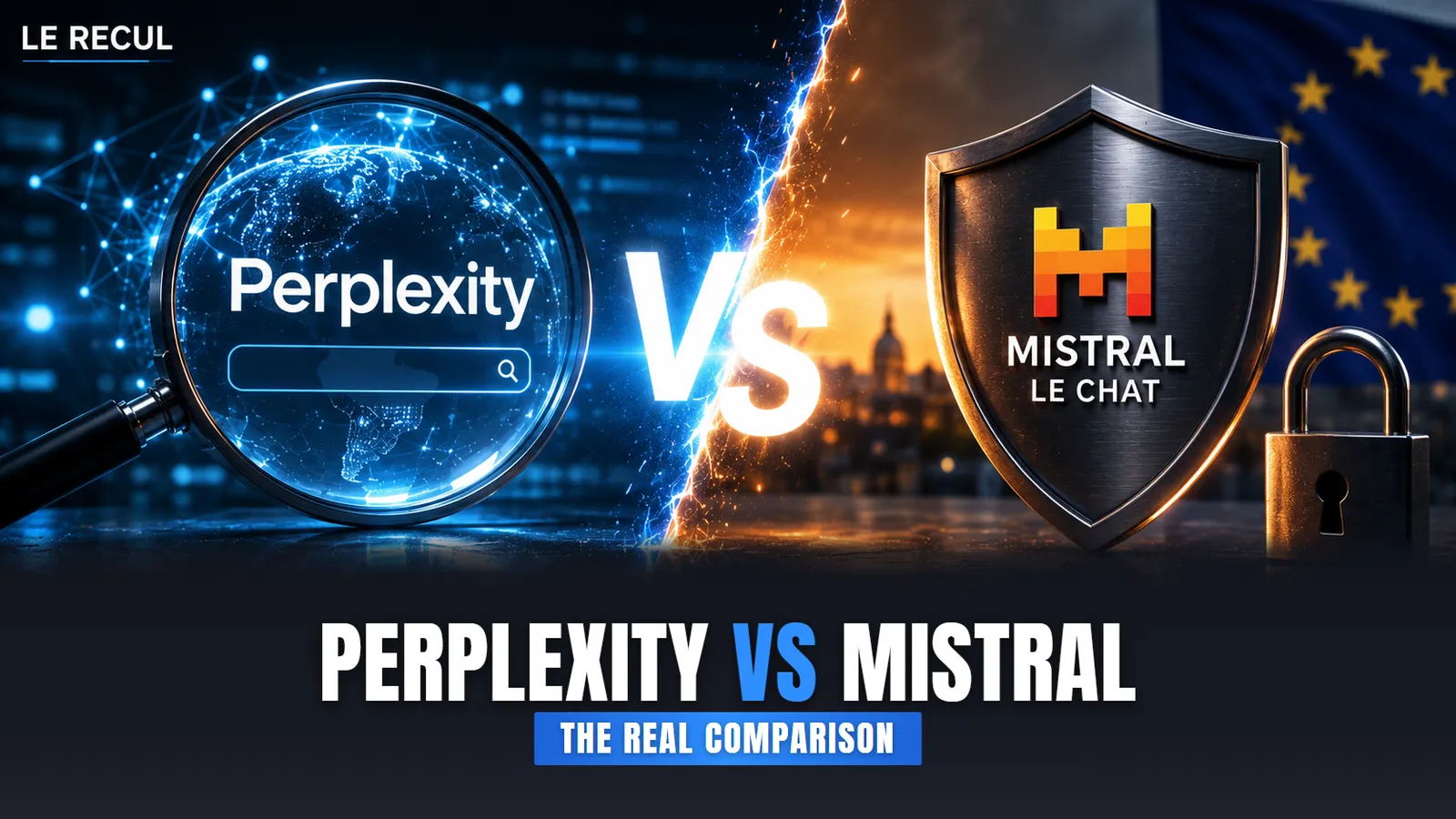
Perplexity against Mistral: the engine that cites its sources against the assistant that protects yours

Perplexity promises a sourced answer to any question in seconds. Mistral, through its Le Chat assistant, promises a general-purpose AI made in France, with your data staying on European soil. Both promises are true. Neither is the whole story. Here is the match as of 4 July 2026 — figures, lawsuits, security holes and real limits included, without the marketing varnish most comparisons simply copy over.