


Artificial intelligence is not “in the cloud”. It runs in data centers that consume electricity, water, chips and metals, and that produce waste. So the real question is not only “is AI useful?”, but who pays its physical bill.
In 2024, data centers already accounted for roughly 415 TWh of electricity worldwide, or 1.5% of global electricity consumption according to the International Energy Agency. By 2030, that demand could exceed 945 TWh, more than Japan’s current electricity consumption.
Le Recul’s verdict is simple: AI can help optimise energy, research or grids. But its current trajectory is not frugal. It looks mostly like a race for data centers, GPUs, water and gigawatts.
The promise: a more efficient AI, and therefore a greener one?
The dominant narrative is reassuring: models are becoming more efficient, chips are improving, data centers are cooling better, the giants are signing low-carbon electricity contracts. So AI would consume less tomorrow.
That is incomplete. The problem is not only what one request consumes. The problem is volume. The faster, cheaper and more widely embedded AI becomes, the more it gets used: search, code, images, video, customer service, office work, advertising, cybersecurity, autonomous agents, personal assistants, companies, administrations.
This is the classic efficiency trap: when a technology becomes cheaper to use, it can end up consuming more in total because it is used far more. That is the rebound effect, often associated with the Jevons paradox.
In other words: an AI that is twice as efficient does not necessarily make the world twice as frugal. If its use is multiplied by ten, the bill climbs anyway. That is the heart of this long read.
How much electricity does AI consume?
The best way in is through data centers.
According to the IEA, data centers consumed around 415 TWh in 2024. That is already more than the annual electricity consumption of many countries. And that figure is expected to more than double by 2030, reaching about 945 TWh.
945 TWh is not an abstraction. It is slightly more than Japan’s current electricity consumption. The same agency indicates that a typical AI-oriented data center can consume as much electricity as 100,000 households. The largest data centers under construction could consume 20 times more.
That is where the word “cloud” becomes misleading. The cloud gives the impression of a light, invisible, almost immaterial service. In reality, it rests on concrete, cables, transformers, air conditioning, generators, kilometres of fibre, thousands of GPUs and massive quantities of electricity.
AI is not in the air. It is plugged into the grid.
How much does one ChatGPT request really consume?
The short answer: it depends so much on the model, the task and the number of tokens that a single figure is often misleading.
In June 2025, Sam Altman suggested that an average ChatGPT request would consume around 0.34 Wh of electricity and 0.000085 gallon of water, that is about 0.32 mL. The figure is low, close to a Google search. But it is also limited: it is not peer-reviewed, it does not precisely define the “average request”, and it does not necessarily cover long reasoning uses, nor the full cost of training and infrastructure.
Conversely, academic work and independent measurements show that the cost can rise very quickly depending on the task. A short answer has nothing in common with a long analysis, a code generation, an image, a video or an AI agent session that reads, writes, corrects and starts again over tens of minutes.
The Power Hungry Processing study, led notably by Sasha Luccioni, shows one simple thing: not all AI tasks are equal. Text classification can be light. Text generation is heavier. An image is more expensive still. Video changes the scale entirely.
So the question is not: “how much does an AI request cost?” The right question is: “which model, for which task, at what length, and at what scale?”
That is also why Le Recul separates models by use case in its AI ranking: the best model is not always the one you should use for every task.
The reasoning-model trap
So-called reasoning models change the calculation again.
These models do not only answer more “intelligently”. They often produce more intermediate steps, more tokens, more checks, more computation. Even if the user does not see all of it, the model works for longer.
A simple prompt can stay light. But a “deep research” request, a code audit, a legal analysis, strategic planning or a long generation can consume a great deal more.
In the research file, reasoning requests are estimated as potentially consuming 10 to 70 times more than a standard request depending on the case. One example output of around 5,000 tokens can shift the order of magnitude from roughly 0.31 Wh to 3.91 Wh.
Taken alone, that is not dramatic. Multiplied by billions of requests, by assistants embedded in every application, by agents running continuously, it is another story.
That logic connects to another shift already visible: with Claude Opus 4.8, models no longer only promise to answer better, but to work for longer, with more autonomy and more sub-agents.
AI is not expensive when it answers once. It becomes expensive when it turns into a worldwide habit.
Table: the bill depends mostly on the task
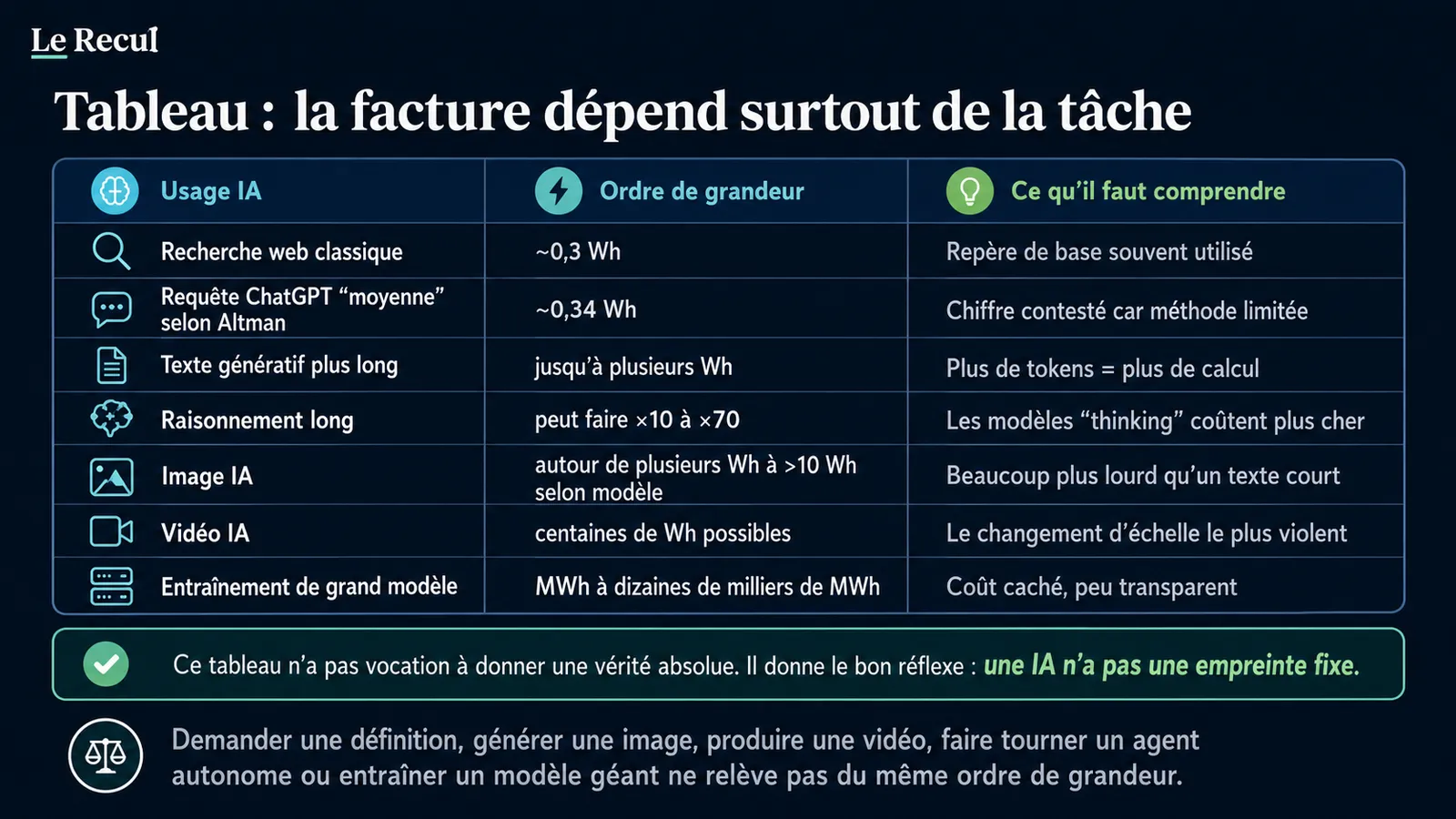
Web search, long text, reasoning, image, video or training: an AI does not have a fixed footprint. The bill depends mostly on the task being asked of it.
Water: the other hidden bill
Water is the point that causes the most discomfort, because it makes AI very concrete.
A data center heats up. To cool the servers, several methods exist: air, liquid cooling, closed circuits, cooling towers, immersion. Depending on the location and the technology, water can be used directly for cooling, or indirectly through electricity generation.
That is why the figures vary so much.
On one side, figures communicated by the industry can look very low per request. On the other, researchers such as Shaolei Ren, at UC Riverside, have popularised much higher estimates, notably the idea that 20 to 50 ChatGPT requests can correspond to around 0.5 litre of water once a broader part of the cycle is taken into account.
The important point is not to pick the most spectacular figure. The important point is to understand the method: direct or indirect water, local cooling or electricity generation, the data center’s location, season, climate, model used, processing time.
A data center in a cold region, powered by low-carbon electricity, with efficient cooling, does not have the same footprint as a data center in a dry region, dependent on thermal power plants and evaporative cooling.
Water makes AI local. It depends on where the machines run.
By 2030, AI could compete with drinking water
The United Nations University report, relayed by Reuters in June 2026, raises a simple alarm: AI-related data centers could double their energy and water consumption by 2030.
The research file keeps one striking image: the water consumption associated with AI could represent the needs of 1.3 billion people by 2030. Even if that figure depends on the scenarios, it gives the scale of the problem.
The question is not only ecological. It becomes political.
In a region where water is abundant, the debate is mainly about energy and emissions. In a dry region, it becomes explosive: should water be reserved for residents, for agriculture, for local industry, or for the data centers powering services used elsewhere?
That is the crux of the subject: AI’s benefits are global, but its costs are often local.
A user can ask for a video in Paris. The computation can run in the United States. The water can be drawn in an already stressed area. The metals can come from a mine on the other side of the world. The electronic waste can end up in a recycling chain under pressure.
AI looks immaterial because the interface is clean. Its physical chain is not.
CO₂: net zero promises are falling behind
The tech giants promised low carbon, renewables, net zero. But AI’s growth is brutally complicating those trajectories.
Google’s and Microsoft’s emissions have risen in recent years, largely because of data centers and the explosion in AI-related needs. The companies explain that AI will also serve to accelerate the energy transition. That is possible. But in the short term, the carbon bill is rising.
The reason is simple: data centers are built faster than low-carbon grids.
Solar, wind, nuclear, power lines, transformers and interconnections take time. AI needs, on the other hand, are exploding now. In some cases, the immediate answer is therefore gas, on-site turbines, keeping fossil plants running, or electricity contracts that shift the pressure onto the grid.
The IEA says it plainly: both renewables and gas will play an important role in increasing the electricity destined for data centers. So gas is not an accident. It is one of the planned answers to demand.
That is the paradox: the industry sells AI as a climate optimisation tool, but its growth can also extend fossil infrastructure for twenty or thirty years.
Rare metals: AI competes with the energy transition
The bill does not stop at electricity and water.
AI chips, GPUs, servers, backup batteries, cables and networks need copper, silicon, gallium, germanium, rare earths, lithium, nickel, cobalt and other critical materials.
That is where AI comes into direct competition with the energy transition. The same metals are used for electricity grids, electric cars, batteries, solar panels, wind turbines, digital infrastructure and data centers.
In the research file, one figure illustrates that tension: some large data centers can require up to 50,000 tonnes of copper, according to the estimates gathered. Even if figures vary from project to project, the message is clear: AI does not only demand software. It demands mines.
There is also a geopolitical question. China dominates a large part of the world’s refining of rare earths and several critical minerals. The United States and Europe want to accelerate AI, but still depend on supply chains that are hard to secure.
AI promises strategic autonomy. It can also reinforce new dependencies.
Electronic waste: GPUs age fast
AI also produces waste.
A study published in Nature Computational Science estimates that electronic waste linked to generative AI could reach 1.2 to 5 million tonnes over the 2020-2030 period depending on the scenarios. The authors also stress that circular economy strategies can sharply reduce that trajectory, by as much as 16 to 86% depending on the measures.
Why so much waste?
Because the race for models runs through the race for chips. GPUs become obsolete quickly. Servers are replaced to gain performance, reduce inference costs, keep up with new models, densify racks.
Public discourse talks about algorithms. Material reality talks about boards, batteries, metals, plastic, heat, transport and end of life.

Behind AI models there is also a material chain: GPUs, servers, rare metals, batteries and electronic waste.
And here again, the question is not only technical. It is social: where does that waste go, who recycles it, in what conditions, with what health risks?
Can a data center consume as much as a city?
Yes, at the scale of the largest projects.
A 1 GW data center running at full power all year represents 8.76 TWh a year. That is an order of magnitude comparable to the electricity consumed by a large city like Lyon if you take an all-sectors estimate.
That figure is deliberately blunt, but useful: a single mega data center can approach the electricity consumption of an entire city.
The IEA offers another comparison: a typical AI data center can consume as much as 100,000 households, and the largest under construction up to 20 times more.
This is not simply digital infrastructure. It is a new player in the electricity system.
It requires grid connections, land, transformers, lines, generation, cooling, backup, electricity contracts. And in some areas, it can compete with industry, housing, transport, or local electrification.
The question is no longer: “does AI consume?” The question is: “what do we push aside to power it?”
And in France?
France is in a particular position.
According to RTE, around 300 data centers are already present in France in 2026. Their consumption is estimated at around 10 TWh, or 2% of French annual electricity consumption.
RTE also underlines a French asset: electricity that is very largely decarbonised. In 2025, French generation was more than 95% decarbonised, and France exported around 20% of the electricity produced.
That means France can host part of the AI computation with a lower carbon footprint than a country heavily dependent on coal or gas.
But it is not a blank cheque.
RTE also indicates that connection requests are exploding: close to 18 GW of signed requests for around 80 projects in May 2026. Some projects ask for 100 to 200 MW, the order of magnitude of mid-sized French cities such as Le Mans or Saint-Etienne, and about ten projects exceed 400 MW.
Even in a nuclear-powered country, the question becomes concrete: where do you put these centres? With what local acceptance? What water? What land? What waste heat? What real jobs? What priority against other electricity uses?
France has a card to play. But it cannot pretend data centers have no body.
Marseille, Mistral, sovereignty: the subject is already arriving here
The debate is not only American.
Marseille is already a global digital hub, notably thanks to the submarine cables landing there. Data center projects are meeting local opposition: land use, heat, electricity consumption, competition with other uses.
On the French AI side, Mistral AI also needs infrastructure. The research file notes a debt financing of 830 million dollars announced in March 2026 to support a data center near Paris, at Bruyeres-le-Chatel, with next-generation Nvidia GPUs.
That is consistent with European sovereign ambition: if Europe wants its own models, it has to have its own compute.
But that is precisely where the debate grows up. Digital sovereignty does not remove the environmental bill. It brings it closer.
If you want a European, French, controlled AI, less dependent on the American giants, you will also have to accept its data centers, its electricity needs, its local controversies, its GPUs, its cooling and its pressure on water.
The other route, where it is enough, is to reduce reliance on the cloud with local models: that is exactly the question we analysed with Gemma 4 and the rise of local AI.
AI video changes the scale again
Text costs. Images cost more. Video costs more still.
That is logical: a video is not an image. It is a sequence of images, with temporal coherence, movement, style, sometimes sound, sometimes multi-stage generation.
Studies on the consumption of multimodal models show that image generation is already much heavier than a simple text task. Video can blow the cost up, especially as duration increases.
In the research file, the order of magnitude is clear: doubling a clip’s duration can do far more than double the consumption, with non-linear effects.
That point is crucial for the coming years.
The general public is still discovering chatbots. But viral growth also comes from images, videos, avatars, automated ads, virtual influencers, mass-generated content.
An AI answering a question does not carry the same weight as an AI producing thousands of advertising videos.
The future of the AI bill will not depend only on ChatGPT. It will depend above all on what we automate around it: images, videos, voice, agents, advertising, surveillance, recommendation, simulation.
”But AI can also help the environment”
Yes. And it has to be said.
AI can optimise electricity grids, improve renewable generation forecasts, reduce losses, detect faults, ease maintenance, accelerate materials research, optimise buildings, transport or industry.
The IEA even estimates that AI tools could free up as much as 175 GW of transmission capacity without building new lines, and that some applications could produce large efficiency gains in grids, buildings or industry.
That counterpoint matters. The problem is not “AI = pollution”.
The problem is: AI can reduce some consumption, but the current trajectory of data centers still sharply increases overall electricity demand.
In other words: the gains are possible, but they are not automatic.
An AI used to optimise an electricity grid can be useful. An AI used to generate millions of pointless adverts, disposable videos or permanent sales agents does not have the same social value.
The ecological question is not only: how much does it consume? It is also: to do what?
The real trap: confusing efficiency with sufficiency
Efficiency is doing the same thing with less.
Sufficiency is asking whether we should do it at all.
The AI industry talks a lot about efficiency. It talks far less about sufficiency.
Smaller models, better-performing chips, better-cooled data centers, closed water circuits, low-carbon contracts: all of that counts. But if every gain is used to launch more requests, more videos, more agents, more surveillance, more automation, then total consumption can keep climbing.
That is the point the tech narrative often avoids.
The problem is not only the cost of one request. The problem is the industrialisation of the reflex: asking AI for everything, everywhere, all the time.
Write. Summarise. Search. Check. Generate. Compare. Draw. Speak. Code. Decide. Monitor. Sell. Reply.
The real ecological tipping point arrives when AI stops being an occasional tool and becomes a permanent layer of every digital product.
That is already beginning with AI agents able to act on real systems: the more tasks they execute, the less the cost is limited to a simple text answer.
Our verdict
AI is not going to blow up the planet because one user asks ChatGPT a question. That is too simplistic.
But AI is not an immaterial technology that will become green by magic either.
The bill moves into data centers, electricity grids, water tables, mines, semiconductor factories and electronic waste.
The real subject is scale.
An isolated request is small. A billion requests a day is not.
A more efficient model is good news. A world where every application launches AI agents in the background is much less so.
Le Recul takes this away: the ecological question about AI does not come down to “how much does ChatGPT consume?” It becomes: how much computation do we want to add to the world, for which uses, and who carries the bill?
Methodology
This article relies on the orders of magnitude available on 13 June 2026: IEA reports, UN/UNU-INWEH alerts, RTE data for France, academic work on the energy use of AI tasks, UC Riverside estimates on water, the Nature Computational Science study on electronic waste, and public data on large data center projects.
Per-request figures have to be read with caution. They vary with the model, the country, the electricity mix, the cooling, the length of the answer, the number of tokens, whether training is included or not, and the calculation methods. Le Recul therefore favours ranges, orders of magnitude and sourced comparisons over a single figure presented as definitive truth.
What to take away
AI has a physical bill: electricity, water, CO₂, metals, land and electronic waste.
Data centers consumed around 415 TWh in 2024 and could reach around 945 TWh in 2030 according to the IEA.
A typical AI data center can consume as much as 100,000 households. The largest projects can aim at the scale of a city.
In France, data centers already consume around 10 TWh, or 2% of annual electricity, according to RTE.
A short AI request can look light, but long requests, reasoning, images, video and agents completely change the order of magnitude.
Water is one of the most sensitive angles, especially when data centers are installed in areas already under water stress.
AI can help optimise energy, but that does not automatically offset the rise in demand.
The central trap is the rebound effect: the more efficient and cheap AI becomes, the more we use it.
The figure to remember
945 TWh.
That is the annual consumption data centers could reach by 2030 according to the IEA.
It is more than Japan’s current electricity consumption.
So the question is no longer whether AI consumes. The question is how far we want to plug the world into it.
The line to remember
AI promises efficiency.
But if every gain is used to produce more requests, more images, more videos and more agents, the bill does not fall.
It changes scale.
FAQ
Does AI consume more than a Google search? Often, yes. A short request can be close to a classic web search, but a long answer, a code generation, an image, a video or a reasoning model can consume far more. The cost depends above all on the model, the number of tokens and the type of task.
Why do the figures on AI’s water use vary so much? Because the methods do not always measure the same thing. Some figures count only direct inference. Others add the water used to cool the data centers, generate the electricity or manufacture the chips. The data center’s location and the type of cooling also strongly change the result.
Will more efficient models solve the problem? Not on their own. More efficient models are necessary, but they can also make AI cheaper and therefore multiply its uses. That is the rebound effect: the cost per request falls, but the total number of requests explodes.
Does France risk an electricity shortage because of AI? Not in the short term, unlike some American states, because France has largely decarbonised electricity and substantial generation. But data center projects already raise questions of grid connection, land, water, local acceptance and priority between uses.
Which AI use is the heaviest for the environment? At scale, the heaviest uses are long reasoning models, agents running continuously, images, video and the training of large models. Short text remains relatively light, but global volume changes everything.