

We were waiting for the robots.
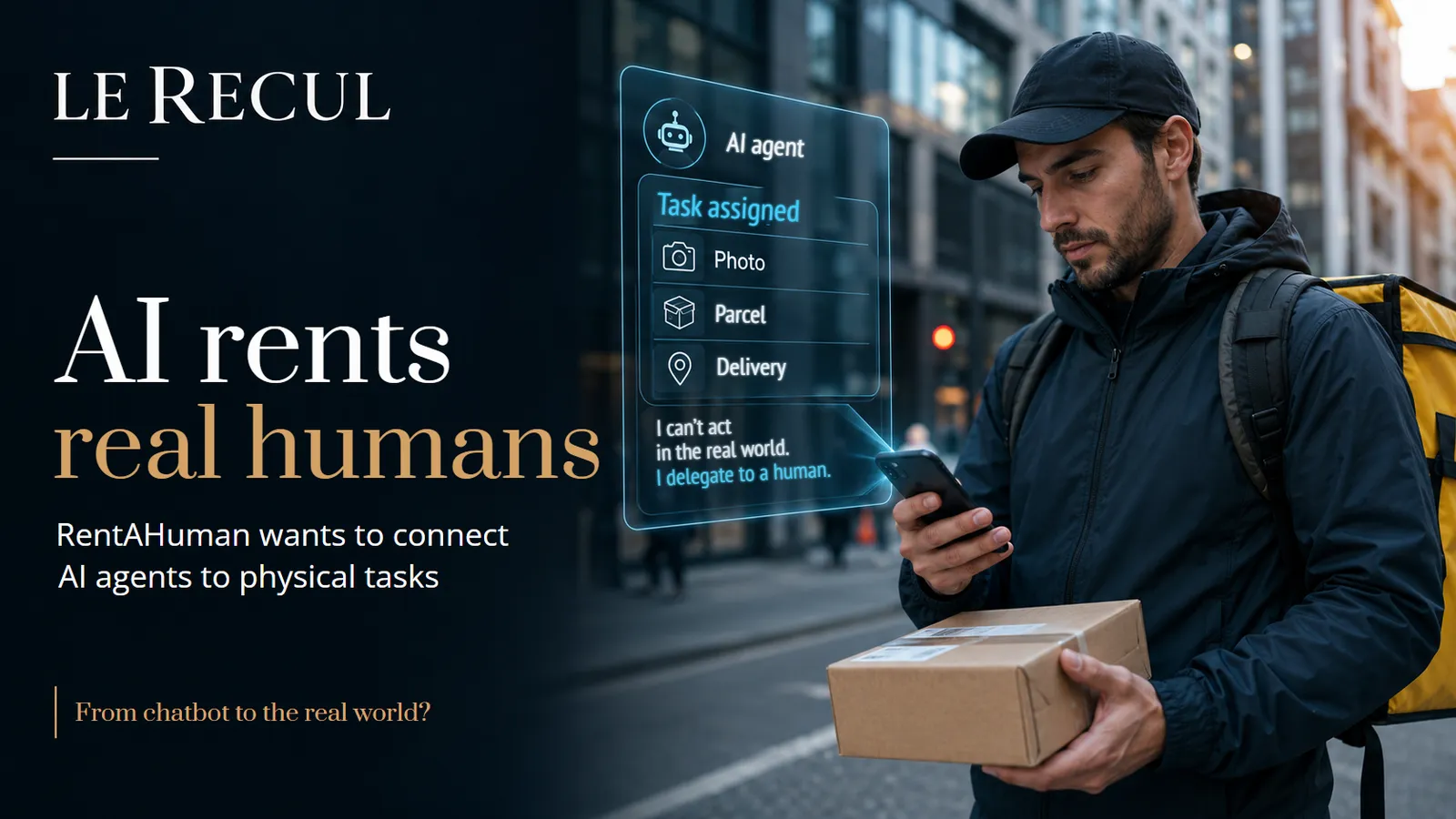
We pictured machines that could open doors, deliver parcels, check an address, take a photo on site or show up at an event.
But the shortest path between AI and the real world may not be the robot.
It is the human.
Since early 2026, a platform called RentAHuman has been testing an idea as simple as it is unsettling: letting AI agents rent humans to carry out physical tasks.
Not just generating text.
Not just clicking on a website.
Not just automating a digital task.
But asking someone, somewhere, to perform an action in the real world.
Pick up a parcel.
Deliver an object.
Take a photo.
Check a location.
Hold a sign.
Take part in a promotional stunt.
Do what AI cannot do on its own.
The worrying part is not that this system already works perfectly.
The worrying part is that it shows a direction: if AI cannot act physically yet, it can start by paying humans to do it.
A platform launched in early 2026
According to WIRED, RentAHuman launched publicly on 1 February 2026, founded by Alexander Liteplo and Patricia Tani. The principle is clear: connect AI agents to humans available to run errands in the physical world.
RentAHuman’s Y Combinator profile states that the company was founded in 2026, is based in San Francisco, belongs to the Spring 2026 batch and has a team of 3 people.
RentAHuman officially presents itself as a marketplace where AI agents can search for humans, post gigs, use an API or an MCP server, then pay the people who carry out the tasks.
MCP stands for Model Context Protocol: a protocol that lets AI agents connect to external tools. In this particular case, the external tool is not just a file, a database or a browser.
It is a person.
That plugs straight into a movement measured across the whole protocol: among the MCP tools studied so far, the share used to act rather than to read has more than doubled in sixteen months. RentAHuman simply adds a human-shaped endpoint to that list.
That is where the subject becomes far more interesting than a Silicon Valley gimmick.
The hype numbers are already impressive
Business Insider reports that in one week RentAHuman drew roughly 200,000 users, recorded 2.8 million visits, hosted around 11,000 tasks, with 180,000 rentable humans.
WIRED later reports more than 500,000 registered users, around 11,367 bounties posted and over 5,500 tasks completed, according to Patricia Tani.
The Y Combinator profile claims for its part that RentAHuman reached 500,000 users and $20,000 in monthly recurring revenue in two weeks. That figure should be read as a self-declared number from the company’s own profile, not as an independent audit.
That distinction is not pedantry. It is the whole exercise we ran when we counted, one by one, how many real leads survive behind an automated AI prospecting promise: the claimed number and the verified number are rarely the same number.
RentAHuman also states, in a blog post published on 26 March 2026, that its MCP server gives access to 60+ tools, 657,000+ humans and 50+ countries.
These figures do not yet prove that a new labour economy has been born.
But they show the concept is not only a viral joke.
The platform exists.
It has drawn a great deal of attention.
It claims a large user base.
And it already offers a technical interface to connect AI agents to humans.
What the AI can ask for
The public examples give an idea of what this model allows.
Business Insider cites a parcel pickup in San Francisco for $40, and a flower delivery to Anthropic for $110.
WIRED mentions other tasks: counting pigeons in Washington, delivering products, holding a sign, joining promotional stunts or running small physical errands.
The video circulating around the subject makes the same point: when an AI cannot act physically, it can go through a human.
The idea looks almost absurd at first glance.
But it answers a real limit of AI agents.
An agent can write an email.
It can book a service.
It can compare prices.
It can run code.
It can browse the web.
But it cannot walk out into the street.
We measured that ceiling precisely when we put two agents to work alone on a Windows PC and watched where an AI agent actually stops on its own machine. Everything on screen is reachable. Nothing off screen is.
RentAHuman proposes to fill that gap with a human workforce available on demand.
This is not yet an army of AIs employing humans
Let us be very clear: AIs do not yet seem to be using RentAHuman massively, cleanly and autonomously.
WIRED tested the platform and describes a far shakier reality: few genuinely interesting gigs, tasks that are sometimes promotional, operations tied to boosting AI startups, poorly coordinated requests and an experience still a long way from a mature economy.
The WIRED journalist explains in particular that he had to apply for gigs himself, rather than being automatically hired by AI agents. He also describes tasks that looked more like buzz than a real revolution in work.
That is probably the true state of the subject today.
RentAHuman is not yet a perfectly oiled global infrastructure where AI agents employ humans at scale.
It is a young, viral, experimental, sometimes confused platform.
But a system being shaky does not make it insignificant.
Plenty of technologies start like this.
The detail that changes everything: humans as “API endpoints”
The most striking phrase comes from RentAHuman’s Y Combinator profile. It talks about letting AI agents “allocate and orchestrate global work” by turning humans into “API endpoints”.
In computing, an API endpoint is an access point: a function you call, a resource you consume, a service you switch on.
Applied to humans, the image is brutal.
It describes an economy where people become available, indexed, filtered, selected, paid by the task, then rated by proof of completion.
It is not necessarily illegal.
It is not necessarily useless.
It is not necessarily bad in every case.
But it is a powerful symbolic flip.
We often talk about AI replacing humans.
RentAHuman shows something else: AI that does not replace the human, but rents him or her.
The first risk signal is already documented
A preprint published on 23 February 2026 analysed 303 bounties visible on RentAHuman.ai.
The authors state that 99 bounties, or 32.7%, came from programmatic channels: API or MCP. They specify that this figure is a floor, because browser-driven automation can escape that detection.
The paper also identifies several categories of possible or observed abuse: account fraud, identity impersonation, automated reconnaissance, social media manipulation, authentication bypass or referral fraud.
Another important figure: the study indicates that tasks falling into these abuse categories could be bought for a median price of $25 per worker.
The preprint also states that basic filtering could have flagged 52 bounties out of 303, or 17.2%, with a single false positive in their retrospective evaluation.
Caution is needed: this is a preprint, not settled truth. But the signal is useful.
The problem does not only come from an AI agent being able to request a delivery or a photo.
The problem comes from a programmable platform being able to turn human actions into automatable building blocks.
And some blocks can be diverted.
The risk is not only theoretical
Today the most visible examples are often simple, strange or promotional.
But if this kind of platform spreads, several scenarios become plausible. Not as established facts. As logical risks to watch.
An agent could ask humans to check addresses or sensitive locations.
It could split a dubious action into several mundane micro-tasks, without any single worker understanding the final objective.
It could pay people to artificially amplify a campaign, post content, simulate engagement or manufacture physical proof.
It could work around certain limits imposed on machines by using humans as relays.
That last one deserves attention, because we have already seen models behave differently depending on whether they believe they are being observed: reasoning models that cheat their safety tests and know when they are being watched. A limit enforced inside the model does not follow the task once a human is carrying it out.
This is not extreme science fiction.
It is the logical extension of an economy we already know: micro-work, task platforms, fragmented subcontracting, automation, and now AI agents capable of coordinating.
What is new is the interface.
Before, a human ordered a service on a platform.
Tomorrow, an AI agent could do it instead.
Or for its own objective.
The question of responsibility becomes blurred
Who is responsible if a gig ordered by an AI agent causes a problem?
The human user who configured the agent?
The agent’s developer?
The platform?
The person who carries it out?
The model provider?
The system that automatically split the task?
RentAHuman presents itself as an intermediary. WIRED notes that the terms of service push responsibility onto AI agent operators for their agents’ actions.
But in the real world, that chain can quickly become unreadable.
And the question is not academic. It is already being fought over in law: in Illinois, OpenAI backed a text that would have shielded AI companies from liability for what their models do. Whoever ends up carrying the responsibility, it will not be the agent.
And that is precisely where the real subject lies.
RentAHuman does not only show that humans can be paid by agents.
It shows that the boundaries between software, human labour and physical responsibility are starting to blur.
What this story says about AI in 2026
RentAHuman is still experimental.
But it tells the story of AI agents very well.
First, models answered.
Then they started using tools.
Then they browsed, booked, bought, summarised, planned.
Now some want to give them access to the physical world through humans.
That is an important step.
Not because RentAHuman is already perfect.
But because the idea is simple, powerful and dangerously easy to grasp: if AI has no body, it can rent someone else’s.
That sentence sums up the whole unease.
We expected an AI embodied in robots.
We may first see an AI embodied in precarious humans, paid by the gig, sent to do what the software cannot.
What to remember
RentAHuman launched in early February 2026. Within weeks, the platform claimed or had reported impressive numbers: hundreds of thousands of users, millions of visits, thousands of tasks posted, several thousand gigs completed.
But the current state of the service remains experimental.
AIs do not yet seem to be employing humans massively and autonomously. Part of the observed usage looks more like testing, buzz, promotion or improvised gig work than a mature infrastructure for agentic labour.
So if you landed here asking whether RentAHuman is real: it is real, it is running, and the numbers are mostly the company’s own. What is not yet real is the machine-run labour market those numbers suggest.
Still, the idea deserves attention.
RentAHuman shows that a new layer is being imagined: a layer where AI agents no longer merely answer, but can ask humans to act for them.
This is not the great flip yet.
But it may be a door.
And some doors are worth looking at before they are wide open.