

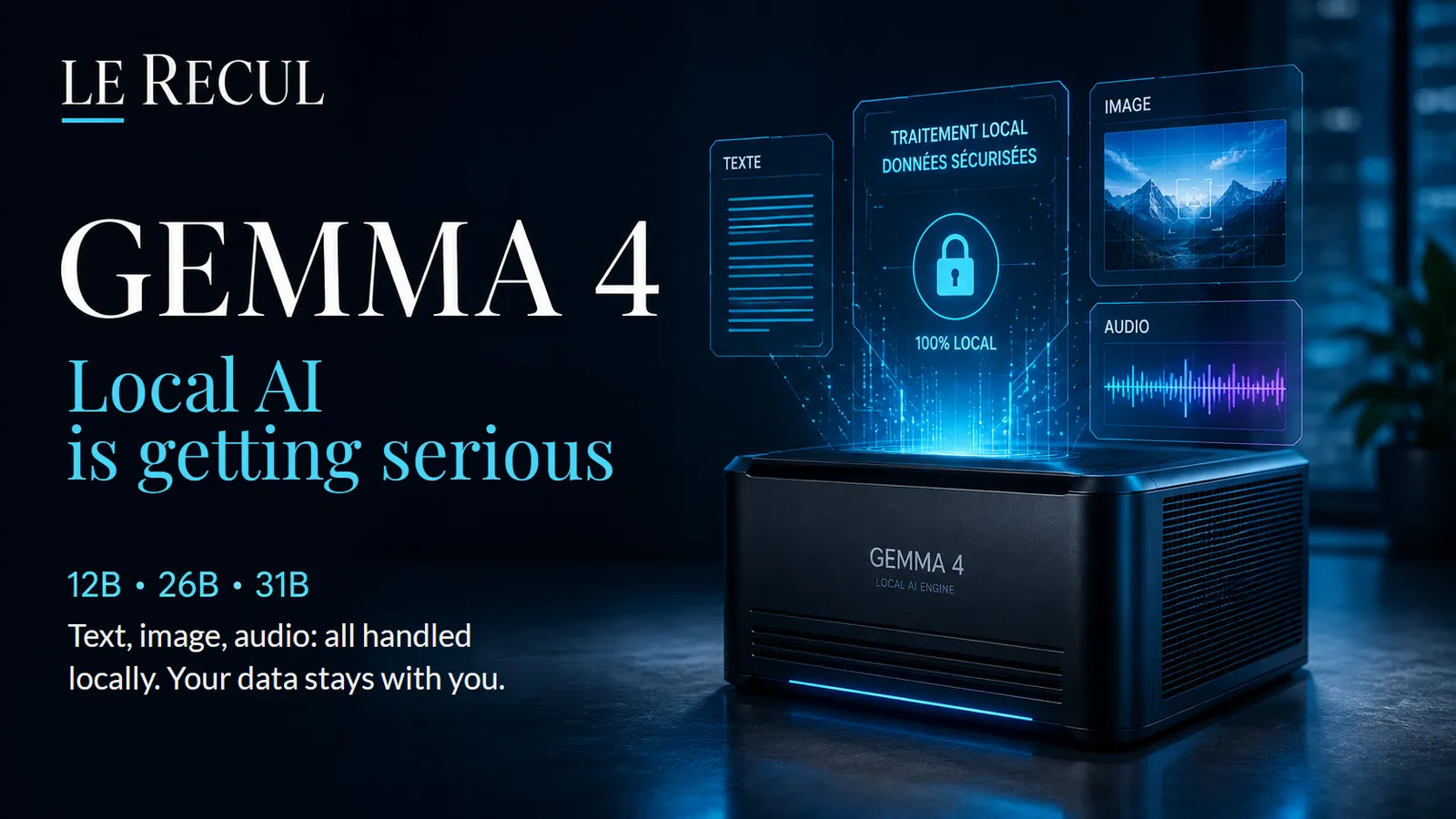
Google has just shipped Gemma 4 12B Unified, a new local AI model able to handle text, images and audio.
It is not an autonomous assistant.
It is not an agent that acts on its own.
It is not a drop-in replacement for ChatGPT, Claude or Gemini Ultra.
But for a lot of real-world uses it may be something more important:
a local AI powerful enough to reduce the dependency on the cloud.
And that is exactly where the subject gets interesting.
A fresh release: Gemma 4 12B lands on 3 June 2026
Google states that Gemma 4 12B Unified was published on 3 June 2026.
The model completes the Gemma 4 family, already launched on 31 March 2026 with these versions:
- E2B
- E4B
- 26B A4B
- 31B
On 16 April 2026, Google had also released MTP variants to speed up inference.
So there is officially no Gemma 4 24B and no Gemma 4 32B.
The models to watch are rather:
- Gemma 4 12B Unified
- Gemma 4 26B A4B
- Gemma 4 31B Dense
And all three stay under the 35B parameter mark, which keeps them consistent with a serious local-AI approach.
What Gemma 4 12B changes
Google presents Gemma 4 12B as a dense multimodal model, with a Unified and encoder-free architecture.
In plain terms: instead of routing image or audio through large separate encoders, the model projects those inputs directly into its core.
The goal is straightforward:
- cut latency;
- simplify multimodal processing;
- make local use more realistic;
- allow text, image and audio on a personal machine.
Google states that Gemma 4 12B can run on computers with 16 GB of VRAM or unified memory.
That is where the promise becomes concrete.
A local multimodal AI is no longer only a toy for researchers or enthusiasts with an unaffordable machine.
It is starting to target serious laptops, workstations, and developers who want to keep their data at home.
26B A4B: the speed / power trade-off
The Gemma 4 26B A4B model is different.
It is a Mixture-of-Experts model.
It holds around 25.2 billion parameters, but only 3.8 billion are active during inference.
That does not mean it loads like a 4B.
Google makes clear that every parameter still has to be loaded into memory.
But it does let the model run faster than a conventional dense model of equivalent size.
It is probably the most interesting model where you are looking for a good balance:
- decent quality;
- speed;
- more controlled hardware cost;
- local use or internal server.
31B: the most serious local model in the family
Gemma 4 31B Dense is the most capable of the range.
Google positions it for:
- reasoning;
- code;
- IDE assistants;
- agentic workflows;
- use on high-end consumer GPUs or workstations.
This model is not going to run comfortably on any laptop.
But it falls into an interesting category:
local models that are starting to be good enough to replace the cloud on certain specific uses.
Not all of them.
But some.
And that is already a shift. It is the same movement we watched from the agent side when we put OpenClaw and Hermes head to head on a Windows machine: the interesting question stopped being “is it as good” and became “is it good enough for this particular job”.
Context goes up to 256K tokens
Gemma 4 also brings long context:
- 128K tokens for E2B and E4B;
- 256K tokens for 12B, 26B A4B and 31B.
It is not Claude’s million tokens.
But for a local model, 256K tokens is already very high.
It makes it possible to analyse:
- long documents;
- code;
- technical files;
- transcripts;
- internal files;
- heavier multimodal content.
It is one of the things that make Gemma 4 credible for professional local use.
The performance figures, to read with care
Google publishes several benchmarks in the model card.
A few useful numbers:
Gemma 4 31B
- MMLU Pro: 85.2 %
- AIME 2026: 89.2 %
- LiveCodeBench v6: 80.0 %
- Codeforces ELO: 2150
Gemma 4 26B A4B
- MMLU Pro: 82.6 %
- AIME 2026: 88.3 %
- LiveCodeBench v6: 77.1 %
Gemma 4 12B Unified
- MMLU Pro: 77.2 %
- AIME 2026: 77.5 %
- LiveCodeBench v6: 72.0 %
These numbers are interesting, but they have to be read properly.
They are benchmarks published by Google.
They do not prove that Gemma 4 beats the best cloud models.
But they do show that Google is pushing very hard on one idea:
build local models that are no longer merely “fine”, but genuinely usable.
If you want figures that do not come from the vendor, our open-source model ranking and our local code model ranking aggregate around twenty public sources and are refreshed continuously.
Memory required: local does not mean light
This is the point most marketing posts leave out.
Google gives memory estimates for inference.
In 4-bit quantization:
- Gemma 4 12B: about 6.7 GB
- Gemma 4 26B A4B: about 14.4 GB
- Gemma 4 31B: about 17.5 GB
In BF16, it is far heavier:
- 12B: about 26.7 GB
- 26B A4B: about 57.7 GB
- 31B: about 69.9 GB
So yes, Gemma 4 is local.
But no, that does not mean everything runs perfectly on any machine.
The 12B is the most interesting for accessible local use.
The 31B is aimed rather at powerful machines, developers, workstations or internal servers.
We measured what this actually costs in hardware, second-hand graphics cards included, when we compared a 30B local model with free ChatGPT: the entry ticket is the part of the “run it at home” promise that nobody puts in the announcement.
Is it a real competitor to cloud models?
Yes, but not head-on.
Gemma 4 does not replace the best cloud models on the hardest tasks.
Nobody should be telling you that Gemma 4 buries GPT, Claude or Gemini Ultra.
That would be false.
The real subject is a different one:
Gemma 4 goes after the uses where the cloud is not indispensable.
For instance:
- private document analysis;
- local code;
- OCR;
- summarising internal files;
- multimodal prototypes;
- assistants inside an IDE;
- processing sensitive data;
- offline use;
- embedded applications;
- internal company AI servers.
In those cases the question becomes simple:
why send your data to the cloud if a local model does the job well enough?
What this could change
Gemma 4 does not kill the cloud.
But it can reduce the need for it.
That is probably the real subject.
If local models become good enough, fast enough and multimodal enough, then part of AI usage can come back:
- to the PC;
- inside the company;
- onto a private server;
- into a line-of-business tool;
- into an IDE;
- into a local application.
That can weigh on several markets:
- paid cloud APIs;
- enterprise AI assistants;
- coding tools;
- document-processing solutions;
- AI products that rest on nothing but an external cloud model.
The cloud will stay dominant for the most powerful models.
But it could lose some everyday uses.
And for users, that is good news:
- lower cost per use;
- more privacy;
- less dependency;
- more control;
- the option of working offline.
What to remember
Gemma 4 is not a spectacular revolution.
But it is an important step.
Google is not only saying:
“here is a new model.”
Google is rather saying:
“local AI can get serious.”
With Gemma 4 12B Unified, Google brings a local multimodal model able to handle text, image and audio.
With Gemma 4 26B A4B, Google offers an efficiency / power trade-off.
With Gemma 4 31B, Google pushes a heavier local model, built for code, reasoning and professional use.
The conclusion is simple:
Gemma 4 does not replace the best cloud models.
But it makes one question far more credible:
do we really need the cloud for every AI task?
And if the answer becomes no, part of the market could change.