

Introduction — the same month, the same tool, two opposite ratings
Justin Waters built three complete applications in a single week. He says so himself, and he takes nothing back. He still gave Base44 two stars out of five, on 8 September 2026, for a reason that fits on one line: “It just took >$650 from my account without showing me the cost or confirmation.”
Both halves of that review are the subject of this article.
Base44 is an Israeli vibe-coding platform: you describe an application in plain language, an artificial intelligence writes it, hosts it and puts it online. Founded in January 2025 by Maor Shlomo, solo and without outside funding, it was acquired by Wix in June 2025 for an initial $80 million in cash, with further milestone payments due in 2029. Six to eight employees at the time of the sale, depending on the source. Weeks before the acquisition, its founder published a monthly profit of $189,000.
So this is not a curiosity. It is one of the most widely used products in its category, and its annualised revenue went from $100 million to $200 million in about five months.
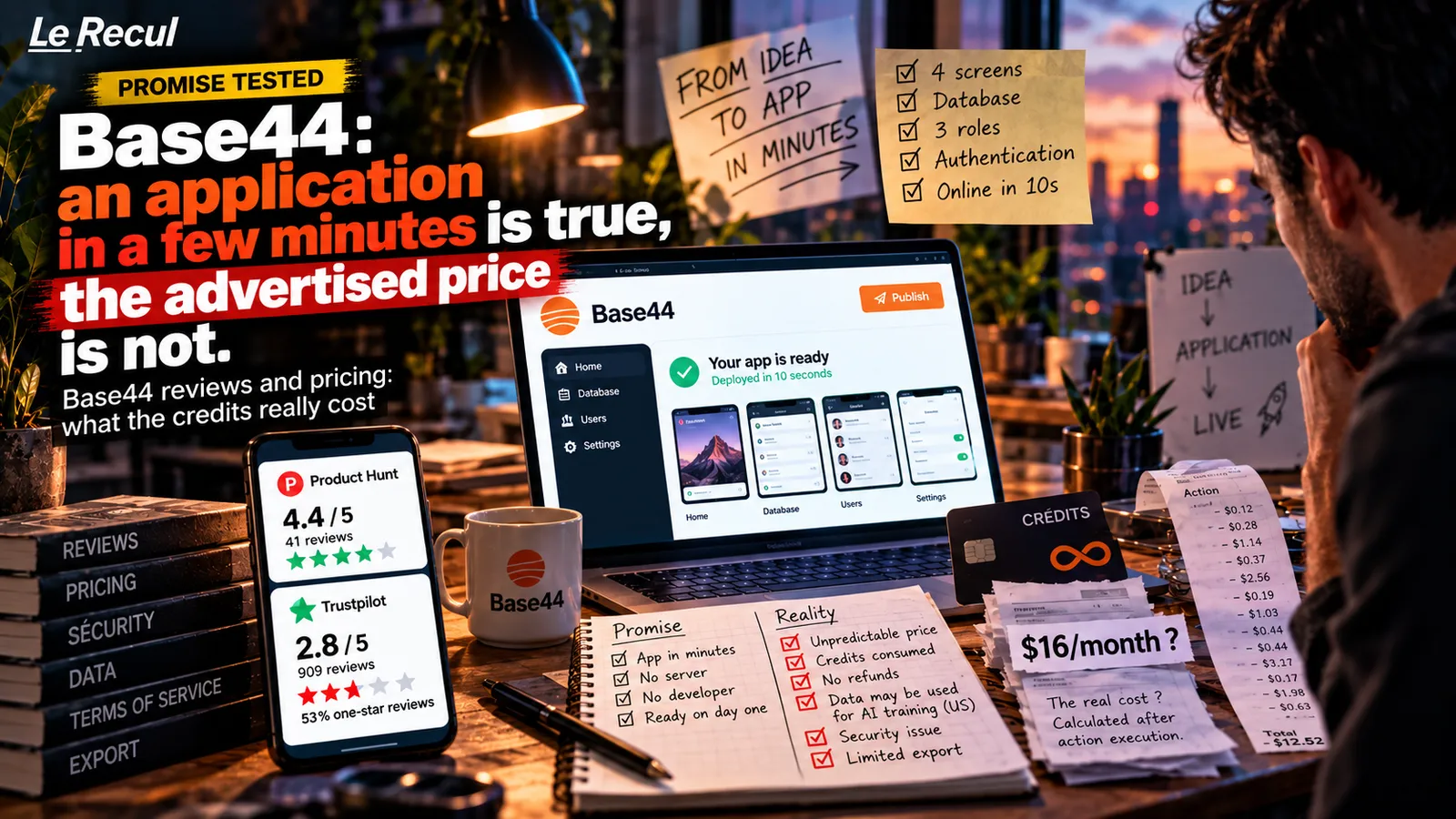
And that is where the numbers get interesting. On Product Hunt, Base44 scores 4.4 out of 5 — from 41 reviews. On Capterra, 3.3 out of 5 — from 3 reviews. On G2, roughly 3.8 out of 5 — from 4 reviews. On Trustpilot, 2.8 out of 5 — from 909 reviews, of which 53% give one star.
The bigger the sample, the lower the score. This article explains why, with the receipts.
Test summary
The promise: describe an idea in plain language and get, within minutes, a complete application with a database, authentication, payments and hosting, ready to ship on day one, from $16 a month, with no developer and no technical knowledge.
Our verdict: partially kept.
Three findings carry the whole article.
1. The technical half is true, and it is measurable. A four-screen app with a database, demo data and three user roles comes out of a single prompt in under six minutes, and goes live in ten seconds. That is not an advertising line: it is reproducible, and a French-language tester timed it across eight weeks of use.
2. The advertised price is not the price paid, and Base44 says so. Its official documentation states that “there is no set credit amount used per message” and that the cost is “calculated after the action runs”. For integration credits it adds: “There is no way to preview an integration credit cost before running an action.” You cannot know the price before you buy.
3. The terms of service make the customer pay for the tool’s mistakes. Credits consumed when output is faulty, buggy or hallucinated will not be “restored, re-credited, or refunded”. This is not a malfunction: it is the written rule. And it is exactly what the negative reviews describe.
What we verified, and what we could not
For this test to be usable, each figure has to come with its source.
What we recorded ourselves, on 11 October 2026, at the source rather than from a summary: the exact promise wording on Base44’s home page; its official pricing page and what it actually displays; its credits documentation; its privacy documentation; its terms of service; its public feedback board and roadmap, where you can see what its own users are asking for and where each request stands; the public record of its outages; and the full distribution of its 909 Trustpilot reviews.
What we take from others, with attribution: the Wiz Research security disclosure of July 2025; Veracode’s benchmark on AI-generated code; the eight-week French-language test published by Impli, which is to our knowledge the only timed measurement in French; and the Product Hunt, Capterra and G2 scores.
What we could not verify, and will therefore not present as established. The Reddit threads, heavily quoted in articles about Base44, are not accessible to us: we will not reuse any figure that reaches us second-hand from them. We could not open the Capterra listing directly and take its figures through a summary. We found no official table of credit cost per action: the values in circulation (around 0.5 credits for a visual tweak, 3 to 4 for an app-wide change) are attributed to the documentation by third-party guides, and we could not read them on the official page. Finally, we did not audit the code Base44 produces: the security benchmarks quoted below cover AI-generated code in general, not this platform in particular.
We have used it. What we saw matches what the reviews describe: the first app arrives fast and impresses, and the bill turns unpredictable the moment the tool gets something wrong.
What Base44 promises, word for word
You have to read the promise before judging it. Here is what the home page displayed on 11 October 2026.
“Every builder needs a base.”
“Turn any idea into a fully functional app — with backend, auth, payments, and hosting already built in.”
“No setup, no engineers, no waiting.”
“Ship something real with vibe coding — without touching a server, wiring up a payment provider, or configuring a database.”
“User management and authentication are built in.”
“Build a website for any need. AI-generated design, custom domain, built-in SEO tools — ready to go live from day one.”
“Base44 is an AI platform for building fully functioning apps in minutes.” / “No code, no integrations, ready to ship on day one and built to grow with you.”
Note what is being promised, because we are going to test each element separately: the speed, the absence of setup, the built-in authentication, the payments, the SEO, shipping on day one, and the ability to grow.
Note too what is not promised, and this is to the vendor’s credit: the phrase “production-ready” does not appear on that page. Base44 says “ready to ship”. The distinction matters, and we will come back to it.
One reading note. The page features a customer, Gift My Book, with three figures: “1 week to launch”, “$1M ARR in 3 months”, “6-8% conversion”. Those are the customer’s figures, not Base44’s, and we found no independent source allowing us to verify them. A testimonial in a shop window is not a measurement.
What is true: the app really does come out in minutes
This is where the promise is kept, and it should be said as plainly as the rest.
The most thoroughly documented French-language test is Impli’s, over eight weeks of use. The author asked for a project-management app — four screens, demo data, three roles (admin, member, client) — from a single detailed prompt. Result: under six minutes from idea to working app, then ten seconds to go live. Interface, database and authentication included. The AI even fixed a React error on its own during generation, and a simple “switch to dark mode” flipped the entire app.
That is not nothing. It is, literally, the promise.
The positive reviews describe the same thing, and there are many of them: 34% of the 909 Trustpilot reviews give five stars. A British user, The Relief Greenkeeper, wrote on 1 October 2026: “I have just saved myself over 30 hours of work per week!” — he had an invoicing app for freelancers built, “in a couple of days”. An Australian, Benny Manns, on 14 September 2026: “I would have spent thousands if i hired someone to do the same!” On Product Hunt, the most frequent praise tags are “no-code platform” (15 times), “fast prototyping” (13) and “easy to use” (9).
And on the three professional platforms, the scores are respectable: 4.4 on Product Hunt, 3.8 on G2, 3.3 on Capterra. Tiny samples, but not hostile ones.
So where does 2.8 out of 909 come from?
The number that turns it over: 4.4 from 41, 2.8 from 909
Here is the most important measurement in this test, and it needs no tooling: just compare the samples.
| Platform | Score | Reviews | Audience |
|---|---|---|---|
| Product Hunt | 4.4 / 5 | 41 | technical community, early builders |
| G2 | ≈ 3.8 / 5 | 4 | business software |
| Capterra | 3.3 / 5 | 3 | business software |
| Trustpilot | 2.8 / 5 | 909 | general public, billed customers |
The score does not fall because the product got worse. It falls because the nature of the sample changes. Product Hunt collects the views of people who try tools for pleasure, know what a token is, and walk away from a trial without drama. Trustpilot collects the views of people who handed over a card number.
And the distribution of those 909 reviews says it even more clearly:
| 5 stars | 4 | 3 | 2 | 1 star |
|---|---|---|---|---|
| 34% | 3% | 4% | 6% | 53% |
87% of the reviews sit at the two extremes. Only 13% in the middle. That is not the signature of a mediocre product — a mediocre product produces a bulge around 3. It is the signature of a product that either works perfectly or ruins its user, with nothing in between.
The explanation lies in the credit system, which is where we go next.
The real price: three sentences from Base44’s own documentation
The official pricing page, recorded on 11 October 2026, lists five plans:
| Plan | Advertised price | Message credits / month | Integration credits / month | What is missing |
|---|---|---|---|---|
| Free | $0 | 25 (5 a day maximum) | 100 | 5 apps maximum, no custom domain |
| Starter | $16/month | 100 | 2,000 | no AI model choice, no GitHub integration |
| Builder | $40/month | 250 | 10,000 | no early beta access, no premium support |
| Pro | $80/month | 500 | 20,000 | no premium support |
| Elite | $160/month | 1,200 | 50,000 | — |
First finding, just from looking at the page: it displays annual-billing prices only. The monthly price is not shown. Its FAQ says annual billing saves 20%, which implies a monthly rate around $20, $50, $100 and $200 — but you have to work that out yourself. The page selling you a subscription does not show you the price of the monthly subscription.
Second finding, and this is the heart of the matter. Credits are not a currency whose exchange rate you know. Here is what Base44’s official documentation says, word for word:
“There is no set credit amount used per message.”
The cost is “calculated after the action runs”.
“There is no way to preview an integration credit cost before running an action.”
Put those three sentences together: you order without knowing the price, and the price is set after delivery, by the seller. In any other trade, that sentence would stop the sale.
Third finding: unused credits are lost. From the documentation: “Your credits refresh automatically on a set schedule, and any credits you have not used expire when they reset.” Bonus credits and top-ups never carry over. So you pay for capacity you lose if you do not consume it, and which stops dead if you consume it too fast: “When you reach your credit limit, actions that use credits pause until your next reset.”
One review captures the consequence better than a paragraph. Mark, in France, two stars, 17 September 2026: “I am now left with an unusable function for another month until my credits renew.”
Paying to have the tool’s own mistakes fixed
This is the most frequent complaint, in every language. And it is not a defect: it is written into the contract.
Base44’s terms of service state that credits consumed when output is faulty, buggy or hallucinated will not be restored, re-credited, or refunded, and that the user has no right to a refund or credit for errors or interruptions. The billing documentation adds: “Credits are non-refundable for tool behavior and AI mistakes.”
Now read the reviews with that sentence in mind.
Daniel Harter, three stars, 14 September 2026, writing in French: “Having to pay to get the bugs generated by the AI’s own development and its misinterpretations fixed.”
GUEN, one star, 12 September 2026: “And when you try to solve them through the chat, they deduct credits from you abusively.”
Bob, United Kingdom, one star, updated 23 September 2026, with figures: “On first game I used 70 credits. On this broken one I am into 148 credits.” On a Builder plan with 250 monthly credits, that is 59% of the month consumed by a single broken app.
Lionel, South Africa, one star, 7 September 2026: “What a bad service! They wasted so much money, and the software hangs, takes so many credits.” He mentions paying “double credits for repeating” issues.
Ambre Miron, one star, 23 April 2026: “Message credits are a monumental scam: all sorts of tricks so that in the end a message costs 2-3 credits.”
And on Product Hunt — the platform that rates it 4.4 out of 5 — Nolan Vu: “The free plan is brutal though. 25 message credits a month, max 5 a day, and you’ll burn through them just tweaking UI.”
The decisive point is not that users complain. It is that what they complain about is the vendor’s written policy, and the vendor knows it. Which brings us to the next section.
One ordinary user’s journey, reconstructed from real reviews
A note on method, because it matters more than the story. What follows is not a testimonial, and it is not our own usage log. It is a reconstructed journey: every figure comes from a public review, dated and signed, and we name its source at each step. We assemble it because a single review only shows one piece of the trip — and it is the whole trip that decides your bill. Nothing in it is invented. Nothing in it is presented as a measurement we made ourselves.
Day 1 — the free plan, and the moment of astonishment. You describe your idea in plain language. The app comes out: four screens, a database, demo data, three user roles. Under six minutes, then ten seconds to go live (Impli’s timed test, eight weeks of use). That exact minute is where the 34% of five-star reviews are decided, and they are deserved. Then you want to fix three interface details. The free plan gives 25 message credits a month, capped at 5 a day. Nolan Vu, on Product Hunt — the platform that rates the tool 4.4 out of 5 — : you burn through them “just tweaking UI”.
Day 2 — choosing a plan, and the first trap. You take the one in the shop window, Starter at $16. It includes no backend functions, no AI model choice, and no GitHub export. For a project that has to actually do something, the first genuinely usable plan is Builder: $40 a month, and since the page shows annual pricing only, that means $480 committed at once. You have just paid for a year of a tool you started using yesterday.
Week 1 — the loop. The app works at 80%. The remaining 20% is a bug the AI says it has fixed, and which comes back. You prompt again. Every prompt counts, failed attempts count too, and the terms provide that those credits are not refunded. The only precise figure published by a user, Bob, in the United Kingdom, on 23 September 2026: “On first game I used 70 credits. On this broken one I am into 148 credits.” On a Builder plan with 250 credits, a single broken app ate 59% of the month. Another review reports a simple icon change billed at 100 credits.
Week 2 — the wall, then the wait. Two outcomes, both documented. Either the project grows and you meet “Context window exceeded. It seems like your project is too large” — a user on the vendor’s feedback board reports hitting it after five messages. Or the credits are gone, and then nothing happens at all: “When you reach your credit limit, actions that use credits pause until your next reset.” Mark, in France, on 17 September 2026: “I am now left with an unusable function for another month until my credits renew.” You paid for a year, and you wait three weeks.
Support, and this has to be said both ways. Impli’s tester writes that customer support is “almost non-existent” and cites delays of 10 to 15 days on blocking problems. Tib, in France, on 27 July 2026: “the AI engine hallucinates regularly, support is useless, nothing but apologies and never, ever a goodwill gesture.” But Connor Dewulf, on 17 September 2026: “Great customer service reasonably quick at responding and very helpful and understanding”, and Sean Martin, the same day, names the person who helped him. The vendor replies to 54% of negative reviews, generally within 48 hours. Support is not absent: it is uneven, and you cannot know in advance which side you will land on.
If you decide to leave. Export is reserved for Builder and above — so you cannot retrieve your code from the plan advertised in the shop window. It hands you the front end, not the backend, not the database, not the secrets. Sync goes one way only, and once connected, earlier history can no longer be restored.
And the bill, which is the real subject. Justin Waters, United States, 8 September 2026: “It just took >$650 from my account without showing me the cost or confirmation.” Shirl Bain, Australia, 7 September 2026: “a year later they took $640 AUD from my account”, after cancelling, she says. Teresa Spates, 2 September 2026: “they make it almost impossible to delete account so they continue charging you”. Laecio D., Brazil, 16 September 2026: “The charge failed 9 times”, and his paid annual plan was cancelled, leaving him on the free tier for about three months.
What an ordinary project actually costs
| Stage | What you pay | Where the figure comes from |
|---|---|---|
| Trial | $0 — 25 credits, 5 a day | official pricing page |
| First real plan | $480 committed (Builder, $40/month on annual billing) | official page, which shows annual only |
| A bug the AI cannot fix | up to 59% of the month | Bob, 23/09/2026: 148 credits against 70 |
| One misunderstood tweak | up to 100 credits | Trustpilot review, icon change |
| Credits gone before month end | waiting, up to 3 weeks | Mark, 17/09/2026 + official documentation |
| Credits left unused | lost | documentation: they “expire when they reset” |
| Getting your code out | Builder plan minimum | documentation: export reserved for Builder and above |
| The tool’s own mistakes | on you | terms of service: neither restored nor refunded |
What this journey demonstrates, and it is the whole article: nobody is misled about what the tool does. People are surprised by what it costs — because the cost depends on how many times the tool gets it wrong, and nobody can state that number in advance. Not even the vendor, which writes in plain words that the amount is “calculated after the action runs”.
What Base44’s feedback board says about Base44
Base44 publishes an open feedback board and roadmap. That is to its credit: few vendors expose what they are criticised for so openly. And for this test it is the most useful exhibit of all, because it comes from the vendor and its own customers.
Recorded on 11 October 2026: 100 open requests (74 features, 20 improvements, 6 bug reports), 29 items shipped, 21 in progress, 20 planned.
Among the open requests under review, these are the ones that line up exactly with what the reviews describe:
- “Protect users from credit consumption during builder error loops”. Under review. Base44’s customers are formally asking to stop paying for Base44’s own mistakes.
- “Pay as you go Credits, I’m bored waiting a month”.
- “Private app uploads remain accessible through unauthenticated direct file URLs” — filed as a bug, under review for two weeks. Files uploaded into a private app would remain reachable by direct URL without authentication.
- “Rate limiting / lockout for failed logins and OTP resend”. Under review. Remember this one: we return to it in the security section.
- “Prevent new user account on App Login screen”. Under review.
- “Allow app builders to select the database region as required by local law”. Under review.
- “file storage in the UK not the US for uploaded images and documents”. Under review. The same request exists for Australian and Indian servers.
- “Make Base44 Apps Findable: Fix Prerendering for Data-Driven Pages”. Under review. The home page promises “built-in SEO tools”.
- “Allow editing the subject line (and language) of built-in auth emails”. Under review.
And in fairness, here is the other half of the board, the half that shows the vendor moves fast: among the 29 shipped items are “Custom Login” (8 June), “Security + Testing Pack” (10 June), Base44 payments in the United Kingdom (11 June), native support for scheduled backend functions (1 October), and a long run of newly added models — Sonnet 5.5, Opus 5.5, GPT 6 Astra. Base44 ships a great deal, and quickly.
It is the comparison between the two columns that is instructive. What ships is mostly new models and new capabilities — the things that sell. What stays “in progress” or “planned” is the plumbing a European professional needs:
- “We need EU-Hosting” — in progress. 10 votes, 12 comments.
- “Base44 payments - EU” — in progress. 33 votes. Base44 payments shipped in the United Kingdom on 11 June; the European Union version is still being built. A French or German user who wants to take money therefore goes through an external provider — while the home page promises shipping “without wiring up a payment provider”.
- “Customized login/sign-up modal” — in progress, 5 votes and 167 comments. One of the most discussed items on the board.
- “Customize the invitation email of users to my app” — only planned, with 19 votes and 199 comments.
- “Support for Tracking Pixels (Meta Pixel, GTM, Google Analytics)” — only planned.
In other words: the vendor’s velocity goes to the features that attract, not to the plumbing that lets you ship in Europe.
”Authentication is built in”: what Wiz found
The home page promises: “User management and authentication are built in.” That is true. And it is precisely what caused the problem.
On 9 July 2025, Wiz researchers reported a critical authentication bypass to Wix and Base44. The mechanism is disarmingly simple: two API endpoints were exposed with no restrictions at all —
api/apps/{app_id}/auth/registerapi/apps/{app_id}/auth/verify-otp
— and the application identifier, app_id, is not a secret: it is visible in the app’s URL and in the path of its manifest.json file. So knowing the address of a private app was enough to register an account on it, verify that account yourself by one-time password, and sign in. Wiz writes that the flaw “effectively bypassed all given authentication controls that Base44 provided, including Single Sign-On (SSO)”.
Wiz confirmed the method worked on real enterprise applications: internal chatbots, knowledge bases, and “PII & HR operations”.
In Wix’s favour: the fix shipped within 24 hours, was verified by Wiz on 10 July, confirmed resolved on 13 July, and published on 29 July. Wix states it “found no evidence that any customer was impacted”. No CVE number was assigned. The response was fast and correct.
What remains is the lesson. When authentication is “built in”, it is not under your control: you inherit the platform’s security, good or bad, with no way to audit or fix it. And that is where the feedback board takes on a different light: three requests still under review in October 2026 cover the same ground — no rate limiting after failed logins and one-time-password resends (that is, exactly the endpoint exploited in 2025), no way to prevent account creation from the app’s login screen, and a bug report saying private app files would remain reachable without authentication.
For context, and because it would be dishonest to make this a case against Base44 alone: Veracode’s benchmark across more than 100 language models and 80 coding tasks found that 45% of AI-generated code fails security tests, with 86% failing to defend against cross-site scripting and 88% vulnerable to log injection. Its March 2026 update found the pass rate unchanged, around 55%, even as coding benchmarks improved. The problem belongs to the method, not to one brand.
Your data goes to the United States, and may train models
This point appears nowhere on the home page, and it is decisive for professional use in Europe.
Base44’s official documentation states that all Base44 servers are currently located in the United States. Data for all workspaces is stored there by default. Enterprise plans can obtain storage in the EU or the UK, but the page specifies that this residency governs where data is stored, not where it is processed, and that media files, account details and billing information stay in the United States.
And on model training, the same page draws a line:
- Enterprise plan: “your data is not used to train AI models”;
- every other plan, Business included: “your data may be used to train AI models”.
The page states there is no setting to opt out. The exclusion is automatic for Enterprise, and only for Enterprise.
What that means in practice if you handle data about people resident in the European Union: the transfer outside the European Economic Area must be covered by appropriate safeguards (standard contractual clauses, a data processing agreement), documented in your records of processing, and the people concerned must be informed. For health, banking or government data, US hosting is generally incompatible with the usual requirements. And you must factor in that, on the ordinary plan, content may be used to train models.
To the vendor’s credit: it states SOC 2 Type II compliance and ISO 27001 certification, and the “We need EU-Hosting” request is marked in progress on its roadmap. This is not being ignored. It has not shipped.
More than 37 outages in a year, almost never acknowledged
“Built-in hosting — when your app is ready, it’s instantly live and shareable,” promises the home page.
StatusGator’s public record, monitoring Base44 since March 2025, counts more than 37 outages affecting users over one year. The ten incidents detailed on its page:
| Date | Duration | Symptom | Officially acknowledged |
|---|---|---|---|
| 20 August 2026 | 1 h 23 | site and app not loading | never |
| 1 August 2026 | 1 h 18 | 503 error on web and admin apps | never |
| 27 July 2026 | 25 min | applications not loading | never |
| 27 July 2026 | 19 min | slow app, pages not loading | never |
| 24 July 2026 | 30 min | server connection errors | never |
| 6 July 2026 | 29 min | app not loading, slow performance | never |
| 18 June 2026 | 54 min | backend server not responding | never |
| 17 June 2026 | 28 min | chatbot no longer responding | never |
| 2 June 2026 | 41 min | site and builder inaccessible | not stated |
| 26 May 2026 | 38 min | service outage | never |
Nine of the ten incidents were never acknowledged on the official status page. That is the point to keep: not the length of the outages, which stays modest, but the fact that if your client’s app went down for one hour and twenty-three minutes on a Thursday afternoon in August, you had no official page to show that client.
For the record, as of 11 October 2026, Base44 is operating normally.
Leaving: what the export gives you, and what it keeps
“Built to grow with you.” The real question is: grow where?
Export to GitHub exists, but you need to understand what it contains. The sources agree on the essentials: it gives you the front end — React or Vue components, interface logic, client-side state — and, according to some, the source of your backend functions and a schema file. What it does not give you: the @base44/sdk library itself, the database, and above all the ability to run the code without rewriting every call to the SDK. Secrets do not travel: the credentials your functions use stay with the vendor and have to be reissued elsewhere.
Three practical constraints to know before you start, not after:
- Export is a paid feature. The documentation reserves GitHub sync for the Builder plan ($40/month on annual billing) and above. The Starter plan, the one whose price is in the shop window, does not include it. On Free and Starter, what remains is copying files by hand, one at a time.
- Sync is one-way: you push from Base44 to GitHub; you do not import from GitHub back into the editor.
- Connecting is hard to undo. The vendor’s integration page states that after connecting GitHub, version history from before that connection can no longer be restored, and that after disconnecting you cannot reconnect to the same repository.
In plain terms: you can get your code back. You cannot get a working application back without rebuilding the backend, the data, the authentication and the secrets — which means without a developer.
The ceiling: “your project is too large”
There is a limit to growth, and it has an error message. On Base44’s feedback board, a user reports: “Context window exceeded. It seems like your project is too large.” The same user says their app got stuck after only five messages. The request, titled “Upgrade context window limit”, is under review.
We found no official documentation of this ceiling, no confirmed figure for the maximum size of a project, and no confirmation that a higher plan raises it. The workarounds in circulation — open a new conversation per feature, split files longer than about 400 lines, move large refactors into a local editor — come from third-party guides and are not verified.
What is certain is the shape of the wall: it exists, it is undocumented, and it arrives when your app starts to get serious. Which is precisely the opposite of “built to grow with you”.
The constraints nobody mentions before you buy
Three points we found on no sales page, and which matter.
The login screen and authentication emails. “Custom Login” shipped on 8 June 2026: login customisation exists. But the “Customized login/sign-up modal” request is still in progress with 167 comments, the request to change the subject line and language of built-in auth emails is under review, and the one asking to customise the invitation email is only planned — with 199 comments. If your app addresses a non-English-speaking audience, check the language of those automated messages before promising a client a date.
SEO. The home page promises “built-in SEO tools”. On the vendor’s own board, a request under review reads “Make Base44 Apps Findable: Fix Prerendering for Data-Driven Pages”. If your project depends on being found in search engines, test that before committing, not after.
Billing after cancellation. This is the gravest complaint because it concerns money actually taken. Shirl Bain, Australia, one star, 7 September 2026: “a year later they took $640 AUD from my account” — after cancelling, she says. Jamie Crum, United States, one star, 18 September 2026: “They keep billing after you cancel” — Base44 replied that a refund had already been issued. Teresa Spates, 2 September 2026: “they make it almost impossible to delete account so they continue charging you”. Laecio D., Brazil, 16 September 2026: “The charge failed 9 times”, and his paid annual Starter plan was cancelled, leaving him on the Free tier for about three months. On Capterra, the one-star review is titled “Glorified demo with broken cancellation and ghost subscriptions” and describes two parallel subscriptions on two workspaces of the same account, both billed to the same card.
Two things worth knowing, and they are useful. First, cancel inside the app, never by email: several users report charges continuing after a request sent by message. Second, if you are in the European Union or the United Kingdom, you have a fourteen-day right of withdrawal on a new subscription bought at a distance, and the vendor’s terms defer explicitly to mandatory local law. That is your best recourse, and it is time-limited: do not let the fourteen days pass hoping it will sort itself out.
Conversely, and for completeness: 34% of reviews give five stars, and several of them praise customer service specifically. Connor Dewulf, 17 September 2026: “Great customer service reasonably quick at responding and very helpful and understanding.” Sean Martin, the same day, names the representative who helped him. Base44 replies to 54% of negative reviews, generally within 48 hours. Support is not absent; it is uneven.
What you actually need to know for this to work
This is the question Base44 does not ask, since it promises “no engineers”. Here, based on everything above, is what you really need in order for the tool to keep its promise.
To prototype — almost nothing. Know how to describe precisely what you want. The six minutes are real. This is the tool’s right use, and it is excellent at it.
Not to burn your credits — four habits. Use “discuss” mode rather than “build” while you are still thinking: it is markedly cheaper. Make visual tweaks by hand in the editor, where they cost nothing, instead of asking the AI. Write short, targeted prompts, because the documentation itself says a broad prompt touching several screens costs more. And open a new conversation per feature, instead of letting one chat grow until it hits the context wall.
To go to production — a real developer. Not to write the code: to audit the authentication and permissions, confirm no private file is reachable without authentication, wire up a payment provider because Base44 payments do not yet cover the European Union, and take over the backend if you ever have to leave. Veracode’s 45% security-test failure rate on AI-generated code is not an opinion about Base44: it says generated code gets reviewed.
To stay compliant — the ability to read a contract. US hosting, data liable to train models outside the Enterprise plan with no way to opt out, transfers outside the European Economic Area to be covered. If you handle European customers’ data, this is not optional.
That is the honest answer to “no technical knowledge”: for a prototype, it is true. For a tool a business depends on, it is false.
What it really costs
Let us gather the figures, without inventing any.
The free plan is not a plan, it is a trial. 25 message credits a month, 5 a day maximum, 100 integration credits, 5 apps. The Product Hunt user puts it bluntly: you burn through them “just tweaking UI”.
The plan advertised at $16 does not include the exit. No GitHub integration, no AI model choice, no backend functions. The first plan genuinely usable for a serious project is Builder, at $40 a month on annual billing, which means $480 committed at once.
The real cost depends on how often the tool gets it wrong, and you are the one paying. The only precise user figure we could read: 148 credits consumed on a broken app, against 70 on one that worked — 59% of a Builder month for a single broken app. Impli’s tester puts it in a sentence we cannot improve on: “you are not paying for advanced features, you are paying to make up for the tool’s inefficiency.”
And the competition? Entry prices are close — Lovable at $25 a month, Bolt around $20 to $25, Replit around $20 — but the meters differ, and it is the meter that decides the bill. Bolt bills raw tokens and rolls unused tokens over; Lovable bills task-weighted credits, also with rollover; Replit bills effort-priced checkpoints. Base44 rolls nothing over. For irregular use, that single difference matters more than the advertised price.
Our Le Recul verdict
Promise partially kept.
What Base44 says it will do, it does: a working application, with a database, authentication and hosting, comes out of a plain-language prompt in minutes. That is real, it is measured, and it is remarkable. The 34% of five-star reviews are not fakes: they are people whose project fitted inside the credits.
What is not kept is the price. Not because it is high — $40 a month for a business tool is cheap — but because it is unknowable. The vendor’s documentation says no fixed amount is attached to a message, that the cost is calculated afterwards, and that no preview is possible. Its terms say credits burned by its own mistakes are not refunded. Its customers have filed a request on its public board to stop paying for its error loops: it is under review.
That is where the gap between 4.4 from 41 reviews and 2.8 from 909 comes from. Not from the quality of the software. From who absorbs the mistake.
Our usable position: Base44 is an excellent prototyping tool and a good internal tool wherever an outage is not serious. As of October 2026, it is not a platform on which to place a tool that revenue or European customers’ personal data depend on — unless you have a developer to review it, an external payment provider, and room in your budget for the months when the tool gets things wrong.
The most honest sentence written about Base44 came from Impli’s tester after eight weeks: “an excellent rapid-prototyping tool, but a bad choice for production”. Nothing we recorded contradicts it.
For the record: Base44 does not promise “production-ready”. It promises “ready to ship”. The difference is not a translation nuance — it is the whole article.
If you want to try it without getting hurt
Six precautions, all of them derived from the above.
- Start on the free plan, knowing it exists to show you the tool, not to build with: 5 credits a day.
- Measure your own consumption on a small project before paying for a year. There is no table of cost per action: the only reliable figure will be yours.
- Pay monthly first, never annually straight away. The page shows only annual pricing: look for the monthly rate.
- Note your subscription date. In the European Union and the United Kingdom, you have fourteen days to withdraw.
- Cancel inside the app, and check the next charge on your bank statement.
- Before putting anything sensitive in it, re-read the hosting section: servers in the United States, and data liable to train models outside the Enterprise plan.
And if your project has to last: have the authentication and permissions reviewed by someone who knows what they are reading. The July 2025 disclosure was not found by a user.
Frequently asked questions
What is Base44?
A vibe-coding platform: you describe an application in plain language, an artificial intelligence writes it, hosts it and puts it online, with a database, authentication and hosting built in. Founded in January 2025 by Maor Shlomo, acquired by Wix in June 2025 for an initial $80 million in cash plus milestone payments in 2029. It continues to operate under its own brand.
Is Base44 free?
There is a free plan, but it is a trial rather than a usage plan: 25 message credits a month with a ceiling of 5 a day, 100 integration credits, 5 apps maximum, and no custom domain. A Product Hunt user, on a platform that rates the tool 4.4 out of 5, sums it up: you burn through them “just tweaking UI”.
How much does Base44 really cost?
The prices on the official page are annual-billing prices: $16, $40, $80 and $160 a month. The monthly rate is not displayed; since the FAQ mentions a 20% annual saving, it sits around $20, $50, $100 and $200. But the subscription price is not the real cost: that depends on how many credits you consume, and the vendor’s documentation states that no fixed amount is attached to a message and that the cost is calculated after the action runs.
Why do the credits run out so fast?
Because fixing costs as much as creating. Every change request counts, failed attempts count too, and the terms provide that credits consumed by faulty or hallucinated output are not refunded. Unused credits expire at the reset and do not roll over. To economise: “discuss” mode rather than “build”, visual tweaks done by hand in the editor, short prompts, one conversation per feature.
Can you get your code out and leave Base44?
Partly. The export returns the front end — interface, components, client-side logic — and, according to some sources, the code of your backend functions. It does not return the vendor’s SDK, the database, or the secrets, and the exported code does not run without rewriting the SDK calls. Export is reserved for Builder and above, GitHub sync goes one way only, and after connecting, earlier version history can no longer be restored.
Is the data hosted in Europe?
No. The official documentation states that all Base44 servers are currently located in the United States. European or British storage exists for Enterprise plans, but it governs storage only, not processing, and media, account data and billing information stay in the United States. A “We need EU-Hosting” request is marked “in progress” on the public roadmap.
Is my data used to train AI models?
Outside the Enterprise plan, yes: the official documentation states that your data may be used to train AI models, including on the Business plan, and that there is no setting to opt out. The exclusion is automatic for Enterprise only.
Is Base44 secure?
In July 2025, Wiz Research disclosed a critical authentication bypass: two endpoints exposed without restriction allowed anyone, from an app’s public identifier alone, to register an account and sign in to private enterprise applications, bypassing single sign-on. Wix fixed it within 24 hours and states it found no evidence that any customer was impacted. In October 2026, three requests in the same area remain “under review” on the vendor’s public board, including a bug report saying private app files would remain reachable without authentication. Base44 also states SOC 2 Type II compliance and ISO 27001 certification.
Can you take payments from the European Union?
Not with Base44’s own payment system as it stands. Base44 payments shipped in the United Kingdom on 11 June 2026; the European Union version is still listed as “in progress” on the public roadmap, with 33 votes. So you go through an external provider — which the home page promised you would avoid.
Base44 or Lovable?
Entry prices are close, but the meters differ, and it is the meter that makes the bill. Lovable bills task-weighted credits and rolls them over from month to month; Bolt bills tokens and rolls those over too; Base44 rolls nothing over and its credits expire at the reset. For irregular use, that difference alone weighs more than the advertised price. We have not tested Lovable with the same rigour: we will not recommend it on the strength of a pricing page.
Conclusion — the promise is not the contract
Base44 does what it says. Six minutes, a working app, ten seconds to put it online: that is true, and it is why 34% of reviews give it five stars.
But between the home page and the terms of service there is a second document, and it is the one that decides. It says no fixed amount is attached to a message. That the cost is calculated afterwards. That no preview is possible. That credits burned by the tool’s mistakes are not refunded. And that data, outside the most expensive plan, may train models with no way for you to object.
None of this is hidden: it is all published by the vendor, openly, and that is to its credit. It is simply not written on the page that sells.
The gap between 4.4 from 41 reviews and 2.8 from 909 does not measure the quality of a piece of software. It measures the distance between the people who tried a tool and the people who received a bill.
To go further: we compared the models that write this code in Best AI for coding: Claude Opus 5.5 against GPT-6 Sol, and tested the same mechanics of a quantified promise in AI text detectors: what the promised 99% reliability is really worth. On agents meant to work unattended, see Codex against Cowork: which one really works alone on your Windows PC?.