

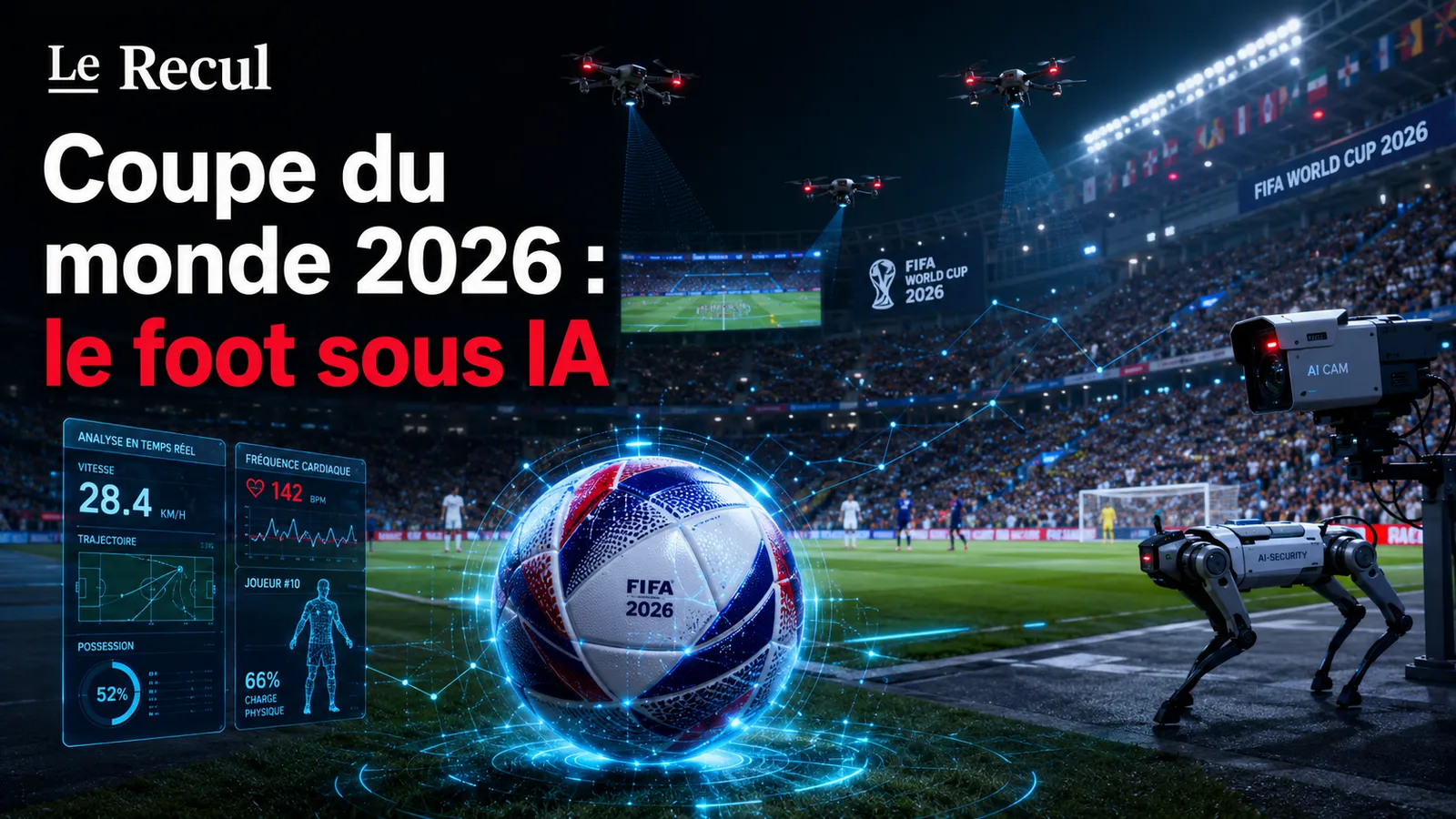
World Cup 2026: AI walks onto the pitch… and into your data
On 11 June 2026, the World Cup kicks off in North America.
3 host countries — the United States, Canada and Mexico.
16 stadiums, 48 teams, 104 matches.
And a discreet guest in almost every passage of play: artificial intelligence.
FIFA is selling a simple promise: fewer errors, fewer rows, more precision. On the pitch, that promise is not false.
The ball will be connected. Offsides will be measured faster. Players will be modelled in 3D. Referees will receive automated alerts. Coaching staffs will have AI assistants. Broadcasters will be able to produce clearer replays, more immersive angles, more personalised highlights.
But this World Cup will not only be “smarter”. It will be more measured, more tracked, more captured, more steered.
The blunt reminder: the best-tracked data of this World Cup may not be the ball’s — it may be yours.
AI is not only going to walk into football. It is going to turn the World Cup into a giant data laboratory: the ball’s data, the players’ data, the fans’ data, the crowds’ data, the tickets’ data, the behaviours’ data.
The promise is precision. The risk is a football that loses part of its naturalness, its unpredictability and its human decisions, in favour of a game that is more and more calculated.
A World Cup in the America of Trump and of AI everywhere
This detail matters: the 2026 World Cup will mostly be played in the United States. Of the sixteen host cities, eleven are American. Canada and Mexico are co-organising the event, but the tournament’s logistical, economic, media and security centre of gravity will be American.
And this World Cup arrives in a country where the Trump administration has made artificial intelligence a lever of power. Since January 2025, Donald Trump has been pushing a clear line: fewer regulatory brakes, more innovation, more infrastructure, more AI in the economy, more AI in national security, more AI in the technology race against China.
The 2026 World Cup is not officially “Trump’s AI World Cup”. But it lands in a very clear political climate: in the United States, AI is meant to be everywhere it can deliver an advantage. In companies, in defence, in infrastructure, in security, in major events.
And the World Cup is precisely that: a global event, a technology showcase, an economic stake, a policing challenge, an enormous crowd, borders, cameras, flows, tickets, payments, data. Football remains the show. But around the show, America is already testing the world that comes next.
The ball, the drones, the robot dogs: the new symbols of the World Cup
The most visible symbol of this technological World Cup is no longer only the official ball. It is the whole ecosystem around it.
At the centre: Trionda, Adidas’s connected ball. Above it: drones, cameras, video feeds, surveillance and counter-surveillance systems. Around the stadiums: biometric devices, reinforced checks, anti-drone systems, and even robot dogs at some sites.
Football keeps its shirts, its anthems, its crowds, its flags. But the picture changes. The ball still rolls, except that it is now surrounded by sensors. The pitch still exists, except that it becomes a measuring surface. And the match is still played by humans, except that every second is captured, interpreted, turned into data, then fed back into the decisions.
The ball no longer just rolls
Trionda is not only a more stable, more aerodynamic or better-looking ball. It is a connected object. It carries a motion sensor able to transmit data to the VAR in real time, at an announced frequency of 500 Hz.
500 Hz means 500 measurements per second. Every contact, every deflection, every strike, every movement of the ball can produce usable data. The ball is no longer only there to be played. It is there to timestamp the precise instant of contact.
And in modern football, that instant can change everything. An offside is not judged only on a player’s position. It is judged on the exact moment the ball is touched by their teammate. A few hundredths of a second are enough to turn a valid move into a disallowed goal.
So with Trionda, the ball becomes a technical witness. It does not say who is right. But it gives the system a more precise signal to decide with.
What the sensor really changes
The ball’s 500 Hz sensor can help on several kinds of situation: offside, handball, deflections, double touches or fouls that are hard to read at full speed. The system has to know when the pass leaves, whether the ball was touched, deflected or struck, and at what exact instant the passage of play tips over.
Football loves saying that “it all comes down to a detail”. In 2026, that detail becomes a piece of data.
That is where the debate starts. Because the more you measure, the more you give the impression that the game is becoming objective. But football is not entirely objective. A contact can be real without being a foul. A position can be illegal without influencing the play. A handball can exist without being punishable. An offside can depend on interference, on obstruction, on intent, on a movement.
The AI measures. The referee interprets. And that difference is essential, because the day the public believes the data tells the whole truth, the human becomes suspect the moment they decide otherwise.
Semi-automated offside: faster, not magic
The 2026 World Cup will use semi-automated offside. The system relies on a set of cameras able to track players in real time. Those cameras capture movement at high frequency, reconstruct body positions and help calculate more quickly whether an attacker is ahead of the last defender at the precise moment the ball is played.
But it should not be sold as an AI referee. It is not the AI that decides alone.
For clear-cut cases, the system can send a signal to the assistant referee. If the gap is obvious, the assistant receives an alert. If the situation is tighter, the system can ask them to hold. If the case is ambiguous, the human keeps control.
It is an aid, not a replacement. But it is also a pressure. Because the referee is no longer only facing the game. They are facing a system that measures, flags, frames and influences their decision. FIFA is selling clarity. But football keeps its grey areas.
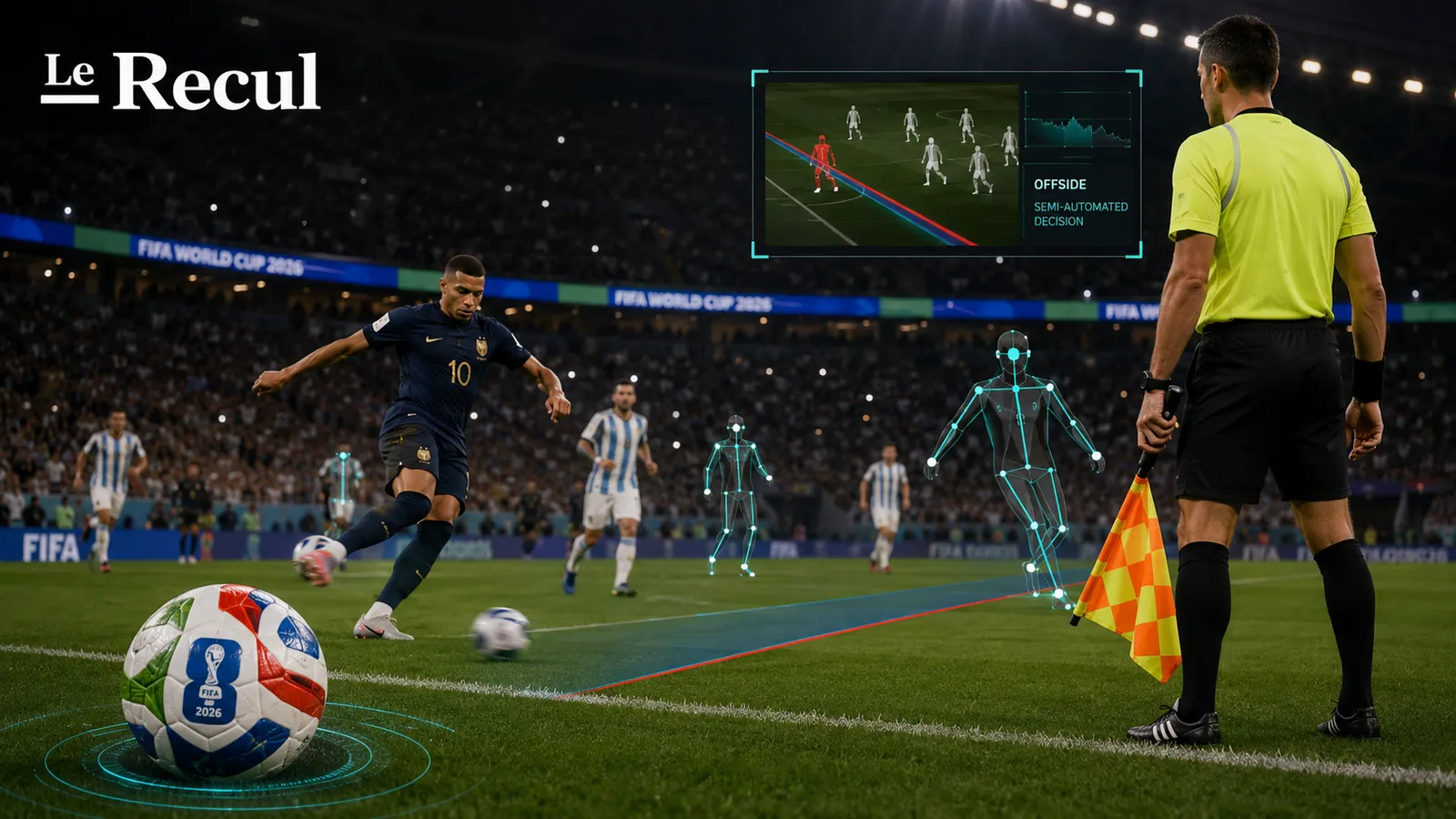
Connected ball, semi-automated offside, cameras and position data: AI does not replace the referee, but it frames their decision more and more.
Ten centimetres can change a World Cup
The most striking detail is the scale. Some semi-automated offside systems treat cases as “clear” when the gap exceeds roughly 10 centimetres.
Ten centimetres. Less than a hand. Less than a foot. Less than a hip movement during a sprint.
So the system can speed up the obvious decisions. That is useful. But it will not remove the arguments. It will move them. Before, people contested the referee’s eye. Tomorrow, they will contest the camera, the point chosen on the shoulder, the exact moment of the pass, the quality of the scan, the reading of interference or the generated line.
Technology does not remove controversy. It gives it a new interface. And little by little it turns football into a sport of thresholds, margins, lines, signals and calculations.
Players become data in motion
Another major shift: players will be tracked, measured, modelled. To improve VAR decisions, particularly on offside, bodies can be represented in 3D. For the viewer, that means clearer replays. For the video referee, it can make a situation easier to read. For FIFA, it helps sell a decision as more transparent.
But the real subject lies elsewhere. A player is no longer only a filmed body. They become a set of points: a posture, a speed, a position, a trajectory, an avatar, a digital twin.
Professional football has always observed bodies. But AI changes the scale. It no longer watches only a player running. It turns that player into usable, comparable, replayable, visualisable data.
The ownership question deserves to be asked without getting lost in it: who controls those digital twins, how long are they kept, and how far can they be reused? It is short, but central. Because in modern sport, players no longer produce only a show. They produce high-value data.
Football AI Pro: tactical AI for all 48 teams
The second big pillar of the AI World Cup is Football AI Pro, developed with Lenovo. The idea is strong: give all 48 national teams an AI assistant able to analyse large volumes of football data.
The system is meant to help teams prepare matches, compare opponents, analyse trends, produce clips, interpret metrics, spot tactical patterns, track certain physical or technical signals.
The official promise is appealing: data parity. The big footballing nations have long had access to analysis departments, expensive software, video analysts, statistical databases, scouting tools. Smaller national teams do not always have those means.
With a shared tool, FIFA can say: everyone gets the same base. That sounds good. But it is not neutral.
Football stays human. But AI is starting to steer the game.
This may be the heart of the matter. Football has always been a sport of instinct, of collective play and of the unexpected. A player attempts a pass nobody saw coming. A goalkeeper comes out too early. An attacker sets off a fraction of a second before the defender. A manager senses it is time for a change. One team cracks mentally. Another wakes up without the statistics announcing it.
It is that mix of technique, chance, fatigue, emotion and human decision that makes football what it is. But the 2026 World Cup adds a new layer: a layer of calculation.
The ball marks the exact moment of contact. The cameras trace the bodies. The 3D models reconstruct the positions. The AI assistants read the opponents. The algorithms suggest trends, risks, substitutions, weak zones, strategy, game plan. Automated replays turn a passage of play into evidence.
The match is still played by humans. But it is more and more framed by systems that measure, recommend, flag and steer.
That is where football changes in nature. Not because AI is going to score goals. But because it is starting to influence what is seen, what is judged, what is corrected, what is advised, what is contested.
The game becomes less spontaneous. Less organic. Less human in how it is read. A decision that came from a referee becomes a decision backed by a chain of sensors. A substitution choice that came from a manager becomes a decision taken under the pressure of data. A passage of play that lived in the emotion of the stadium becomes a sequence cut up, measured, replayed, annotated.
Football does not disappear. But it slides towards something else: a sport where humans still play, but where the machine watches, calculates and increasingly influences.
And when a game becomes data-driven, it stays spectacular. But it loses part of its naturalness.
Data parity, or football under a single model?
Giving everyone the same tool can reduce some inequalities. But it can also flatten how the game is read. If every national team looks at the same dashboards, the same metrics, the same alerts, the same patterns, they risk being influenced by the same vision of football.
Football has always been a sport of styles: the Brazilian school, the German press, Spanish control, Italian discipline, English verticality, African transitions, compact blocks, flashes of genius, the unexpected.
AI can help us understand the game better. But it can also push coaching staffs towards cold optimisation: less risk, more probability, more simulation, more “rational choices”. The question is not whether Football AI Pro is useful. The question is whether it will make football smarter or simply more standardised.
AI does not replace the manager, but it changes the pressure on them
A manager will not be obliged to obey the AI. But they will have to explain why they did not listen to it.
That is a real consequence. If an AI assistant flags that a player is dropping physically, that a flank is exposed, that an opponent is repeating a pattern or that a substitution is statistically preferable, the staff can ignore the recommendation. But if it goes wrong, the question will come back: why not follow the data?
AI does not need to decide in order to influence. It is enough for it to produce a recommendation. In elite sport, where every choice is dissected, AI becomes one more voice in the room. A voice with no public responsibility, but one that can weigh heavily.
That is the same shift we described on a very different terrain, when developers started becoming supervisors of AI: the human still decides, but now has to justify decisions against a machine’s output.
Broadcasting becomes algorithmic too
The 2026 World Cup will also be a technology showcase for broadcasting. Lenovo is FIFA’s official technology partner. The goal is to support a faster, more immersive, more personalised experience: stabilised cameras, enriched viewing angles, Referee View, 3D replays, content generated from the data, tools for media and broadcasters.
So AI is not only there to referee. It is also there to produce the show. The match is no longer only filmed. It is reconstructed, enriched, selected, personalised.
Tomorrow, two viewers might not really be watching the same World Cup. One will get their team’s passages of play. Another their favourite player’s touches. A third the refereeing controversies. A fourth the statistics.
Football becomes a feed. And AI becomes the invisible editor.
The fan becomes data too
That is the other side of the subject. If the experience is personalised, it is because it is tracked. To offer highlights based on favourite players, you have to know the preferences. To optimise the flows, you have to measure the behaviours. To sell content, you have to segment the profiles. To recommend, you have to observe.
The spectator is no longer only an audience. They become a profile. They watch, click, share, buy, arrive at the stadium, present a ticket, pass a check, order, pay, leave. Every step can produce data.
And the World Cup is a dream for the platforms: millions of supporters, worldwide attention, a tight calendar, strong emotion, purchase pressure, a fear of missing the event. When emotion rises, data is worth more.
This is the same question we asked about banking and healthcare: who actually processes your data behind an essential service — except that here, the service is a month-long global party.
Facial recognition walks into the stadium
In some American stadiums, facial recognition can be used to smooth entry or payments, generally on an optional basis depending on the local setup.
On paper, the argument is simple: fewer queues, less fraud, less friction, more security. But you have to look at what it normalises: entering a stadium with your face, paying with your face, being recognised in a crowd, being matched against a database, being folded into a control system.
Even if it is optional, even if it is regulated, even if it is convenient, the gesture is not trivial. Major sporting events often serve as test beds. What is exceptional during a World Cup can become ordinary tomorrow in a concert, an airport, a shopping centre, a station or a club stadium.
Technology enters through convenience. It stays through habit.
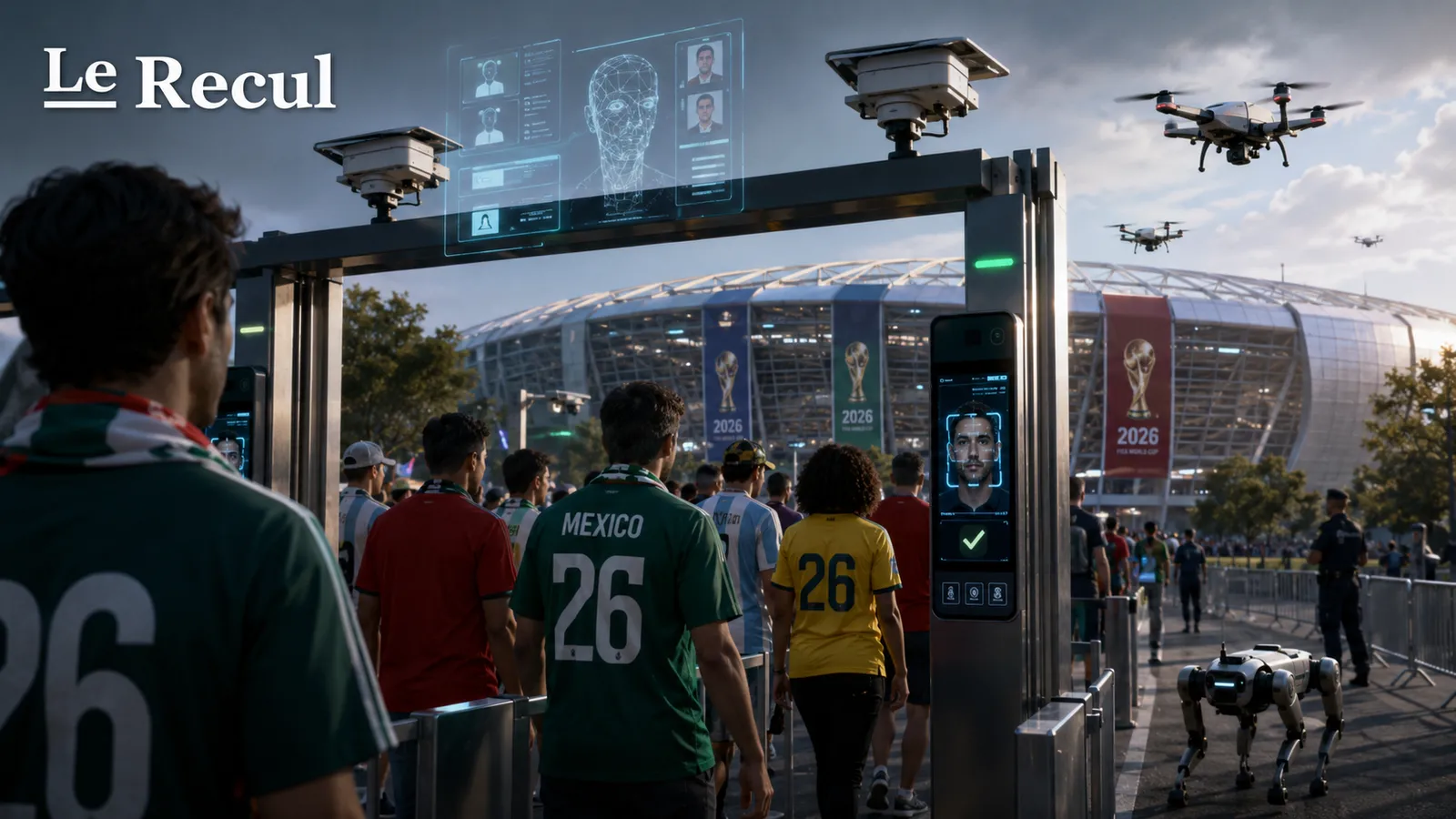
Biometric entry, drones, cameras and robot dogs: the 2026 World Cup promises smooth flow, but it also installs a new normality of surveillance.
Drones, anti-drones and robot dogs: security becomes a technology showcase
The 2026 World Cup will not only be a sporting tournament. It will be an enormous security challenge: massive crowds, international travel, stadiums spread across three countries, public figures, political tensions, cyber threats, fraud risks, intrusion risks.
In that context, technology becomes pervasive: cameras, drones, anti-drone systems, facial recognition, crowd analysis, sensors, coordination platforms, cybersecurity tools.
In Mexico, around the BBVA stadium in Guadalupe, K9-X robot dogs are due to take part in the security setup. WIRED reports that four units were unveiled by local authorities. They are not armed. They carry cameras, night vision and communication systems. Their role: patrol, detect suspicious situations, enter risk areas, act as a first response ahead of the security forces.
The authorities present this as protection. And in some cases the argument holds: sending a machine into a dangerous area can avoid exposing a human. But the image is striking: a World Cup with connected balls, 3D avatars, cameras everywhere, drones, anti-drone systems and robot dogs around the stadiums.
Football remains a game. The environment around it is starting to look like an augmented security infrastructure.
The NGOs’ warning
The surveillance angle does not come only from the technology. It also comes from the political context.
Reuters reports that human rights organisations, including the ACLU, published a travel advisory ahead of the World Cup in the United States. They raise risks of racial profiling, device searches, social media monitoring, arbitrary detention or mistreatment for certain travellers.
This is not a direct accusation against FIFA. But it is a signal. A global event draws crowds, checks, security forces, data, borders, platforms, states. AI slots into that environment. It can help. It can also amplify biases.
Facial recognition, for example, has often been criticised for making more frequent errors on women and on people of colour. At an international event, with supporters from all over the world, that point is not theoretical. A recognition error in an advert is awkward. A recognition error at a border, in a stadium or at a security check can become serious.
The real risk: happy surveillance
The danger is not necessarily a brutal dystopia. The danger is subtler.
Everything will be presented as convenient: faster to get in, safer for families, clearer for refereeing, smoother to watch, more personalised for fans, more efficient for teams, more profitable for organisers. And every promise will be partly true.
That is what makes the subject difficult. The 2026 World Cup will not be a technological nightmare. It will probably be spectacular, smooth, optimised, fascinating.
But it will also show how a society accepts sensors everywhere when they are wrapped in entertainment. The trap is not that AI is frightening. The trap is that it is pleasant.
The scams are going AI too
The 2026 World Cup will not only be used by FIFA, the broadcasters, the teams and the security forces. It will also be used by fraudsters.
TechRadar reports that Group-IB identified more than 4,300 fraudulent domains imitating FIFA’s official presence, some of them dormant since 2025. A campaign called “Ghost Stadium” reproduces login pages with high visual fidelity, uses fake Facebook adverts, exploits the urgency around tickets, and pushes victims into entering their credentials or payment details.
The financial risk is enormous. Losses tied to premium ticket fraud are estimated at between 71 and 474 million dollars.
And AI makes everything more believable: the emails are better written, the fake sites cleaner, the visuals more realistic, the messages better translated. Fake customer support can reply automatically. Deepfakes can imitate public figures, influencers, players, media or supposed official representatives.
We have already seen what happens when that capability is pointed at a real, identifiable person: the xAI case over sexualised images generated with Grok shows how fast an image can be manufactured, and how slowly the recourse arrives.
So the World Cup will be a showcase for official AI. But also a party for criminal AI.
What this really changes for supporters
For a supporter, the effects will be very concrete. They will see faster refereeing decisions, 3D replays that are easier to understand, more personalised content, entries that are perhaps smoother, faster payments.
But they will also have to be more wary: fake tickets, fake sites, fake emails, fake accounts, fake promotions, fake customer services, reinforced checks, biometric devices, different rules depending on the country, the stadium, the supplier and the service used.
The 2026 supporter no longer only has to know their team. They also have to understand the digital environment they are walking into.
What this changes for players
For players, the effect runs deeper still. Every movement can be recorded. Every acceleration can be compared. Every position can be modelled. Every action can feed a database.
That is useful for refereeing, performance, health, analysis, injury prevention. But it is also permanent capture.
Players no longer produce only a show. They produce high-value data. And that data interests a lot of people: clubs, federations, broadcasters, sponsors, video game publishers, betting platforms, AI providers, insurers, recruiters, analysts, media.
Professional football has always exploited players’ bodies. AI now makes it possible to exploit their performances and digital twins as well.
What this changes for referees
For referees, AI is both a support and a pressure. A support, because it can reduce obvious errors. A pressure, because it creates the expectation of a perfect decision.
But a perfect decision does not always exist. Even with 500 measurements per second. Even with high-frequency cameras. Even with 3D avatars. Even with VAR.
The referee remains responsible for a human decision in an increasingly technical environment. They will have to trust systems they do not fully control, explain decisions generated by a chain of sensors, and absorb the anger when the technology “did not fix everything”.
The danger is believing that AI will remove responsibility. It moves it.
What this changes for football
Football has always been a sport of uncertainty: a ball that bounces badly, a referee who sees or does not see, a defender who slips, an attacker who sets off a fraction too early, a stadium that pushes, a coach who senses the moment.
AI does not erase that uncertainty. But it tries to frame it. It wants to measure the exact instant, calculate the exact position, objectify the contact, predict fatigue, recommend the substitution, reduce the human margin.
That may be good for sporting justice. But it also changes how the game feels. The more football becomes measured, the more it becomes contestable by data. The more it becomes assisted, the more human decisions look suspect when they contradict the figures. The more it becomes optimised, the more it risks losing what made it strong: the unexpected, instinct, the decision taken in the tension of the moment.
Football needs truth. But it also lives on chaos. The 2026 World Cup will test that limit: how much precision can you add before the game stops quite looking like a game?
Le Recul
The 2026 World Cup will be sold as the smartest World Cup in history. That is probably true. But “smart” does not mean neutral.
Every sensor has a function. Every function produces data. Every piece of data can serve something else. The connected ball helps refereeing. The 3D avatars help decisions and broadcasting. Football AI Pro helps the teams. The cameras help referees and media. Facial recognition helps entry and security. Anti-drone systems help protection. Personalisation algorithms help the fan experience. Cybersecurity tools help detect scams.
But taken together, they form something else: a World Cup where almost everything becomes measurable. The game. The bodies. The crowds. The flows. The faces. The preferences. The risks. The purchases. And even the human choices.
FIFA promises a more precise World Cup. Le Recul also sees the prototype of a sport sliding towards a logic of control: less instinct, more measurement; less chaos, more calculation; less naturalness, more optimisation.
What to take away
The 2026 World Cup will run from 11 June to 19 July, in the United States, Canada and Mexico. It will bring together 48 teams, 104 matches and 16 stadiums. Most of the tournament takes place in the United States, in a country where the Trump administration is strongly pushing AI as an economic, strategic and security tool.
The Adidas Trionda ball carries a 500 Hz motion sensor to assist the VAR. Semi-automated offside will speed up some decisions, but the human keeps the final call. Players will be tracked and modelled in 3D to improve video refereeing and replays. Football AI Pro is meant to give all 48 national teams a tactical and data analysis assistant.
Broadcasting will be more personalised, faster and more algorithmic. Facial recognition will be present in some stadiums or local setups, often presented as optional. Drones, anti-drone systems, cameras and robot dogs illustrate an increasingly technological approach to security.
AI-boosted scams are already exploding, with more than 4,300 fake FIFA domains identified and potential losses estimated at between 71 and 474 million dollars for some ticket frauds.
The real subject is not “AI referees football”. The real subject is: AI measures, steers, secures, personalises and monetises the World Cup.
The figure to remember
500 Hz.
That is the frequency of the sensor inside the Trionda ball. At that level, even the ball is no longer merely played. It becomes a data source.
But the most important reminder lies elsewhere: the best-tracked data of this World Cup may not be the ball’s — it may be yours.
The line to remember
AI is not going to win the 2026 World Cup.
But it is going to measure it, film it, secure it, steer it and monetise it like never before.