

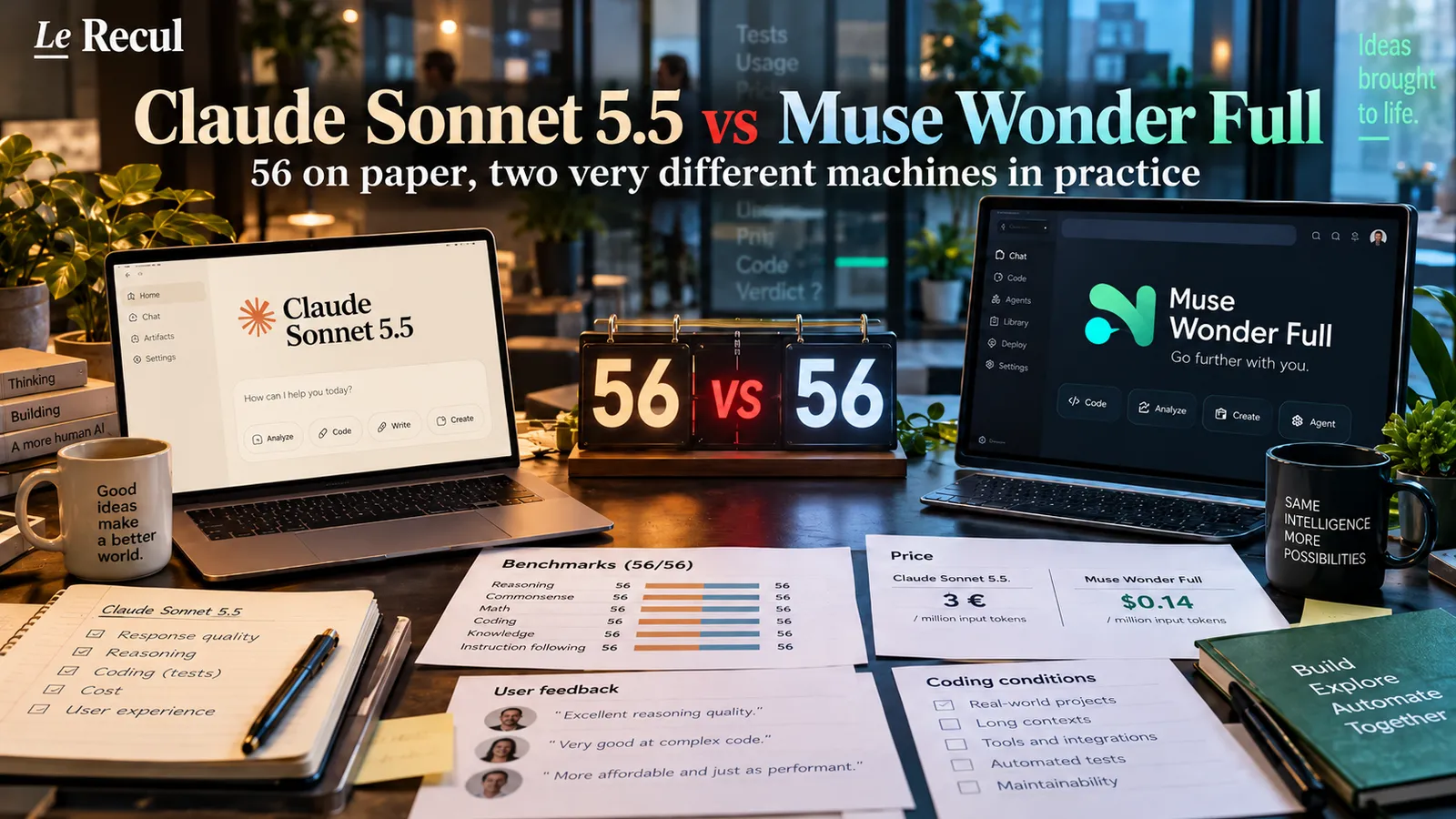
Claude Sonnet 5.5, released on 28 September 2026, is Anthropic’s mid-tier model: cheaper than Opus 5.5, and presented by Anthropic as strongest at well-scoped everyday tasks. Muse Wonder Full, released on 12 October, is Meta’s most powerful model, the one with which Mark Zuckerberg says Meta has joined the leading pack. On the independent Artificial Analysis ranking, they get the same score: 56.
That tie is real. It is also misleading, because it measures both models in conditions you will not necessarily meet. Here is what separates them once you look at price, speed, default settings and what the people using them say.
The verdict in brief
- Raw intelligence: a perfect tie. 56 points each, five tests won each out of ten. Nobody can say today that one is smarter than the other.
- Coding: same score, not the same stopwatch. Each in its own tool, they score 68.4 and 68.0. But Muse Wonder Full finishes a task in 29 minutes on average, Sonnet 5.5 in 87.
- Access: a clear advantage to Sonnet 5.5. Sonnet is available from the free plan in the apps, Claude Code from $20 a month, and Sonnet 5.5 through the API. Muse Wonder Full is subscription-only, from $50, with no API at all.
- Your data: advantage to Sonnet 5.5. Anthropic asks for your choice at signup. Meta sets its subscriptions by default to a mode in which it can train its models on your code.
- Maturity: advantage to Sonnet 5.5. Seventeen days of use, hundreds of reports, known weaknesses. Muse Wonder Full has three days, and the tool that carries it has drawn problems reported by subscribers, plus abnormal quota consumption, fixed on 13 October.
- Our advice: Sonnet 5.5 for most people. Muse Wonder Full is worth a try if you code a lot, if end-to-end speed matters above everything, and if your code is under no confidentiality obligation.
Where the figures in this comparison come from
This comparison is not a test carried out by Le Recul. We did not run the two models ourselves, and nothing here is presented as a measurement we took. Saying so is not a stylistic precaution: a comparison that claimed to have tested what it read elsewhere would be worthless the day you found out.
What we did was set three kinds of sources against each other, and cite each one.
- The independent measurements of Artificial Analysis, the organisation that evaluates models with its own tests: its overall index and its coding agent index, read on 15 October 2026.
- The trials published by Kingy.ai, a site that paid for a Muse Code subscription and put Muse Wonder Full to work on real small projects from 12 October, and that tested Sonnet 5.5 through the API.
- Nearly a thousand user comments on the two Hacker News launch threads: 380 for Muse Wonder, 613 for Sonnet 5.5. We kept only concrete first-hand reports, and each one is attributed to its author’s public username, with its date.
One asymmetry weighs on everything that follows, and it is worth keeping in mind. Sonnet 5.5 has seventeen days of public use, Muse Wonder Full has three. And since Muse Wonder Full is not sold through the API, most users who published a trial “of Muse Wonder” actually tested its smaller sibling, Muse Wonder, several of them openly regretting it. We flag each time which model is involved. No public trial yet sets Sonnet 5.5 and Muse Wonder Full directly against each other.
The two contenders, side by side
| Feature | Claude Sonnet 5.5 | Muse Wonder Full |
|---|---|---|
| Maker | Anthropic | Meta |
| Released | 28 September 2026 | 12 October 2026 |
| Place in the range | Mid-tier, below Opus 5.5 | Meta's most powerful |
| Artificial Analysis index | 56 | 56 |
| Context | One million tokens | One million tokens |
| What it takes in | Text and images | Text, images, audio and video |
| Per-token price (API) | $2 input, $10 output | None: no API |
| Cheapest access | Free in the apps; Claude Code from $20 a month | Muse Code Power Usage, $50 a month |
| Coding tool | Claude Code | Muse Code |
| Training on your data | Choice requested at signup | On by default in the subscription |
| Downloadable weights | No | No |
Sources: Anthropic, Meta, Artificial Analysis.
One row deserves emphasis: Muse Wonder Full understands audio and video, Sonnet 5.5 only text and images. If you want a recording or a video analysed, the question answers itself.
Intelligence: ten tests, five wins each
Artificial Analysis publishes a direct comparison of the two models, test by test, both set to maximum reasoning effort.
| Test | Claude Sonnet 5.5 | Muse Wonder Full | Leader |
|---|---|---|---|
| AA-Briefcase (case-file office work, Elo) | 1,819 | 1,729 | Sonnet 5.5 |
| GDPval-AA (real tasks from 44 occupations, Elo) | 1,838 | 1,857 | Muse Wonder Full |
| AutomationBench-AA (business workflows) | 72% | 71% | Sonnet 5.5 |
| Terminal-Bench 4.0 (coding in a terminal) | 64% | 57% | Sonnet 5.5 |
| SciCode (scientific coding) | 61% | 63% | Muse Wonder Full |
| Humanity's Last Exam (reasoning) | 55% | 54% | Sonnet 5.5 |
| GDP.pdf (work on PDF documents) | 26% | 33% | Muse Wonder Full |
| CritPt (physics) | 31% | 33% | Muse Wonder Full |
| AA-Omniscience (knowledge, penalises errors) | 32 | 30 | Sonnet 5.5 |
| AA-LCR (reasoning over long documents) | 83% | 84% | Muse Wonder Full |
| Overall index | 56 | 56 | Tie |
Source: Artificial Analysis, comparison read on 15 October 2026.
Five wins each, most of them by one or two points. Only three gaps are clear: Sonnet 5.5 on terminal coding (+7 points) and case-file office work (+90 Elo), Muse Wonder Full on work with PDF documents (+7 points). If your job involves having an AI extract and reason over PDFs, Meta’s lead there is the widest in the table.
The default-setting trap. Those 56 points are reached at maximum effort, meaning the model is left to think for as long as it wants. Yet Anthropic says so in its announcement: in Claude Code and its apps, Sonnet 5.5 defaults to medium effort. At that level, the same ranking gives it 41 points, 47 at high effort, 52 at extra-high. In other words, the Sonnet 5.5 that ties with Muse Wonder Full is not the one you are using if you leave the settings alone. For Muse Code, we could not find the default effort in Meta’s public documentation, so the same correction cannot be made on its side.
In coding, each in its own tool: same score, not the same stopwatch
The Artificial Analysis coding agent index is the measurement closest to real use: each model works there in its maker’s tool, Claude Code for Anthropic, Muse Code for Meta, on three sets of development tasks, each attempted three times.
| Measure | Claude Code + Sonnet 5.5 | Muse Code + Muse Wonder Full |
|---|---|---|
| Coding agent index | 68.4 | 68.0 |
| DeepSWE (fixing real code repositories) | 72.0% | 77.0% |
| SWE-Atlas-QnA (technical questions about code) | 66.9% | 68.0% |
| Terminal-Bench 4.0 (work in a terminal) | 66.2% | 59.1% |
| Average time per task | 87 minutes | 29 minutes |
| Tokens used per task | 27.7 million | 15.0 million |
| Cost per task at API prices | $14.19 | Cannot be calculated (no API) |
| Attempts switched to another model by safeguards | 45 of 909 | 0 of 906 |
Source: Artificial Analysis, coding agent index, read on 15 October 2026; both models at maximum effort.
Three findings. The score is identical to within 0.4 points, with opposite strengths: Muse Wonder Full is better at fixing real code repositories, Sonnet 5.5 better at working in a terminal. Muse Wonder Full is three times faster, 29 minutes per task against 87, while using half as many tokens. Of the eight configurations shown by default on this leaderboard, Claude Code with Sonnet 5.5 is both the slowest and the most expensive at API prices.
And 5% of Sonnet 5.5’s attempts were switched to another model, 45 of 909, against none for Muse Wonder Full. That is the result of a choice Anthropic spells out in its announcement: because Sonnet 5.5 is much stronger at cybersecurity than its predecessor, tasks judged risky “will visibly fall back to Sonnet 5”. Routine bug fixing is not affected, Anthropic says. But on a coding benchmark, one attempt in twenty was handled by the previous model.
The bill: a per-token price against a flat subscription
The two makers are not selling the same thing, and that is the real difference for your budget.
| Plan | Price per month | What you get |
|---|---|---|
| Claude Free | $0 | Sonnet in the apps, no Claude Code |
| Claude Pro | $20 ($17 billed annually) | Sonnet 5.5 in Claude Code, at least five times Free's usage |
| Claude Max | From $100 | Five or twenty times Pro's usage |
| Muse Code Everyday Usage | $5 | Muse Wonder, not Muse Wonder Full |
| Muse Code High Usage | $15 | Muse Wonder, five times Everyday's usage |
| Muse Code Power Usage | $50 | Muse Wonder Full, twenty times Everyday's usage |
| Muse Code Maximum Usage | $200 | Muse Wonder Full, eighty times Everyday's usage |
Sources: Anthropic and Meta pricing pages, read on 15 October 2026.
The entry ticket is therefore $20 to code with Sonnet 5.5, against $50 to code with Muse Wonder Full. Neither maker publishes a numerical quota: Anthropic writes that there is no fixed number of messages, and Meta expresses its plans as multiples of the smallest one. Comparing what $20 buys from one and $50 from the other is therefore impossible with the public documents.
On the API, Sonnet 5.5 costs $2 per million input tokens and $10 for output. But it is hungry: at maximum effort, Artificial Analysis measures 197,000 output tokens per task, against 54,000 for Muse Wonder Full, more than three and a half times as many. That explains its $5.46 per task on the overall index, and $14.19 per coding task. Muse Wonder Full, having no per-token price, simply cannot enter that calculation.
One observation from Kingy.ai completes the picture on Meta’s side: inside Muse Code, Muse Wonder Full uses two to three times as much of your plan as Muse Wonder for the same accepted work.
What the first users of Muse Wonder Full say
Three days is not much, and first-hand reports on the Full version are rare. Here are the ones that exist, with what they are worth.
The most solid trial comes from Kingy.ai, which paid for a subscription and put Muse Wonder Full to work on 12 October. On three small utilities (pagination, CSV invoice reconciliation, an SQLite task tracker), Muse Wonder and Muse Wonder Full both passed every check. But Full was slower every time, up to 9 minutes 51 seconds against 3 minutes 48 for Wonder. The site’s conclusion: “Full did not deliver an additional accepted project”. On a real Python repository, four jobs to complete unaided, Muse Code with Full got everything done in 26 minutes 39 seconds, against 8 minutes 53 for Claude Code with Opus 5.5. Careful: that is Opus, not Sonnet, and four jobs do not make a ranking, as Kingy.ai itself writes.
On Hacker News, on 12 October, the user ekojs, a subscriber to the $50 plan that gives access to Full, put it on real work: polishing a React interface, reviewing a Node backend, changes to a Rust server. Their impression: still “a step below” Opus 5.5, GPT-6 Astra and Fable 5.1, with the intelligence there but not yet the “taste” and “judgment”. They describe the model stuck in a fix loop, at the seventh iteration on a simple change. The comment does not say which of the two models was selected.
The tool itself caused trouble. The same day, the user wkcheng wrote that they paid for a month of Muse Code without ever getting its sandbox to work, on Mac or Linux, both standard installations. It is a single report, but it concerns the only way in to Muse Wonder Full.
Quotas melted, then were fixed. On 12 October, sergiotapia reported using 14% of their weekly quota on the $5 plan with three simple questions, and hugh4life 4% of their weekly quota with two small requests to Muse Wonder on the $15 plan. Neither was using Full, which is not in their plans. On 13 October at 00:31, Alexandr Wang, who leads AI at Meta, announced a fix for the problem causing this “unusually fast” consumption for both models, and reset the meters. Quota complaints from before 13 October therefore no longer describe the current situation.
What users of Claude Sonnet 5.5 say
Seventeen days of use give a sharper picture, with better-identified weaknesses.
Maximum effort can spin without result. On launch day, the developer Simon Willison (simonw) asked Sonnet 5.5 for the same drawing at every effort level. At extra-high effort, the answer came in 42 seconds for under 6 cents. At maximum effort, the model thought for 15 minutes 40 seconds, used up the 128,000-token limit, and returned nothing, for $1.28. He reports the same flaw with Opus 5.5.
The cyber safeguards get in some professionals’ way. On 28 September, rfgplk, who says they pay $200 a month and belong to Anthropic’s cyber verification programme, wrote that they cannot use Opus 5.5 or Sonnet 5.5 for authorised vulnerability work, their requests being flagged immediately. Conversely, dom96 notes that Sonnet 5.5 triggers those safeguards less than Opus on their own benchmark. If your job is security, this is the first point to check.
Its best use, according to regulars: volume work. Several users describe it as an efficient executor under Opus’s direction. jtrn, on 30 September, uses it to have code inspected by ten sub-agents looking for a specific pattern, without paying Opus prices. But adastra22, on 29 September, reports an experiment in which Opus came out at half the cost per task of Sonnet, because it uses fewer tokens.
An output format that sometimes fails through the API. In Kingy.ai’s trial of 96 programs to be delivered through a JSON interface, Sonnet 5.5 passed only 52, but 36 of its responses could not be scored through that interface: of the 60 programs the trial could score, 52 passed, or 87%. Muse Wonder, on the same trial, passed 85 of 96. Kingy.ai says so itself: those totals measure how usable the responses were more than coding ability.
Anthropic, for its part, publishes customer testimonials it has selected: Base44, whose promise we evaluated, says Sonnet 5.5 produced apps at Opus 5’s level in 3.6 iterations on average against 7.7, across 118 real builds; Unity, that it completed 90% of the tasks in its internal benchmark. These are testimonials chosen by the maker, and they should be read as such.
A working week with each, reconstructed from real reports
What follows is not a testimonial, and it is not our own trial. It is a reconstructed journey to show you, step by step, what to expect with each of the two models. Nothing in it is invented: every fact comes from a specific source, cited in the final table.
Day 1, signing up. With Claude, you pay $20 for the Pro plan, and Anthropic asks you at signup whether your conversations and coding sessions may be used to train its models. With Meta, you pay $50 to reach Muse Wonder Full, and you start in Contributor mode, the subscriptions’ default setting: if you work on confidential code, Meta’s terms forbid you to send it in that mode, and you first need to switch it off.
Day 1, installing. Claude Code existed well before Sonnet 5.5, which joins it as one more model. Muse Code is a younger tool. One subscriber says they never managed to get its sandbox running; another, that they could not pay because of an error message.
Days 2 and 3, everyday work. In Claude Code, Sonnet 5.5 runs at medium effort unless you change the setting: fast, but well below its best level. If you push it to maximum effort, it can think for a quarter of an hour without returning an answer. In Muse Code, Muse Wonder Full is slower than Muse Wonder on small jobs, and uses two to three times as much of your plan for the same result.
Day 4, a long task. This is Muse Wonder Full’s ground. On the Artificial Analysis coding tasks, it finishes in 29 minutes on average, where Sonnet 5.5 takes 87, for an equivalent result. If your task touches on security, Sonnet 5.5 may hand over to its predecessor.
End of the week, the balance. For $20, you will have had a well-run-in tool, a very good but hungry model, and an explicit choice about your data. For $50, a faster model on long tasks, a younger tool, and a data setting you have to correct yourself.
| Step | Claude Sonnet 5.5 | Muse Wonder Full | Where the fact comes from |
|---|---|---|---|
| Entry price for coding | $20 a month | $50 a month | Anthropic and Meta pricing pages |
| Training on your data | Choice requested at signup | On by default | Anthropic's terms; Muse Code documentation |
| Confidential code | No prohibition found | Forbidden in Contributor mode | Meta Model API terms, section 6.2 |
| Installation | Tool predates the model | Sandbox broken for one subscriber | Anthropic; wkcheng, Hacker News, 12 October 2026 |
| Default setting | Medium effort (41 on the index) | Not found in the documentation | Anthropic; Artificial Analysis |
| Observed slowness | At maximum effort, 15 min with no answer | Slower than Wonder on small jobs | simonw, 28 September; Kingy.ai, 12 October |
| Long coding task | 87 minutes | 29 minutes | Artificial Analysis, coding agent index |
| Security task | Possible fallback to Sonnet 5 | No fallback measured | Anthropic; Artificial Analysis |
| Quotas | No numerical quota published | Abnormal drain fixed on 13 October | Anthropic; Alexandr Wang, 13 October |
Your data: one principle, two opposite defaults
It would be wrong to set a virtuous maker against another. Both train their models on their consumer subscribers’ coding sessions when the setting is on, and neither does so for standard API use. Anthropic says so for its Free, Pro and Max plans, “including when they use Claude Code”. Meta says so for Muse Code subscriptions.
The difference lies in the starting point. Anthropic asks every new user to choose at signup, and keeps their data for five years if they agree, thirty days otherwise. Meta sets its subscriptions to Contributor mode by default, in which it may train its future models on your prompts, your code, your files and the responses you receive. The setting can be switched off at any time, but only going forward, and switching it off gets you less usage for the same price. Meta’s terms also forbid sending in that mode any code you are required to keep confidential, “including by contract”.
For a freelancer or an employee working on a client’s or an employer’s code, this point matters more than any gap in scores.
What our own ranking says
Our AI ranking, and in particular its coding agents category, already includes both models. But not on equal evidence: Claude Sonnet 5.5 is measured there by three independent sources, Muse Wonder Full by just one, and on only part of the tests. It would be dishonest to derive a rank from that. We will come back to this comparison when the coverage is comparable.
The automatic reading shown below this article illustrates the point. It sets the best-ranked Sonnet 5.5 variant in our ranking, “Xhigh”, 11th overall, against Muse Wonder Full, 406th, and gives Sonnet the edge on three uses: general-purpose, conversation and cost/performance. That does not contradict the tie measured by Artificial Analysis, because the two figures do not come from the same source. This Sonnet 5.5 variant is measured only by LMArena, where users vote blind for the answer they prefer; Muse Wonder Full, which has no API, is measured only by Artificial Analysis. The reading therefore compares user preference with a test index. It will update itself as the measurements come in.
To place these two models among their elders, our comparison Opus 5.5 vs GPT-6 Sol for coding remains the reference at the high end, and our comparison Muse Glimmer vs free ChatGPT shows Meta’s other face: a small open model that runs on your own computer.
Which one to choose for your situation
- You are new to AI for coding, or your budget is tight: Claude Sonnet 5.5. Free in the apps, Claude Code from $20, a well-run-in tool.
- You are building a model into your own product: Claude Sonnet 5.5, without hesitation. Muse Wonder Full has no API.
- You work on confidential code: Claude Sonnet 5.5, or Muse Wonder Full only after switching off Contributor mode, knowing you will then get less usage for the same price.
- You run long autonomous coding tasks and speed matters: Muse Wonder Full is worth a try. It is its clearest measured advantage: three times faster on the Artificial Analysis tasks.
- You need PDFs, audio or video analysed: Muse Wonder Full takes audio and video, and leads on work with PDF documents.
- You work in security: neither without checking. Sonnet 5.5 may fall back to its predecessor; Muse Wonder Full has only three days of track record.
- You already use Claude Pro or Max: nothing in this comparison justifies switching tools today. Do remember, though, to raise Sonnet 5.5’s effort for hard tasks, without going all the way to maximum.
The bottom line
On paper, Claude Sonnet 5.5 and Muse Wonder Full are indistinguishable: 56 points each, five tests won each. In practice, almost everything sets them apart. Sonnet 5.5 is the most accessible, the most run-in and the most respectful of your choice about your data, but it is hungry for tokens, far less capable at its default setting than at maximum effort, and sometimes held back by its safeguards. Muse Wonder Full is clearly faster on long tasks, but it costs at least $50, has no API, has three days of track record, and starts in a mode that lets Meta learn from your code.
What is still missing to settle it: a public trial that pits the two directly against each other, a measurement of their quality in French, and a few weeks of use of Muse Wonder Full. We will update this comparison as soon as those exist.