


Claude Fable 5: Anthropic unveils its next-generation Mythos model
Anthropic has just crossed an important line.
With Claude Fable 5, the company is not only shipping a new, more powerful model. It is opening to the public a guarded version of its Mythos family, until now reserved for hand-picked partners.
On paper, Fable 5 is the most capable Claude ever made widely available: better at code, at reasoning, at document analysis, at vision and at long tasks.
But it arrives with a limitation the company owns up to: some capabilities are deliberately held back.
Anthropic is giving more power.
But not all the power.
What has just shipped
Claude Fable 5 is presented as a Mythos-class model — a tier above the standard Claude models.
Until now the range was fairly simple:
- Haiku: fast and cheap;
- Sonnet: a good cost / performance balance;
- Opus: the premium model for complex tasks;
- Fable 5: a new step above, more powerful but more controlled.
Fable 5 is meant for heavy work: software development, analysis of large case files, complex reasoning, vision, automation, AI agents, long synthesis and high-value professional tasks.
It is the model to reach for when a mistake is expensive.
Not for rewording three lines.
The link with Mythos
The name “Mythos” is not cosmetic.
On 7 April 2026, Anthropic launched Project Glasswing, an initiative giving selected partners access to Claude Mythos Preview, notably in cybersecurity and critical infrastructure.
Among the announced partners: AWS, Apple, Google, Microsoft, NVIDIA, Cisco, CrowdStrike, JPMorganChase, the Linux Foundation and Palo Alto Networks.
The stated goal: use Anthropic’s most advanced models to help defenders find and fix vulnerabilities before attackers do — a capability that, a month later, took Anthropic in front of the Financial Stability Board when regulators worked out that the same model could find the flaws in banks.
Anthropic also announced up to $100 million in usage credits and $4 million in donations to open-source security organisations.
Fable 5 follows the same logic, in a version aimed at a wider audience.
Same family.
Less freedom.
More guardrails.
Why Anthropic holds it back
Anthropic explains that Fable 5’s capabilities go well beyond those of the models it had made generally available until now.
The problem is that those capabilities can become dangerous in certain domains.
The blocks target mainly:
- offensive cybersecurity;
- exploits;
- malware;
- attack tooling;
- certain requests in biology and the life sciences;
- laboratory methods;
- molecular mechanisms;
- extracting the model’s summarised reasoning.
The important point: these filters do not only look at your last message.
They can also analyse what the model reads: files, connectors, memory, web search, or context loaded into the conversation.
So a block can come from a document or a file, even when your request looks perfectly ordinary.
The switch to Opus 4.8
When a request is blocked on Fable 5, Claude can switch automatically to Claude Opus 4.8.
The message is then replayed with Opus, inside the same conversation.
That means two things.
First: Fable 5 is not always the one answering, even when you selected it.
Second: if Claude switches to Opus, the selector then stays on Opus until you manually go back to Fable 5.
That detail matters for users of Claude Code, Claude Desktop, Claude Cowork or Claude on the web — and it matters even more when the model is driving an agent on your own machine rather than answering in a chat window, as we saw when we put Codex and Cowork to work on the same Windows PC.
You think you are working with Fable 5.
But in certain sensitive areas, Anthropic takes the wheel back.
Price and consumption
On the API side, Fable 5 is far more expensive than the standard Claude models.
The reported rate is:
- $10 per million input tokens;
- $50 per million output tokens.
That is roughly twice the usual Opus rate.
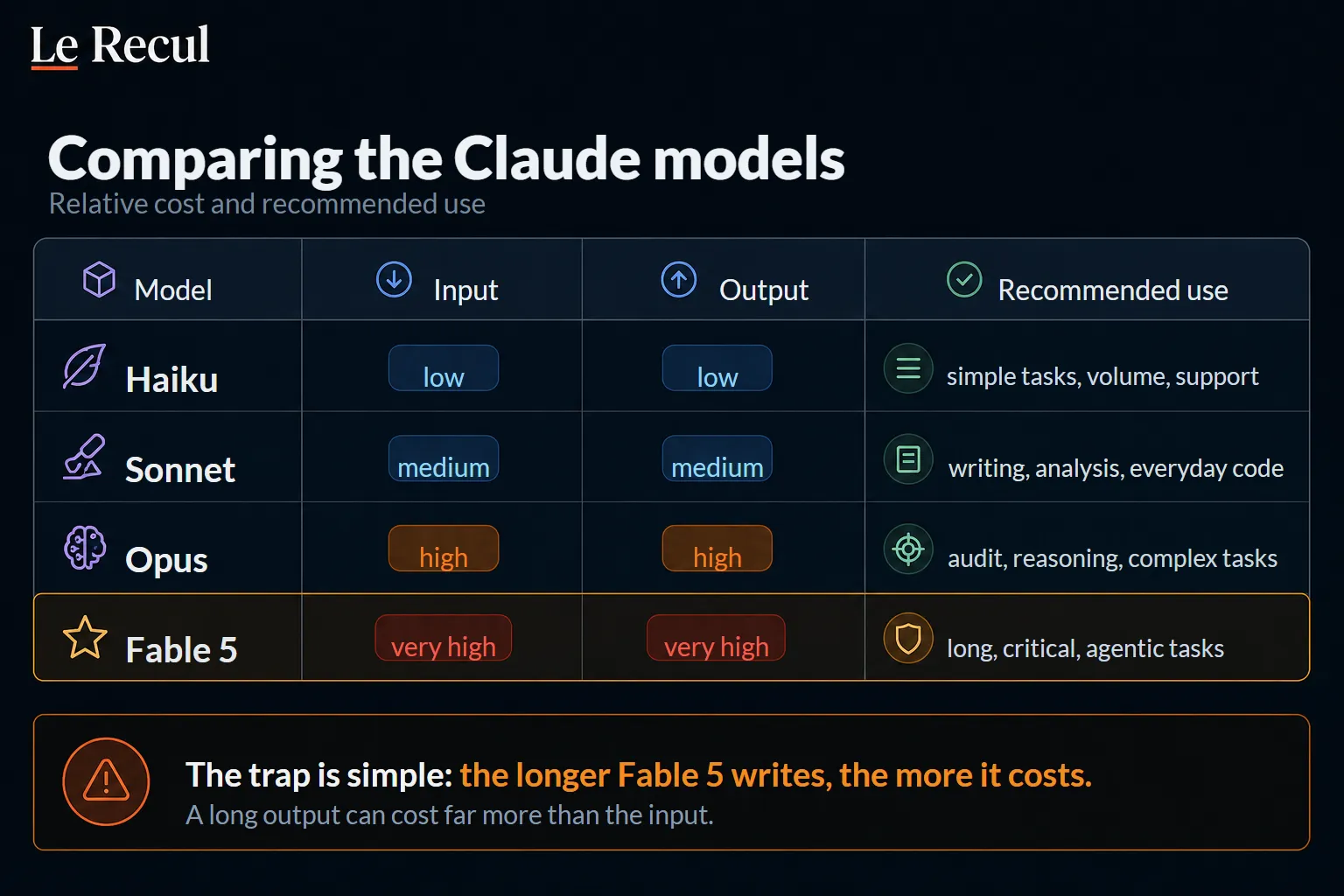
So for API or SaaS use, Fable 5 should be kept for tasks where its higher tier genuinely changes the result.
And for Claude subscriptions?
On Claude Pro, Max, Team or Enterprise, users do not always see a per-token bill.
But the logic is the same: Fable 5 eats more resources.
Business Insider reports that Fable 5 is available immediately to paying subscribers, but that it has to go through usage credits from 23 June 2026, unless extended depending on available capacity.
Put plainly: Fable 5 is a premium model.
It should not be treated as a slightly better Sonnet.
To write a simple post, Sonnet is often enough.
To analyse a large file, Opus can already do the job.
For a complex audit, sensitive code, a heavy architecture or a long-running agent, Fable 5 becomes interesting.
Fable 5 against Opus and Sonnet
The real question is not “is Fable 5 better?”
Yes, probably.
The real question is “is it worth its cost?”
For many tasks, Sonnet remains the best choice: writing, SEO, synthesis, posts, rewording, standard analysis.
For serious projects, Opus is still very solid: code, strategy, architecture, audit, regression checks.
Fable 5 becomes relevant when the context is massive, when the task runs long, when a mistake is expensive, or when deeper reasoning is needed.
It is not a model to use everywhere.
It is a model to bring out when the others start hitting their limits.
That trade-off is exactly the one we measured in detail when we set Fable 5 against Kimi K3, the biggest open model ever published — the most expensive model on the market against the one you can download.
The real signal
The launch of Fable 5 says something broader about AI in 2026.
The best models are getting more powerful, but also more expensive, more monitored and more segmented.
Anthropic is not simply handing users “more intelligence”.
It is handing over a guarded version of an intelligence it judges too sensitive to open completely.
That may well be responsible.
But it is also a change in the market — the mirror image of the movement on the other side, where a 30-billion-parameter model under a free licence now runs on a personal computer. The top of the range is closing while the bottom opens.
Tomorrow, the question will no longer only be:
“Which model is best?”
It will be:
“Which tier of model are you allowed to use, at what price, with which limits?”