

The promise is everywhere.
An AI finds your prospects.
It enriches their data.
It writes the messages.
It personalises the follow-ups.
It contacts the right people.
It syncs the CRM.
It fills your calendar.
And you, in theory, would only have to answer the warm prospects.
That is the version being sold.
Reality is colder: AI can speed up prospecting that is already well built, but it does not automatically turn a list of cold contacts into real qualified leads.
And that is the whole difference between a machine that sends messages and a machine that generates business.
Test summary
Promise analysed: an AI can automate sales prospecting and generate qualified leads with little human involvement.
Simulated duration: 30 days.
Base studied: realistic scenario over 1,000 targeted prospects.
Estimated budget: €100 to €300/month for a simple setup; €300 to €800/month for an advanced setup, excluding human time.
Le Recul verdict: partly true, but heavily oversold.
What AI does well: search faster, enrich lists, write variants, automate follow-ups and structure tracking.
What it does not guarantee: replies, meetings, qualified leads, sales, compliance and deliverability.
So the number to remember is not how many messages were sent.
It is this one:
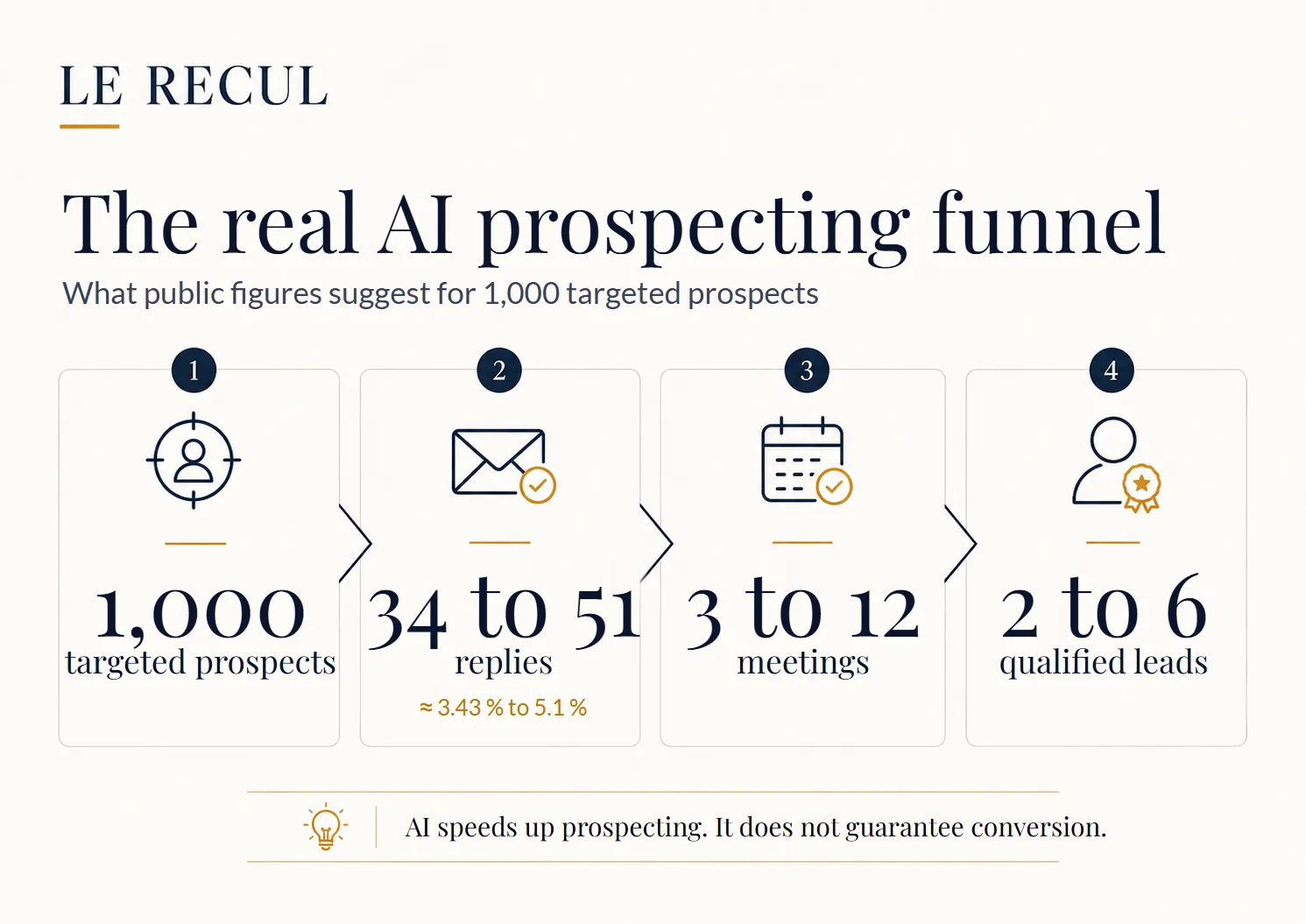
out of 1,000 prospects contacted, public benchmarks often suggest a few dozen replies, a handful of meetings, and only a small number of genuinely qualified leads.
What we checked
To assess this promise, you have to look at something other than the slogans.
We cross-checked:
- several vendors’ promises;
- the public figures displayed by the platforms;
- tool prices;
- cold email benchmarks;
- deliverability constraints;
- the compliance rules;
- the possible gains compared with manual prospecting;
- and a realistic funnel: contact → reply → meeting → qualified lead.
The point is not whether AI can write an email.
It can.
The real question is harder:
how many genuinely qualified prospects are left at the end?
The problem starts with the word “lead”
The market uses the word “lead” very loosely.
Sometimes a contact that has merely been found becomes a “lead”.
Sometimes an enriched email address becomes a “lead”.
Sometimes an automatic reply is counted as a commercial interaction.
That is misleading.
| What gets counted | Real lead? | Le Recul reading |
|---|---|---|
| A company found | No | It is only a potential account. |
| An email address found | No | It is a contact, not an intention. |
| A targeted LinkedIn profile | No | It may be out of scope or out of budget. |
| An email open | No | An open proves neither interest nor buying intent. |
| An automatic reply | No | No commercial interest whatsoever. |
| A "not interested" | No | It is a reply, but a negative one. |
| A curious reply | Maybe | To be qualified: curiosity is not need. |
| A meeting | Not always | A meeting can be off-target or with no buying intent. |
| A prospect with a need, in the target, and interested | Yes | That is where you can talk about a qualified lead. |
For Le Recul, a real lead must meet at least three criteria:
- the prospect matches the target;
- they have a plausible need linked to the offer;
- they accept a useful commercial conversation.
Without that definition, a tool can announce “50 leads” while mostly talking about contacts or enriched profiles.
The vendors analysed
The market is already full of tools. Some sell all-in-one AI agents. Others sell a specific building block: data, sequences, LinkedIn, CRM, enrichment or deliverability.
| Vendor | What it sells | Public figures | Le Recul reading |
|---|---|---|---|
| Limova / Elio | AI prospecting agent for LinkedIn. | Elio promises to find the right profiles, send personalised messages and generate opportunities. | Very relevant to the French-speaking market, but no public qualified-lead rate. |
| Limova / public reviews | User satisfaction. | Very high Trustpilot rating, with several hundred public reviews across the pages consulted. | A signal of adoption and satisfaction, not proof of commercial conversion. |
| Mission IA | Commercial AI agents. | Plans from €149/month; volumes announced by usage tier. | A quantified promise, but the definition of "lead" needs clarifying. |
| HubSpot Prospecting Agent | AI agent built into the CRM. | $1 per lead for which the agent recommends outreach. | More structured, but a recommended lead is not a signed customer. |
| Clay | Enrichment, data and sales workflows. | Launch plan listed at $185/month; variable costs depending on credits. | Very useful for industrialising data, not for guaranteeing sales. |
| Apollo | B2B database, sequences, enrichment. | More than 600,000 companies claimed as users. | A good sourcing tool, but a contact database does not guarantee a pipeline. |
| Instantly | Cold email, sequences, deliverability. | 2026 benchmark: 3.43 % average reply rate; best users above 10 %. | Very useful for setting realistic expectations. |
| Sopro | Cold outreach / prospecting. | 5.1 % average reply rate announced. | Confirms that cold prospecting remains a game of low percentages. |
| Wellsy | Automated AI prospecting. | Promises +23 % open rate and up to +60 % conversion. | Interesting vendor figures, but insufficient public methodology. |
Limova: a strong promise, incomplete commercial proof
Limova is probably one of the most visible French-speaking names on this subject.
Its agent Elio is presented as an AI sales agent able to prospect on LinkedIn: find the right profiles, send personalised messages, grow the network and generate opportunities without manual effort.
That is exactly the promise many small businesses want to hear.
The positive: the promise is clear.
The weakness: the public figures do not show the real conversion rate.
Public reviews show visible satisfaction around Limova. That is a signal of use and adoption. But it does not answer the main question:
Out of 100 prospects contacted by Elio, how many become real qualified leads?
Without that figure, you cannot conclude that the commercial promise is met.
Mission IA: announced volumes, but a vague definition
Mission IA lists plans from €149/month.
The site indicates, depending on usage, monthly volumes of around 300 messages, 150 requests or 50 leads.
That is interesting, because the figure is concrete.
But the decisive information is missing: what is a lead?
A contact?
A request?
A reply?
A meeting?
A qualified prospect?
A commercial opportunity?
“50 leads” can be very strong if these are real qualified prospects.
It becomes much less impressive if it only means contacts generated or unqualified interactions.
HubSpot: more structured, but not magic
HubSpot offers a prospecting agent built into its CRM.
The approach is more structured: the agent can research, analyse, recommend outreach and help produce messages. HubSpot states a cost of $1 per lead for which the agent recommends outreach.
That is more measurable than a plain “our AI finds your customers”.
But precision still matters: a recommended lead is not necessarily a meeting. And a meeting is not necessarily a qualified opportunity.
HubSpot is interesting for teams already organised around a CRM.
It is less relevant for someone looking for an autonomous customer machine.
Clay and Apollo: excellent for data, not a replacement for selling
Clay and Apollo are useful, but they do not play exactly the same role as Limova or Mission IA.
Apollo is mainly for finding accounts and contacts, enriching data and running sequences. The platform claims more than 600,000 companies as users.
Clay is for enriching, cross-referencing data sources, automating workflows and preparing a smarter commercial database. Its Launch plan starts at $185/month, but several market analyses point out that credits, enrichments and volume can push the real cost up.
These tools can be powerful.
But their real strength is upstream: data quality, segmentation, enrichment, signals.
They do not guarantee the prospect will reply.
They do not guarantee the offer is of interest.
They do not guarantee the conversation becomes a sale.
The real benchmark: reply rates stay low
Cold email benchmarks are far more sober than the marketing promises.
Instantly reports an average reply rate of 3.43 % in its 2026 benchmark. The best users exceed 10 %. The report also indicates that 58 % of replies come from the first email and 42 % from follow-ups.
Sopro gives another reference point: 5.1 % average reply rate.
| Source | Figure | What it means |
|---|---|---|
| Instantly 2026 | 3.43 % | About 34 replies per 1,000 emails. |
| Instantly top performers | 10 % and above | Possible, but reserved for the best campaigns. |
| Instantly | 58 % | Share of replies coming from the first email. |
| Instantly | 42 % | Share of replies coming from follow-ups. |
| Sopro | 5.1 % | Confirms a reality of a few per cent. |
These figures do not say AI is useless.
They say that even with specialised tools, cold prospecting stays hard.
Most messages get no reply at all.
And a reply is not yet a lead.
With or without an AI tool: what really changes
The real comparison is not “AI versus human”.
The real comparison is:
badly structured manual prospecting versus well structured AI-assisted prospecting.
Salesforce reports that salespeople spend a large share of their time on non-selling tasks: research, CRM notes, preparation, internal approvals and admin.
That is where AI can create a real gain.
It can cut the time spent searching, enriching, writing and following up.
But it does not remove the need to sell.
| Step | Without an AI tool | With an AI tool | Possible gain | Limit |
|---|---|---|---|---|
| Finding companies | Slow, manual. | Faster via Apollo, Clay, Limova, etc. | High | The target must be clear. |
| Finding contacts | Manual and slow. | Partly automated. | High | Data sometimes wrong. |
| Email verification | Often skipped. | Can be integrated with specialised tools. | Medium to high | Not 100 % reliable. |
| Writing emails | Manual. | Fast generation of variants. | High | Often generic in style. |
| Personalisation | Slow. | Scalable with signals. | Medium to high | Risk of fake personalisation. |
| Follow-ups | Often irregular. | Automated. | High | Risk of irritating people. |
| Qualification | Human. | Assistance possible. | Medium | Judgement stays human. |
| Closing | Human. | Hard to automate. | Low | Trust and a real sale. |
So yes, AI can improve the system.
But mainly at the top of the funnel.
The final conversion stays human.
A realistic comparison over 1,000 prospects
Here is a cautious simulation based on public benchmarks.
It does not claim to give a universal result. It is there to show the orders of magnitude.
| Scenario | Contacts | Replies | Meetings | Qualified leads | Reading |
|---|---|---|---|---|---|
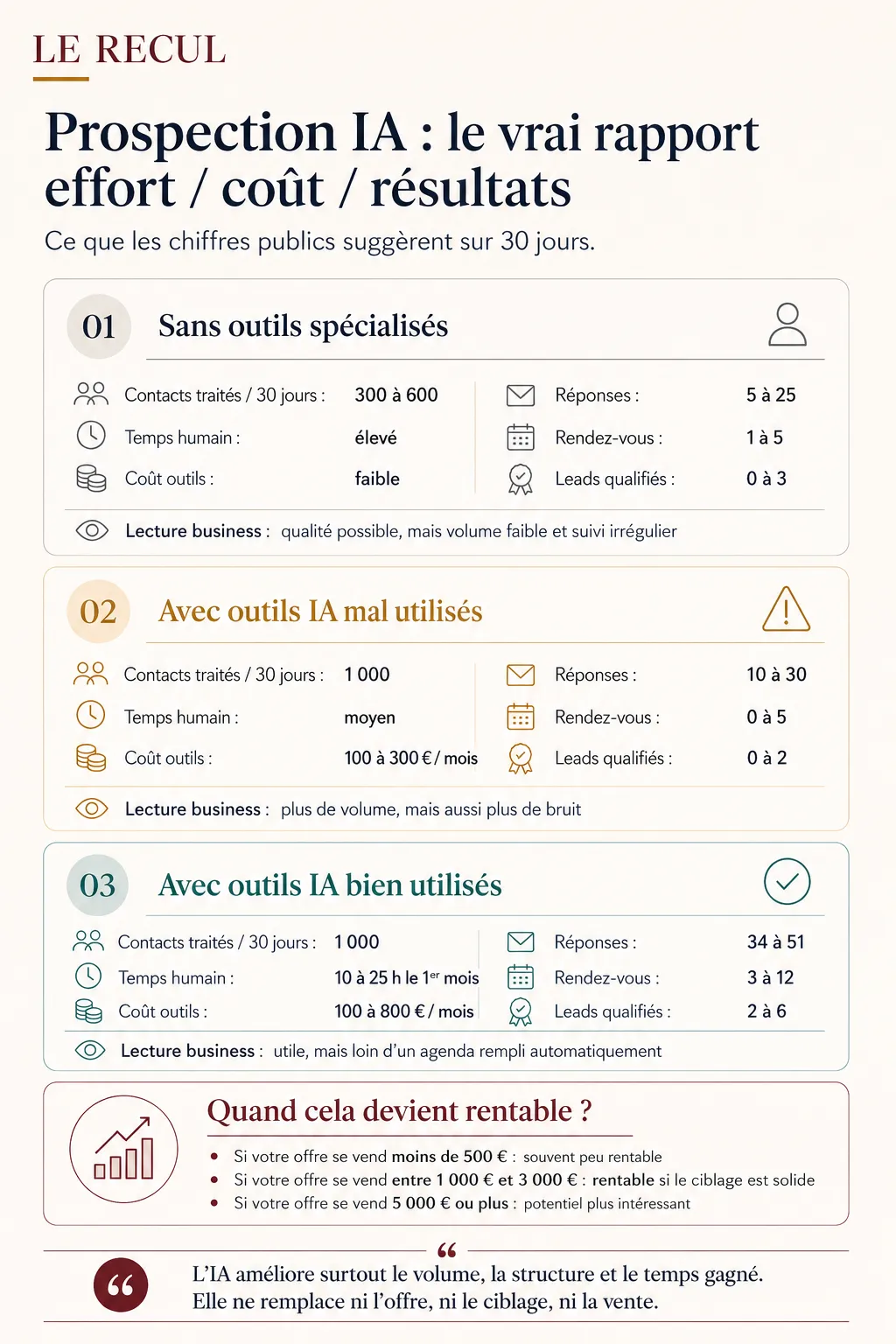
| Without specialised tools | 300 to 600 | 5 to 25 | 1 to 5 | 0 to 3 | Quality possible, but low volume and irregular follow-through. |
| AI badly used | 1,000 | 10 to 30 | 0 to 5 | 0 to 2 | More volume, but also more noise. |
| AI well used | 1,000 | 34 to 51 | 3 to 12 | 2 to 6 | Useful, but a long way from an automatically filled calendar. |
This scenario shows that AI prospecting can produce a useful result.
But not a magical one.
Out of 1,000 contacts, you are not necessarily looking at 100 potential customers. You are looking at a handful of real leads if everything is done properly.
Success rate by task
You have to separate technical functioning from commercial results.
Technically, the tools often work well.
Commercially, it is far more variable.
| Function | Realistic reliability | Why |
|---|---|---|
| Generating an email | 80–95 % | Easy for AI, but often generic. |
| Finding companies | 70–90 % | Fine if the target is clear. |
| Finding contacts | 60–85 % | Depends on the sector and the database. |
| Finding a valid email | 50–85 % | Highly variable by country and job title. |
| Verifying an email | 70–95 % | Reduces the risk, does not remove it. |
| Personalising a message | 50–80 % | Risk of false personalisation. |
| Sending a sequence | 90 %+ | Technically simple. |
| Getting a reply | 3–5 % on average | Based on public cold email benchmarks. |
| Getting a meeting | often 0.5–2 % | Depends heavily on the offer. |
| Getting a qualified lead | often 0.2–1 % | After genuinely sorting the replies. |
The finding is blunt:
the machine mainly works before the selling really starts.
It helps you approach.
It does not guarantee the conversion.
The real costs
The “automated” promise often hides an invoice.
| Item | Example | Indicative cost |
|---|---|---|
| French-speaking AI agent | Mission IA | from €149/month |
| LinkedIn agent | Limova / Elio | depends on the plan |
| CRM agent | HubSpot Prospecting Agent | $1 per recommended lead |
| Advanced enrichment | Clay Launch | from $185/month |
| B2B database | Apollo | free plan + paid plans / credits |
| Cold email sending | Instantly | plans by volume |
| Business email | Google Workspace or equivalent | a few € per month per mailbox |
| Email verification | Hunter, Prospeo, Dropcontact, etc. | often pay-per-credit |
| Human time | founder / salesperson | often 10 to 25 h in the first month |
A simple setup can start at around €100 to €300/month.
A more advanced setup with enrichment, sequences, CRM, several mailboxes and email verification can easily run €300 to €800/month, sometimes more.
But the real hidden cost is still human time.
AI saves time, but it does not remove the preparation.
Financial simulation
Small test
| Targeted contacts | 1,000 |
| Tool cost | €250/month |
| Human time | 15 h |
| Value of human time | €30/h |
| Human cost | €450 |
| Real total cost | €700 |
| Qualified leads obtained | 3 |
| Cost per qualified lead | €233 |
If the offer you sell is worth €5,000, that cost can be perfectly acceptable.
If the offer is worth €300, it is probably too expensive.
Advanced setup
| Targeted contacts | 3,000 |
| Tool cost | €700/month |
| Human time | 30 h |
| Value of human time | €30/h |
| Human cost | €900 |
| Real total cost | €1,600 |
| Qualified leads obtained | 10 |
| Cost per qualified lead | €160 |
That scenario can become interesting for a high-margin B2B offer.
But it does not work if the offer is too small, too vague or too undifferentiated.
Wrong target
| Targeted contacts | 1,000 |
| Real total cost | €700 |
| Reply rate | 1 % |
| Replies | 10 |
| Qualified leads | 0 to 1 |
| Cost per lead | €700, or impossible to calculate |
This is the case the sales pages almost never show.
And yet it is probably the most common among users who launch a campaign without precise targeting.
Deliverability: the wall that can break everything
An email that is not delivered cannot generate a lead.
Google now enforces strict rules: SPF or DKIM for all senders, SPF + DKIM + DMARC for bulk senders, one-click unsubscribe, and a spam rate that has to be kept low.
That changes everything.
The more you automate, the more the risk grows.
| Risk | Concrete effect |
|---|---|
| Invalid emails | Bounces and damaged reputation. |
| Too much volume too fast | Spam suspicion. |
| Generic messages | Complaints, unsubscribes, negative replies. |
| No DMARC | Weakened deliverability. |
| No clear unsubscribe | Legal and reputational risk. |
| Wrong sending domain | Burned domain. |
| Badly targeted list | Negative replies and low conversion. |
AI does not get around that wall.
It can even reach it faster.
Compliance: AI does not remove the regulator
This is the one section where the French edition of this article does not transfer unchanged, and it matters. Le Recul’s reference here is the French regulator, the CNIL, because that is where we checked. The rules depend on where your prospects are, and they differ sharply: prospecting into the European Union is not the same exercise as prospecting into the United Kingdom or the United States. Check your own regulator before assuming this section applies to you.
In France, commercial prospecting is regulated. The CNIL states that prospecting aimed at private individuals requires prior consent in principle. In B2B, prospecting can be possible under conditions — notably if it relates to the profession of the person contacted and if they can object simply.
| Case | General rule (France) |
|---|---|
| B2C | Prior consent. |
| B2B | Information + right to object. |
| Commercial email | Clear identification of the advertiser. |
| Unsubscribe | A simple way to object. |
| Enriched data | Purpose and proportionality must be respected. |
| AI automation | Reinforced oversight required. |
What does not change, wherever you are:
AI does not make a dubious list legal.
It does not turn a purchased database into clean prospecting.
It does not remove the right to object.
It does not exempt you from a clear unsubscribe.
And the more automated the sending, the faster a mistake propagates.
What is viable
| Use | Viability | Verdict |
|---|---|---|
| Enriching a B2B list | High | Very useful. |
| Generating email variants | High | Good time saving. |
| Segmenting prospects | High | Useful if the criteria are clear. |
| Summarising a site or profile | High | Good support for personalisation. |
| Creating follow-ups | High | Useful for structure. |
| Prioritising signals | Medium to high | Depends on data quality. |
| Classifying replies | Medium | Risk of error. |
| Replying automatically | Medium to low | Avoid on important prospects. |
| Generating leads with no human | Low | Too dependent on context. |
| Replacing a salesperson | Very low | Selling stays human. |
So the right use of AI is not “prospect for you”.
The right use is:
doing faster what a good salesperson should already have been doing properly.
What you can reasonably expect
With a good target, a clear offer and clean infrastructure, you can hope to:
- cut research time;
- produce lists faster;
- personalise more;
- improve the regularity of follow-ups;
- track replies better;
- get a few qualified meetings;
- lower prospecting cost on offers with a high average order value.
Those are real benefits.
But they do not look like the magic promise some tools sell.
What you should not expect
You should not expect:
- an automatically filled calendar;
- customers without a solid offer;
- qualified leads without human qualification;
- perfect deliverability;
- automatic compliance;
- high conversion on a bad target;
- an AI able to sell a complex offer on its own;
- results identical to the case studies vendors put forward.
AI can improve the system.
It does not save a bad system.
Le Recul verdict
Promise: “an AI can automate prospecting and generate qualified leads with little human involvement.”
Verdict: partly true, but heavily oversold.
What is true:
- AI speeds up research;
- it makes enrichment easier;
- it helps with writing;
- it automates follow-ups;
- it improves tracking;
- it can increase the volume of commercial activity.
What is exaggerated:
- it does not guarantee replies;
- it does not guarantee meetings;
- it does not guarantee qualified leads;
- it does not guarantee sales;
- it does not replace targeting;
- it does not replace the offer;
- it does not replace trust.
The number to remember is not how many messages were sent.
It is this one:
out of 1,000 prospects contacted, public benchmarks often suggest a few dozen replies, a handful of meetings, and only a small number of genuinely qualified leads.
That is useful.
But it is not magic.
Well-built AI prospecting can become profitable, especially for B2B offers with a high average order value.
But if a tool talks about “leads generated” without saying how many become meetings, opportunities and customers, it has not proved its promise.
It is dressing up the top of the funnel.