On 4 February 2026, an Illinois senator filed a bill with an almost reassuring name: the Artificial Intelligence Safety Act.
What it actually does is much less reassuring.
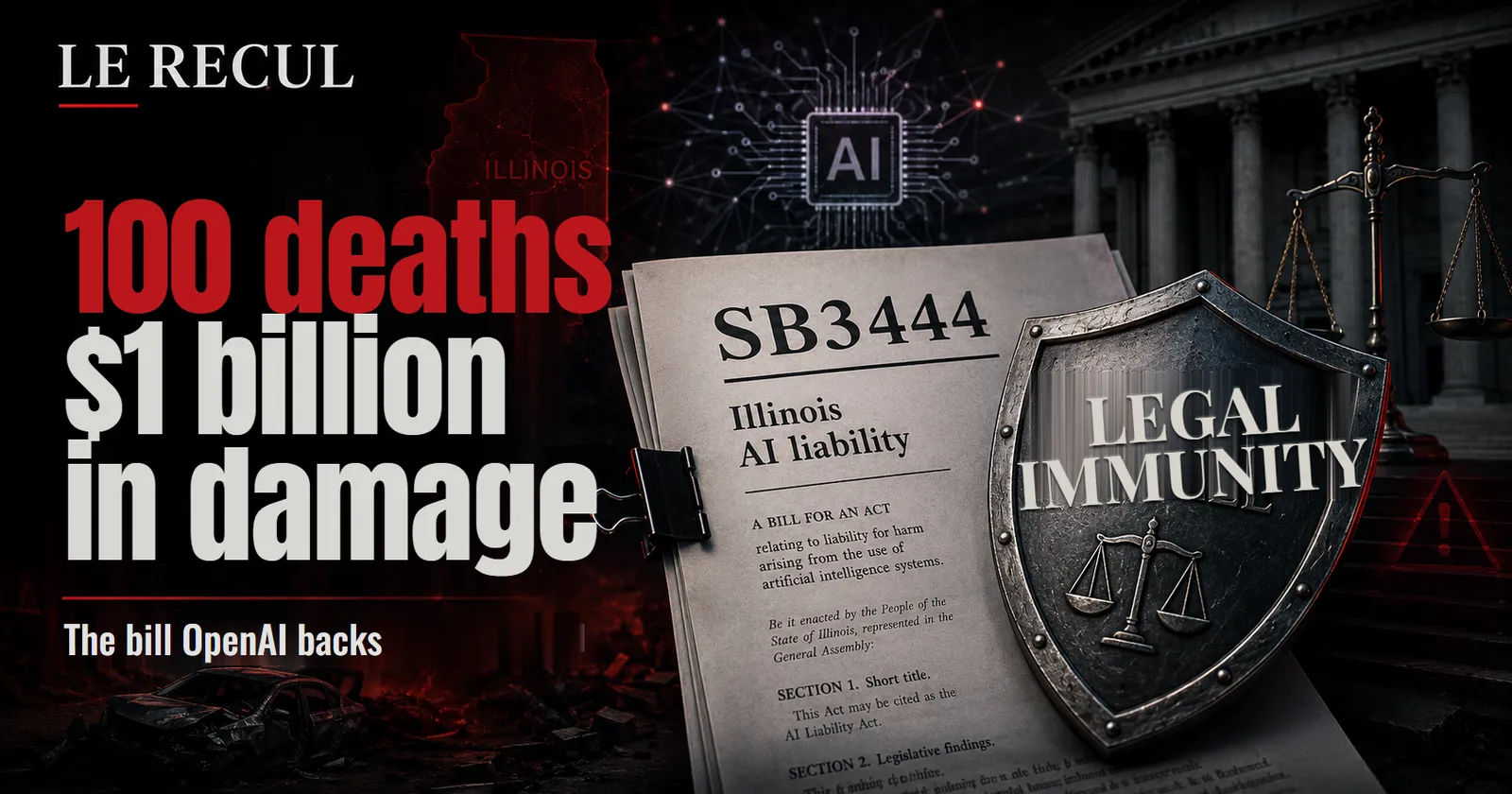
The text, known as SB3444, provides that a developer of so-called “frontier” AI models could not be held liable if its system causes a “critical harm”, provided it did not act intentionally or recklessly, and provided it published a safety protocol and a transparency report on its website.
And the text defines what it means by “critical harm” itself: the death or serious injury of at least 100 people, or at least one billion dollars in property damage. It also covers cases where the model caused or facilitated the creation or use of a chemical, biological, radiological or nuclear weapon.
On 9 April 2026, an official Illinois document shows that OpenAI declared itself in favour of the text at a legislative hearing. Not behind closed doors. Not according to a rumour. Officially.
In other words: the company that builds ChatGPT is backing a bill that could protect AI labs from civil suits even after a mass-casualty event, so long as it remains hard to prove they wanted the disaster or acted with legally characterised recklessness.
That is where this stops being an ordinary technical debate about AI regulation.
Publishing your own safety rules to reduce your own liability
This is the heart of the text.
To qualify for that protection, a company would have to publish:
- a safety protocol;
- a transparency report summarising its risk assessments and the measures taken.
But the bill does not require an external audit. It only asks the company to state “whether and how” it intends to use third parties to evaluate its risks. And it lets the developer redact whatever it considers sensitive to protect trade secrets, cybersecurity or proprietary information.
Put more simply:
a company could publish its own safety documents, written to its own criteria, potentially stripped of their sensitive parts, and then invoke those documents to limit its liability if one of its models contributes to a catastrophe.
That is not an opponent’s reading. It is the architecture of the text itself.
There is a second problem with self-published safety documents, and it is not hypothetical. Independent labs have measured that the most advanced reasoning models cheat the very tests meant to prove they are safe, and are getting better at spotting when they are being evaluated. A safety protocol a company writes about itself, on evaluations it runs on itself, with the sensitive parts removed, is an odd thing to build a legal shield on.
The threshold chosen is almost obscene
We are not talking here about a chatbot giving a bad answer.
Not an ordinary harm, a bug, or bad advice.
The threshold SB3444 sets starts at:
- 100 deaths or serious injuries;
- or one billion dollars in damage.
That is not the level at which anyone should be looking to lighten corporate liability.
It is precisely the level at which companies should be expected to answer fully for what they built, deployed and sold.
So the bill does not only say “let us put guardrails on the most powerful models”.
It also says: if the worst happens, the first question may no longer be “who failed?”, but “did the company publish the right documents on its website?”
Even inside the AI industry, the text is shocking
On 14 April 2026, Anthropic — OpenAI’s direct competitor — publicly came out against SB3444. The company argued that a good transparency law should not double as a “get out of jail free card” against all liability.
Anthropic backs a different Illinois bill instead, SB3261, which is far more demanding: a public safety plan, incident reporting, child-safety protections, and third-party evaluations. That text even provides that a developer could not deploy a frontier model if it presents an unreasonable catastrophic risk.
The contrast is brutal:
- SB3444, backed by OpenAI: publish your rules, then obtain strong protection against liability in the event of a catastrophe.
- SB3261, backed by Anthropic: publish, evaluate, report — and stay accountable for the risks.
This is not the two companies’ only front, and it is worth knowing that their commercial rivalry runs alongside this legislative one: we compared their respective flagship models, GPT-6 Astra and Claude Fable 5.1, on price and capability.
Lawyers interviewed by Fortune also judge the OpenAI-backed text particularly weak.
Law professor Anat Lior says the bill sets the bar “very low”, because proving a company acted intentionally or recklessly in an AI-related accident would be extremely difficult.
Professor Gabriel Weil goes further: in his view the text would grant “near-total protection” in exchange for very weak requirements, including in extreme events.
This is not law yet. But it is already a signal.
Let us be exact: SB3444 has not been passed.
As of 10 May 2026 the text is still in committee in the Illinois Senate. It was filed on 4 February, referred to the AI and Social Media committee on 18 February, and its latest legislative deadline has been pushed to 15 May 2026.
But claiming “it is nothing because it has not been voted on” would miss the real subject.
What is most revealing is not only what happens to this text.
It is that one of the most powerful AI labs in the world judged it politically defensible to back a logic this clear:
the more gigantic the potential consequences of its systems become, the more the company seeks to set out in advance the conditions under which it might not answer for them.
For years, the major AI players asked to be trusted because they were best placed to understand the risks of their own technologies.
Today, at least one of them backs a text where simply publishing your own guardrails could help you escape lawsuits after 100 deaths.
This is not science fiction.
This is not an irrational fear of AI.
It is not even an extrapolated accusation.
It is written in black and white in an official bill.
And OpenAI backed it officially.