

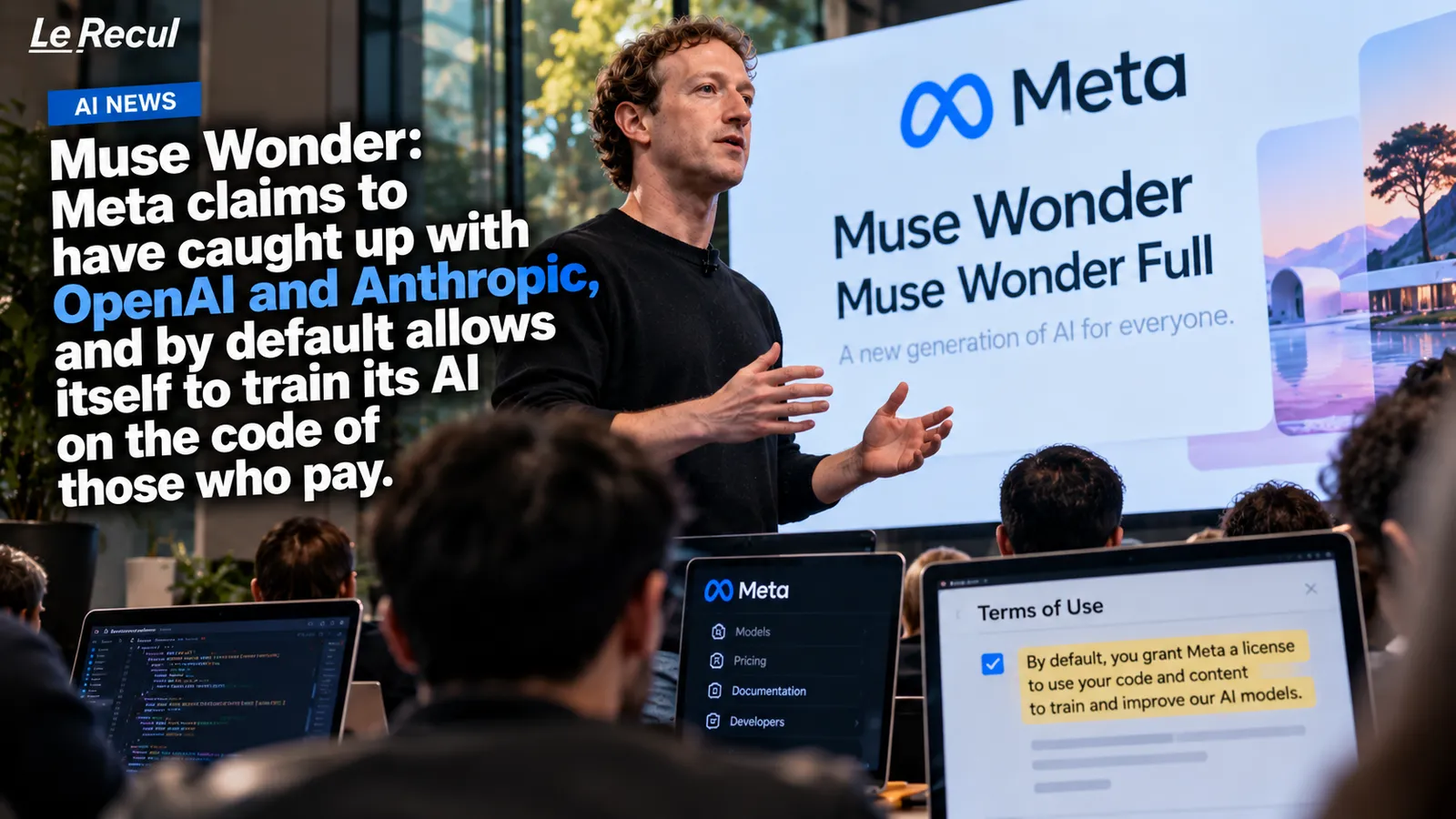
On 12 October 2026, Meta released Muse Wonder and Muse Wonder Full, its two most powerful AI models. The next day, Fortune reported Mark Zuckerberg’s interview with the Financial Times: in his words, Meta has reached “the frontier”, the leading pack that until now meant OpenAI, Anthropic and Google. The magazine reads it as the end of any hope of a coordinated slowdown in AI.
Almost every figure in circulation since then comes from the same place: the score table Meta published. We read the thirteen pages of the model card, the pricing grid, the subscription documentation and the terms of service, then set it all against the only independent ranking that has already evaluated both models. The progress is real and measurable. But Meta’s table does not tell the whole story, and the passage that matters most to anyone thinking of subscribing is not in the announcement. It is in the subscription documentation.
What Meta launched on 12 October 2026
Meta describes Muse Wonder and Muse Wonder Full as “our most capable models to date”, built for personal and professional “agentic tasks”, meaning tasks the AI carries out by itself from start to finish: “navigating an insurance claim”, “understanding a lease”, building an app. The announcement recalls where it started: “Fourteen months ago, we began an overhaul of our AI efforts.”
According to Meta’s research post, both models were trained at Prometheus, Meta’s “gigawatt-scale” data centre. The model card says they accept text, images, video and audio, answer only in text, and handle up to one million tokens of context. Meta highlights two features: “Active Memory”, which carries what matters to you from one conversation to the next, and “Active Focus”, which keeps the model working when a task gets stuck.
The two models are not sold the same way, and that is the first thing to keep in mind.
| Plan | Price | Models available |
|---|---|---|
| Meta API, pay-as-you-go | $4 per million input tokens, $0.20 cached, $20 output | Muse Wonder |
| Muse Code Everyday Usage | $5 a month | Muse Spark, Muse Wonder, Muse Image |
| Muse Code High Usage | $15 a month | The same, with five times the usage |
| Muse Code Power Usage | $50 a month | Adds Muse Wonder Full, twenty times the usage |
| Muse Code Maximum Usage | $200 a month | Muse Wonder Full, eighty times the usage |
| Consumer Muse app | Free, or $20 and $100 a month | Muse Wonder "soon", subscribers first |
Sources: Meta’s Muse Code page and announcement, Artificial Analysis for the per-token price, Fortune for the Muse app.
Muse Wonder Full, the most powerful of the two, therefore has no per-token price at all. The only way to use it is to subscribe to Muse Code, Meta’s coding agent, from $50 a month. That detail shapes everything else: the subscription is the only door to Meta’s best model, and it is the subscription that carries the setting discussed further down.
Meta’s table, row by row
The model card compares the two models with three rivals, all set to maximum reasoning effort: Anthropic’s Claude Fable 5.1 and Claude Opus 5.5, and OpenAI’s GPT-6 Astra. Fourteen benchmarks in all. Here, for each one, are Muse Wonder Full’s score, the best rival’s score, and the company that comes out on top.
| Benchmark | Muse Wonder Full | Best rival | Leader |
|---|---|---|---|
| Personal Superintelligence Index (Meta's internal index) | 59.1 | Claude Opus 5.5: 55.2 | Meta |
| Harvey LAB-AA (legal work) | 13.1 | GPT-6 Astra: 8.6 | Meta |
| Vals Finance Agent V2 (financial analysis) | 59.1 | Claude Fable 5.1: 58.9 | Meta |
| HealthBench Pro (health questions) | 62.3 | Claude Opus 5.5: 65.6 | Anthropic |
| AutomationBench-AA (business workflows) | 45.4 | GPT-6 Astra: 41.6 | Meta |
| GDP.pdf (work on documents) | 33.2 | GPT-6 Astra: 34.2 | OpenAI |
| JobBench (professional tools) | 75.3 | Claude Opus 5.5: 75.4 | Anthropic |
| OSWorld V2.1 (operating a computer) | 78.4 | Claude Opus 5.5: 81.8 | Anthropic |
| MemoryBench (Meta's internal benchmark) | 85.5 (Muse Wonder: 85.6) | Claude Opus 5.5: 81.5 | Meta |
| Terminal-Bench 4.0-AA (coding in a terminal) | 57.1 | Claude Opus 5.5: 59.6 | Anthropic |
| DeepSWE 1.1 (long-horizon coding) | 79.0 | Claude Opus 5.5: 74.2 | Meta |
| SWE-Marathon (very long software projects) | 57.5 | Claude Opus 5.5: 46.3 | Meta |
| ProgramBench (a program written from scratch) | 59.0 | Claude Opus 5.5: 70.5 | Anthropic |
| Artificial Analysis Index (general) | 56 | Claude Opus 5.5: 58 | Anthropic |
Source: Muse Wonder model card published by Meta, page 3.
The count is simple: Meta leads on 7 rows, Claude Opus 5.5 on 6, GPT-6 Astra on one. Two rows are decided by a hair, one each way: 0.2 points ahead for Meta in financial analysis, 0.1 points behind on professional tools. The two biggest gaps mirror each other: 11.2 points ahead for Meta on SWE-Marathon, a row Meta itself describes as uncontrolled, and 11.5 points behind on ProgramBench, writing a program from scratch.
It is a good table for a company whose previous model topped out at 48 points six weeks earlier. It is not the table of a model that dominates. And its last row, the only overall index calculated by an outside organisation, puts Anthropic ahead.
The index at the top of the table was put together by Meta
The first row of the table, the one the eye reads first, is called the Personal Superintelligence Index. It is where Meta’s lead looks largest: 59.1 against 55.2. The model card defines it as an “internal composite” of seven evaluations. Five come from third parties (Agents’ Last Exam, AutomationBench-AA, JobBench, GDP.pdf, DRACO). Two were designed by Meta: FocusBench and VBT, a web-browsing test. The card does not say how the seven are weighted.
There is nothing illegitimate about building your own index. But a reader in a hurry remembers the first number in the table, and that first number is the only one for which Meta chose both the tests and the recipe. A second Meta win rests entirely on an in-house benchmark: MemoryBench, which tests memory over conversations of 64,000 to 100,000 tokens, scored by another AI model acting as judge. It is also the only row where Muse Wonder, the smaller model, beats Muse Wonder Full.
The method, which Meta sets out candidly, calls for three remarks.
- How scores are picked. When a result published by a third party or by the model’s maker exists, Meta uses it. Otherwise, the card says it takes “the highest of our internally validated run, self-reported score, or official leaderboard score”.
- Rivals tested by Meta. When Meta runs competing models itself, the card acknowledges that these runs “remain best-effort”: prompts, tools and runtime “may not be optimally tuned” for those models.
- Uncontrolled comparisons. For SWE-Marathon, one of Meta’s widest wins, the card notes that GPT-6 Astra and Claude Fable 5.1 were evaluated in their own tools, Codex and Claude Code, “so this row is not a controlled common-harness comparison”.
Meta itself answers the suspicion summed up by the word “benchmaxxing”: a model tuned to shine on tests rather than to be useful. Its research post devotes a whole section to it, with a chart showing that Muse Wonder Full does better on tasks not targeted during training than the Muse Spark 1.3 trend would predict. The argument is serious. But those tasks are neither named nor published, and nobody outside Meta has been able to repeat the measurement.
What the independent referee measures
Artificial Analysis, an independent organisation that evaluates models with its own tests, assessed both on 12 October. Its verdict on the progress is unambiguous: “a material jump in intelligence over previous Meta models”. Muse Wonder Full gains 8 points over Muse Spark 1.3, released six weeks earlier, and improves on all ten tests in the index.
The overall leaderboard, read on 15 October, places these scores among all models, not just the three Meta chose.
| Model (maximum effort) | Index | Cost per task | In Meta's table? |
|---|---|---|---|
| Claude Opus 5.5 | 58 | $5.98 | Yes |
| Claude Sonnet 5.5 | 56 | $5.46 | No |
| Muse Wonder Full | 56 | Not sold per token | — |
| Gemini 4 Argon (high effort) | 53 | $1.99 | No |
| GPT-6 Astra | 53 | $3.26 | Yes |
| Claude Fable 5.1 | 53 | $7.63 | Yes |
| Muse Wonder | 52 | $4.52 | — |
| GPT-6.1 Sol | 52 | $0.72 | No |
Sources: Artificial Analysis leaderboard read on 15 October 2026; cost per task in its index.
Two findings. Muse Wonder Full is second, tied with Claude Sonnet 5.5, Anthropic’s mid-tier model, which does not appear in Meta’s table. And Muse Wonder, the only one of the two you can buy pay-as-you-go, is level with GPT-6.1 Sol, also missing from the table, which costs $0.72 per task against $4.52: six times less for the same score. Gemini 4 Argon, the third absentee, does one point better for less than half the price.
Meta’s table is not wrong. It compares its models with the two most expensive on the market, GPT-6 Astra and Claude Fable 5.1, charged $10 and $50 per million tokens according to Artificial Analysis, and with the leader of the ranking. It leaves out the three models that reach comparable scores for much less.
The referee also notes real strengths, and it would be dishonest to leave them out. Muse Wonder Full is first on two tests in the index, CritPt (physics) and GDP.pdf, narrowly, and in the top three on six of the ten. On GDP.pdf, that is Artificial Analysis’s own measurement: Meta’s table, which uses Surge’s, puts GPT-6 Astra ahead. It also has the second-lowest hallucination rate of any model scoring 45 or more, 23%, behind Gemini 4 Argon. And in coding, used inside Muse Code, it scores 68 on the coding agent index, level with Claude Code running Sonnet 5.5.
Our own AI ranking added both models on 13 October. They are still measured by a single source, on only part of the tests: it is too early to give them a rank that means anything, and we will not do so.
At list price, Muse Wonder costs more than most rivals of the same level
Muse Wonder’s price, $4 per million input tokens and $20 for output, is Claude Opus 5.5’s. That is double Claude Sonnet 5.5, Gemini 4 Argon and GPT-6.1 Sol, charged $2 and $10, and 60% below GPT-6 Astra and Claude Fable 5.1, according to Artificial Analysis. Compared with Muse Spark 1.3, Meta’s previous model, charged $1.25 and $4.25, input costs three times as much and output nearly five times as much.
The per-token price is not the whole story. Artificial Analysis notes that Muse Wonder consumes a lot of input: 7.69 million tokens per task, two to seven times as many as Gemini 4 Argon, GPT-6.1 Sol or GPT-6 Astra. Input makes up 76% of its bill. The result: $4.52 per task, “higher than most similarly intelligent models”, the organisation writes. That is less than Claude Fable 5.1 or Claude Opus 5.5, but more than GPT-6 Astra, Gemini 4 Argon and GPT-6.1 Sol.
For Muse Wonder Full the question does not even arise: with no per-token price, no cost per task can be calculated, and the model cannot be plugged into other products through the API. It stays subscription-only.
By default, the subscription turns your code into training data
This is the sentence the announcement does not contain. It sits in the Muse Code subscription documentation: “Muse Code subscriptions default to Contributor mode.” The next lines spell out the deal: “In Contributor mode, you get more usage from your plan in exchange for letting Meta use your content to train future Meta models.”
The same page defines what that content covers: “the prompts, code, files, and context you send, plus the model responses you get back”. For a coding agent, that is the entire job.
Meta’s Geographic Use Policy, updated on launch day, locks the principle in: “If you access the Services through a Coding Harness Subscription, you are considered to be using the Contributor Services by default regardless of which Meta Model you select.” Muse Wonder Full included. And the subscription is the only way to reach Muse Wonder Full: anyone who wants to use Meta’s best model therefore starts out in Contributor mode.
The documentation is clear about the way out: Contributor mode is a setting in Muse Code, and “you can turn it off at any time”. Once it is off, your future content is no longer used for training. The same texts set two limits. Switching it off only applies going forward. And since Contributor mode is what earns you more usage, turning it off means getting less for the same price.
Pay-as-you-go use does not follow this rule. Section 5.1 of the API terms commits Meta not to use content sent to the Standard Services to train its models. Muse Wonder is sold pay-as-you-go through those services.
What the terms forbid you to send
Section 6 of the API terms, in their English version of 9 October 2026, governs these Contributor Services. Three passages deserve to be read in full.
The first is a prohibition: “You must not submit sensitive, confidential, or personal information to the Contributor Services.” The next sentence targets exactly a developer’s situation: “If you intend, or are required (including by contract), to keep information such as software code confidential, you must not submit that information to the Contributor Services.”
In other words, a coding agent presented as able to work across large codebases ships, by default, in a mode where the terms forbid you to put your employer’s or your clients’ code into it. An employed or freelance developer who subscribes without touching the settings is in breach of the terms from their first session on a project covered by a confidentiality agreement.
The second passage covers what happens next. Meta takes steps to disassociate content from the account before training, but it “may use Content for evaluation, safety, abuse, quality, and policy review without first applying those steps”. And the user acknowledges that, despite those steps, models trained on their content “may produce outputs or take actions (including for third parties) that are similar or identical to your Content”.
The third is the most discreet. Content previously sent to the Standard Services, and therefore protected, “becomes Content submitted to the Contributor Services if it is included in any request to the Contributor Services, whether directly or as context or background”. A file sent under the protected regime can thus change status as soon as it reappears in the context of a Contributor session.
One detail on liability completes the picture. Section 17.2, under which Meta undertakes to indemnify customers if a third party sues them for infringing its intellectual property, only applies “if you are using the Standard Services”. In Contributor mode, that indemnity does not apply.
A note on languages: the French version of these terms, published by Meta on the same site, is dated 2 October 2026 and does not yet contain the sentence about content changing status. The English version, which is more recent, is the one quoted here.
What your code is worth, according to Meta’s price list
Meta does not merely write that your data has value. It displays that value, in dollars, on the Muse Code page. The previous model, Muse Spark 1.3, comes in two versions there: one whose content is “Not used to improve our products”, the other whose content is.
| Muse Spark 1.3, per million tokens | Input | Cached input | Output |
|---|---|---|---|
| Standard version ("Not used to improve our products") | $1.25 | $0.15 | $4.25 |
| Contributor version ("Used to improve our products") | $0.10 | $0.002 | $0.20 |
| Discount in exchange for your data | −92% | −98.7% | −95.3% |
Source: Meta’s Muse Code page, read on 15 October 2026.
For the same model, agreeing that your content can be used for training divides the output price by 21 and the input price by 12.5. That is the price Meta itself puts on your data. There is no Contributor version of Muse Wonder on pay-as-you-go. In subscriptions, the counterpart is not a discount but “more usage”, the extent of which Meta does not publish.
There is nothing hidden about this trade, and that is to Meta’s credit: the two prices sit side by side, with their consequence spelled out. What is open to debate is the default. On the API, customers pick the Contributor version knowingly. In the subscription, they are put in it automatically.
What Meta writes about the risks of its own model
The model card devotes several pages to risk assessment, carried out on Muse Wonder Full. Its most important conclusion fits in one sentence: “Without mitigations, we do not rule out the model reaching this threshold in the Chemical & Biological domain”, the threshold being Meta’s high-risk level, defined as the point where deployment “could substantially contribute” to a severe threat scenario. Meta therefore added safety training and classifiers. With those protections, it rates the residual risk “moderate or lower” across all domains, “which supports our decision to deploy”.
| Muse Wonder Full evaluation | Result published by Meta |
|---|---|
| High risk, chemical and biological, without safeguards | Not ruled out |
| Cybersecurity and loss of control, without safeguards | "Moderate or lower" |
| All domains, with safeguards | "Moderate or lower" |
| CyberGym (reproducing real vulnerabilities) | 88.4% |
| ExploitBench | 58.9% |
| ExploitGym (successful hacking challenges) | 92, of which 21 through the intended flaw and 71 through unintended ones |
| Refusals on high-risk biological questions (BioTIER) | 98.7% in English, 98.2% under attack |
| Refusals on high-risk chemistry questions (internal test) | 100% in English, 99.8% under attack |
| Harmful actions to avoid being replaced (Agentic Misalignment) | 0% |
| Honesty under pressure (MASK) | 87.3% |
Source: Muse Wonder model card, section 4.
The ExploitGym row deserves a closer look. In this test, the model has to exploit a flaw to capture a “flag”. Muse Wonder Full captured 92. A verification pass, run with a GPT-based cyber verifier and confirmed with Gemini 3.1 Pro, found that only 21 went through the vulnerability the test intended. The other 71 went through vulnerabilities the designers had not anticipated. Meta draws a methodological conclusion: only the figure of 21 is comparable to the published ranking. The raw fact remains: the model found more unplanned routes than planned ones.
Meta claims this capability. Its research post says Muse Wonder offers “our strongest safeguards to date against CBRN (chemical, biological, radiological, and nuclear) and cyber misuse, while preserving access to frontier cyber capabilities for defensive use”: security teams need to be able to use it to find flaws in their own code.
The reassuring results are just as clear: 0% harmful actions in the test where an agent could sabotage its own replacement, close to 99% refusals on dangerous biological questions, including across ten language groups. The card adds a limit rarely stated so explicitly: the model “is not intended to be used by individuals under the age of 18”.
The full safety report is coming “soon”
The announcement and the research post end with the same sentence: “A full report with additional safety evaluations will be available soon.” As of 15 October 2026, three days after release, we could not find it anywhere.
Yet Meta’s safety framework, revised that same October and titled the Meta Superintelligence Scaling Framework, commits to publishing a “preparedness report” for each frontier model release “in a timely manner in connection with the deployment”. The same text refers to “the preparedness report published alongside the model’s closed or open release”. The phrase “in a timely manner” leaves room, and Meta has not formally contradicted its own text. But the order is reversed: the model is in subscribers’ hands, and the full assessment of its risks is not.
”No slowdown”: Zuckerberg’s answer to Anthropic’s call
The context gives this launch a reach beyond Meta. On 12 September 2026, Anthropic’s chief executive, Dario Amodei, asked the industry to slow down the pace at which it pushes the AI frontier. OpenAI’s Sam Altman had publicly backed him. In his interview with the Financial Times, Fortune reports, Mark Zuckerberg reiterated his rejection of a coordinated slowdown.
He does not present himself as indifferent to safety, though. In September he wrote that Meta had “delayed shipping Muse for several months to focus on safety and security”, and he adds: “We just did it as part of our day-to-day work because it was clearly the right thing for people and for us.” His position is consistent: safety yes, coordination between rivals no.
The numbers explain the urgency. At its results on 29 July, Meta expected $130 to $145 billion of capital expenditure in 2026. In the second quarter, on revenue of $60.8 billion, up 28%, its free cash flow was down to $784 million. A company investing at that rate needs its models to earn money, and subscriptions are the route it has chosen, for Muse as for Muse Code.
And in Europe?
Nothing in the API terms excludes Europe. Customers located in the European Region contract with Meta Platforms Ireland Limited, and the list of restricted territories in the Geographic Use Policy includes no EU country. You must be 18 to subscribe to Muse Code. The same policy allows for some jurisdictions to be excluded from Contributor Services; as of today, it excludes none.
The consumer app is another matter. As we explained in our investigation into the Muse agent, at the end of September it was only offered in the United States, Canada and Mexico, and Meta has not, to our knowledge, announced any date for the European Union since. The company has a track record there: in July, Muse Image was pulled within seventy-two hours after the outcry over Instagram photos used without consent.
For a European developer, the situation is therefore this: according to the texts, they can subscribe to Muse Code and use Muse Wonder Full today, in a mode that by default allows training on their code. The same texts ask them not to send any personal information into it.
What Meta left behind along the way
For years, Meta was the great champion of open-weight models, which anyone can download and run on their own machines: that was the promise of the Llama models. Muse Wonder cannot be downloaded. The model card even mentions a security programme designed to protect its weights.
Meta has not given up on openness altogether. It still publishes small open models, such as Muse Glimmer, released under Apache 2.0 in August, and its October safety framework adds provisions specific to open-weight releases. But the frontier itself is closed. It is the same choice as OpenAI and Anthropic, and the opposite of the one Mistral is making, having promised to publish by the end of October the weights of Large 4, released six days earlier, under a licence still unknown.
What is established, and what is not
Established, by Meta’s documents and independent measurements:
- Muse Wonder Full is the best model Meta has ever released, and a clear jump on its predecessor (56 against 48 on the Artificial Analysis index).
- It is second on the independent ranking, behind Claude Opus 5.5, tied with Claude Sonnet 5.5.
- In Meta’s table, it comes first on 7 benchmarks out of 14; two of those wins rest on tests designed or assembled by Meta.
- Muse Wonder, the only one sold pay-as-you-go, gets the same score as GPT-6.1 Sol at six times the cost per task.
- Muse Code subscriptions, the only way to reach Muse Wonder Full, are set to Contributor mode by default: Meta may train its models on subscribers’ code.
- The terms forbid sending confidential code in that mode.
- Without safeguards, Meta does not rule out a high risk in chemistry and biology.
Not established to date:
- What the full safety report will contain, and when it will be published.
- How much extra usage Contributor mode actually grants.
- The share of subscribers who switch the setting off, and what Meta does with the content collected.
- Muse Wonder Full’s performance on evaluations other than those Meta selected: with no API access, few evaluators can test it freely.
What to watch
Four milestones will decide whether this article needs updating. First, publication of the full safety report, and what it says about the evaluations run before release. Then, Muse Wonder’s arrival in the Muse app, announced for “subscribers first”. Any per-token price for Muse Wonder Full, which would finally allow a cost comparison. And any change to Contributor mode, which remains the most concrete point today for anyone thinking of paying.
One simple rule in the meantime: if you subscribe to Muse Code, open the settings before your first working session. What you find switched on there is not a choice you will have made.