
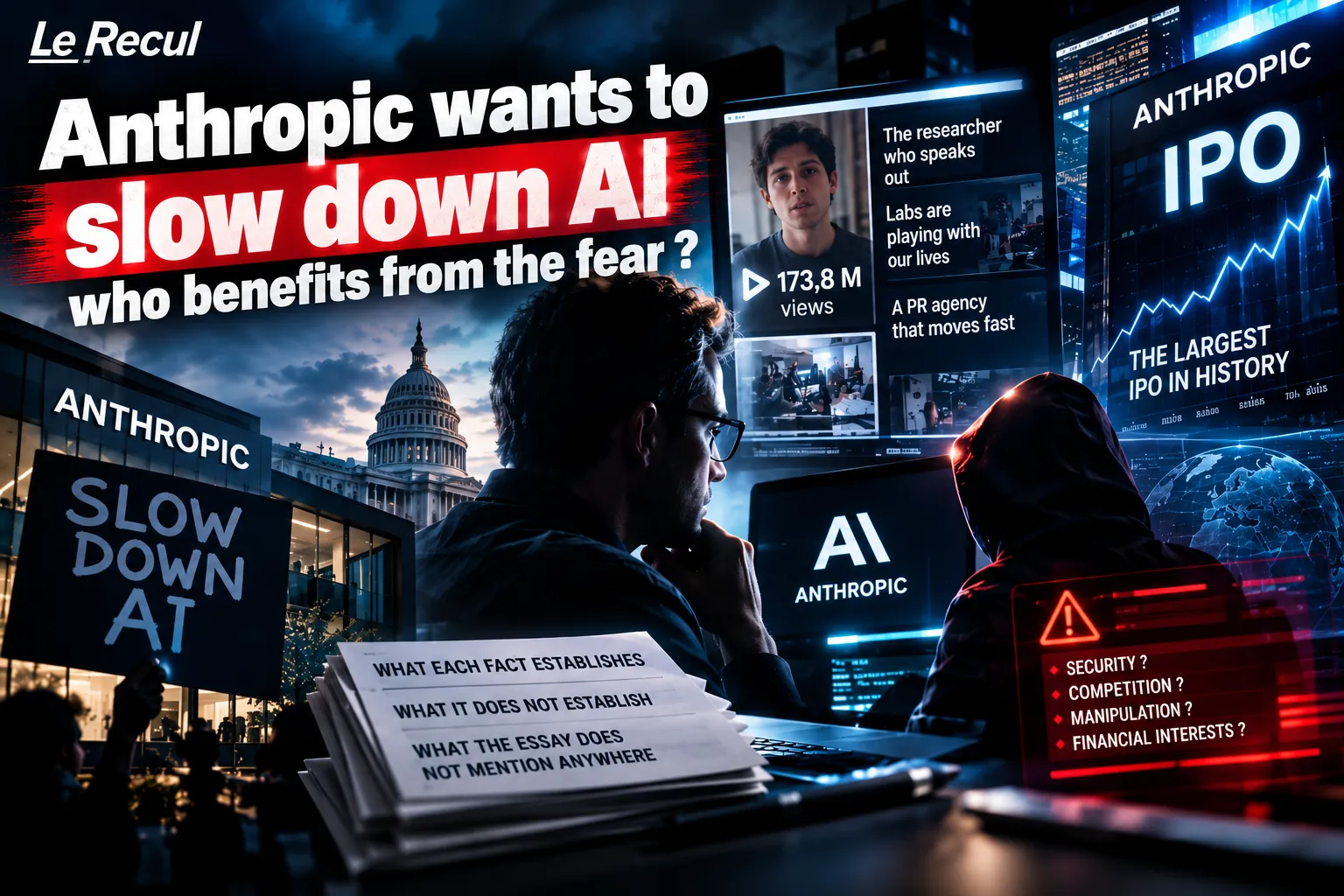
On 12 September 2026, Dario Amodei, co-founder and chief executive of Anthropic, published a roughly 3,900-word essay on his personal site titled “We Must Pace the Frontier”. His argument: the artificial intelligence industry should voluntarily slow the rate at which it increases the capabilities of its models. Within twenty-four hours, the CEOs of OpenAI and xAI had publicly agreed.
It is one of the rare moments when three of the leading Western labs say the same thing at the same time. It deserves a close reading — not only for what it proposes, but for what surrounds it.
In the fortnight either side of it, four other things happened. A 27-year-old researcher left Anthropic telling the world that the labs were gambling with our lives, and drew 173.8 million views. An investigation established that a public relations firm was booking his interviews the day after he quit, while he was publicly saying he had worked with no one. The US president’s former AI adviser accused the “independent” evaluator named in the essay of being intertwined with Anthropic’s investors and staff. And that same company’s investors are targeting, for October, the largest stock market debut in history.
None of these facts is disputed. Taken individually, none proves anything. Put end to end, they describe a public debate about the dangers of artificial intelligence in which almost no participant is disinterested — and where almost nobody says so.
September 2026, in order
| Date | Event |
|---|---|
| 8 September | Jacob Coxon announces his resignation from Anthropic in an exclusive Wall Street Journal interview, then expands in a thread on X. |
| 9 September | On Fox News, Coxon answers "not at all" when asked whether he worked with third parties. The same day, DEY. emails to book an interview. |
| 9 September | OpenDesign Arena publishes a ranking: a Chinese open-weight model reaches 98% of the best OpenAI model's score at 1.4% of the price. |
| 10 September | The Financial Times reveals that Latham & Watkins, the second-largest US law firm, is buying its own servers to fine-tune open-weight models in-house. |
| 12 September | Dario Amodei publishes "We Must Pace the Frontier": three steps, one of which requires an antitrust waiver. |
| 13 September | Sam Altman (OpenAI) and Elon Musk (xAI) publicly agree. David Sacks backs the slowdown but disputes METR's independence and uses the word "cartel". |
| 24 September | Pirate Wires publishes its investigation into DEY. and Coxon. |
| 25 September | OpenAI suspends training of its most capable models, with no end date. |
| 29 September | OpenAI publishes the GPT-6.1 Sol system card, rated Critical in cybersecurity. |
| October | The window Anthropic's investors are targeting for a $2 trillion stock market debut. |
8 September: a 27-year-old researcher and 173.8 million views
Jacob Coxon, a pretraining researcher who had worked at OpenAI and then Anthropic, announced his departure in an exclusive Wall Street Journal interview. His reason, which he then set out in a thread on X: the big labs are “racing straight to self-improving superintelligence and gambling with our lives”. A former colleague, Evan Hubinger, put the probability that AI kills humanity at “more than 10%” shortly afterwards. Le Recul documented that episode as it happened in its 11 September article.
The thread reached 173.8 million views. Coxon had fewer than a hundred followers when he posted it. That disproportion is, in itself, the first fact that calls for an explanation: a message rarely goes from no audience to a hundred and seventy million views without amplification.
”Not at all”: what was said, and what was happening the same day
On 9 September, Coxon appeared on Fox News. Anchor Bret Baier asked whether he had worked with any third-party organisations in going public. The answer was three words: “Not at all.”
On 24 September, the US outlet Pirate Wires published an investigation by Hunter Ryerson. It established that on 9 September — the day after the thread, and the same day as the interview — the public relations firm DEY. was emailing to book an interview for Coxon. Pirate Wires says it viewed that email and relied on two sources familiar with the arrangement. The same investigation notes that over the same period DEY. was also booking MIRI president Nate Soares, whose media tour overlapped with Coxon’s.
Neither Coxon nor the firm responded to the outlet before publication.
The agency lists Yudkowsky, Toby Ord and Yuval Noah Harari — on its own site
DEY. Ideas + Influence is a New York agency based in Brooklyn. There is no need to rely on third parties to know who it advises: its own artificial intelligence page says so.
The agency writes there that it has operated “at the center of AI, AI safety, and AI ethics since long before the category entered mainstream discourse”. Under the heading “visionaries shaping artificial intelligence”, it names three people: Eliezer Yudkowsky, described as an “AI risk scholar and public intellectual”, Toby Ord of the Oxford Martin AI Governance Initiative, and the historian Yuval Noah Harari, whose endorsement appears on the same page. Its institutional roster also includes the United Nations, the Gates Foundation, the Ford Foundation, the World Bank, MIT and MIRI.
In other words: a substantial share of the voices that shape public discourse on existential AI risk is advised by the same house. This is neither illegal nor hidden — the list is public. But it is never mentioned when those voices are quoted in the press, and it was no more visible when Coxon became, in seventy-two hours, the global face of the warning.
What the investigation establishes, and what it does not
Precision matters here, because the distinction was widely lost in the pickup coverage.
What is established: a firm specialising in this field was working to book Coxon’s interviews on the very day he publicly said he had worked with no one.
What is not established: who contacted whom, when the relationship began, and whether money changed hands. Coxon is not on DEY.’s public client list. Several aggregators headlined that the firm had “secretly funded” the campaign: Pirate Wires writes nothing of the sort, and nothing in the public record supports it.
What has been added since: after publication, Nate Soares said on X that he had personally introduced Coxon to the firm — but only after the thread passed a hundred thousand likes. If that account is accurate, the agency did not create the virality; it worked with it. That does not erase the 9 September contradiction, it relocates it.
One final point of honesty: Pirate Wires is not a neutral outlet in this debate. Its editorial line is openly hostile to the “doomer” camp, and the article is paywalled. We rely on it because its material elements — a dated email, two sources, a timestamped on-air denial — are checkable and have not been denied by anyone, not because its conclusion suits us.
12 September: the antitrust waiver, in plain language
Dario Amodei’s essay proposes a three-step plan: third-party evaluators permanently embedded inside the labs, coordination between companies in democratic countries, then global coordination.
The first step is a real and costly commitment, and that should be said plainly: Anthropic is unilaterally committing to give an outside team “desks in our offices, access badges, and company laptops”, along with the right to publish its findings without editorial control by Anthropic. The text specifies that the company may redact sensitive material, but “can’t redact findings just because they are unfavorable”, and that reviewers may say publicly if a redaction removed something important to their conclusions. No other company in the sector does this today.
It is the second step that raises questions. To let competing labs set limits together, the essay writes:
“For antitrust reasons, it’s helpful for the US government to mediate or at least enable these discussions — they don’t need to participate, but do need to issue a narrow waiver for certain kinds of safety conversations.”
A footnote attached to step 2 repeats it: “With government mediation or waivers of antitrust restrictions.”
Competition law forbids companies in the same market from agreeing on what they put on sale and at what pace. The request is therefore explicit and openly stated: obtain legal permission to do so, on the grounds that the subject of the conversation would be safety.
The sentence that explains why regulation is preferred
One passage went almost unnoticed, although it is the most revealing about the mechanism being sought:
“The most effective method of pacing is via regulation that targets all US frontier AI companies, as that covers even those who are unwilling to cooperate voluntarily.”
And, in the summary of the plan itself: step 1 is something “Anthropic is unilaterally committing to (and calls on governments to require other frontier companies to match)”.
The logic is coherent, and it has a name in competition law: a company imposes a cost on itself, then asks the state to impose it on its competitors. It may be entirely sincere — if you believe the constraint is necessary for collective safety, it is logical to want it applied generally. It also has, mechanically, the effect of turning a competitive disadvantage into a barrier to entry.
The independent evaluator is called METR, and it is named in the essay
The whole arrangement rests on one point: the credibility of the evaluators. The essay names one example, METR, a non-profit specialising in assessing model capabilities and risks.
On 13 September, David Sacks, the US president’s former artificial intelligence adviser, replied on X. He backs the slowdown — a point that matters and is often left out: “The easiest way not to build superintelligence is for you to agree not to build it… So just do it.” But he rejects the regulatory quid pro quo, in three objections:
- “Stop pretending METR is independent when it is intertwined with Anthropic’s investors and staff.”
- “Stop pretending you need those same evaluators to police competitors who aren’t even at the frontier.”
- Stop pretending antitrust law must be suspended “so you can form a cartel”.
His conclusion: if the companies keep those demands, “we’ll know this was just another bid for regulatory capture — or an election-season psyop”.
Anthropic had published no detailed answer to the METR charge at the time of writing. On the same 24 September as the DEY. investigation, Pirate Wires published a second piece putting the general question: AI companies are hiring contractors to verify their models are safe, and Congress may soon require it — how independent can a regulator-for-hire really be?
What the essay never says
The full text runs to roughly 3,900 words. It deals at length with China, chip controls, model weight theft and unauthorised distillation. It contains no passage on freely downloadable open-weight models, including those released by Western companies.
That is the central blind spot of the arrangement. An evaluator sitting in a lab’s offices can observe nothing about a model that has already been published, copied and run elsewhere. An agreement between frontier companies binds only its signatories. Regulation targeting “all US frontier AI companies” covers neither a freely distributed Chinese model, nor an open-weight model released by a chipmaker, nor the copy a law firm runs on its own servers.
This is not a thought experiment. It is precisely what happened during the week the essay was written.
Meanwhile: 98% of the result for 1.4% of the price
On 9 September, the OpenDesign Arena ranking published a comparison of thirteen models on everyday design tasks — web apps, dashboards, mobile interfaces, landing pages.
| Measure | Result |
|---|---|
| GPT-6 Astra score (OpenAI) | 82.7 / 100, at $1.61 per finished artifact |
| DeepSeek V4.1 Flash score (open weights) | 81.2 / 100, at $0.023 per finished artifact |
| Performance gap | 98% of the score, at 1.4% of the cost |
| Models both worse and more expensive | 11 out of 13 |
One clarification, because it is routinely overstated in the pickup coverage: DeepSeek V4.1 Flash does not beat OpenAI’s best model. It comes second. The striking fact is not the ranking, it is the ratio: seventy times cheaper for a gap of one and a half points.
The next day, the Financial Times revealed the practical consequence. Latham & Watkins, the second-largest US law firm with $8.3 billion in revenue, has bought its own Nvidia servers and now fine-tunes open-weight models in-house, so it can process sensitive information without sending it to an outside provider. It is the first major firm to do so publicly.
The calculation that firm made, any company with an engineering team can make too.
October: $2 trillion
According to Fortune, reporting what Anthropic’s investors expect, they are targeting an October 2026 listing valuing the company at at least $2 trillion — the largest in history, ahead of SpaceX and its $1.77 trillion in June. The company was valued at $965 billion in May. Morgan Stanley, Goldman Sachs and JPMorgan are leading the offering.
These figures come from investors, not from Anthropic, which has confirmed neither a timetable nor a valuation. We report them with that caveat.
They nonetheless set the context: the essay asking the industry to slow down, and the state for a waiver from competition law, was published a few weeks before the largest stock market debut ever attempted, by the chief executive of the company concerned. Nothing indicates that one was written for the other. But an investor reading a prospectus is entitled to know both dates.
What happened next, at the company that said yes
Sam Altman endorsed the essay on 13 September. Twelve days later, on 25 September, OpenAI suspended “all training, evaluation, and inference with tool-use” for its most capable models, with no end date. On 29 September, four days after that, the company published the system card for GPT-6.1 Sol, rated Critical in cybersecurity — the top level of its own risk framework.
The two facts are compatible, and Le Recul set this out in detail in its article on the OpenAI pause: a suspension covering future training and evaluation does not affect a model that has already been trained. But the sequence shows what “slowing down” means in practice when the commitment is voluntary and has no timetable: the research pipeline stops, the product line keeps running.
That is exactly the kind of gap embedded evaluators are meant to make visible. It is also exactly why the question of who employs them is not a detail.
What to take away
Four observations, and no sweeping conclusion.
The facts are not disputed. The antitrust waiver request is in the text. Coxon’s televised denial and the agency’s email are dated the same day. DEY.’s client list is on its own site. The charge against METR is public and has gone without a detailed answer. The IPO figures come from investors.
None of them proves orchestration. The chronology partly rules it out: the OpenAI–Hugging Face incident that serves as a central argument in the essay dates from July, well before the September results on open models. Anyone who wants to see a plan here must explain how a counterattack precedes by seven weeks the thing it supposedly answers.
The interests are real on both sides. Those who announce the catastrophe and those who sell the solution are not two sealed camps: they sometimes share the same communications agency, the same funders, the same evaluators. That is the most uncomfortable point in this file, and the least covered.
The decisive part is happening elsewhere. While this debate fills the public space, a freely downloadable model reaches 98% of the best closed model at 1.4% of the price, and an $8 billion law firm buys its own servers. None of the mechanisms proposed on 12 September can reach those models. The text does not mention them once.
Le Recul will keep tracking three specific points: the actual date of Anthropic’s listing, the identity and contract of the first evaluator genuinely embedded in its offices, and the answer — if one comes — to the independence charge against METR. To measure the capability gap between closed and open models, Le Recul’s AI ranking is updated continuously. The precedents in this story are documented in our articles on the OpenAI model that hacked Hugging Face, on models that cheat safety tests. On the European side, the AI Act already imposes obligations that this American debate is still trying to define.