

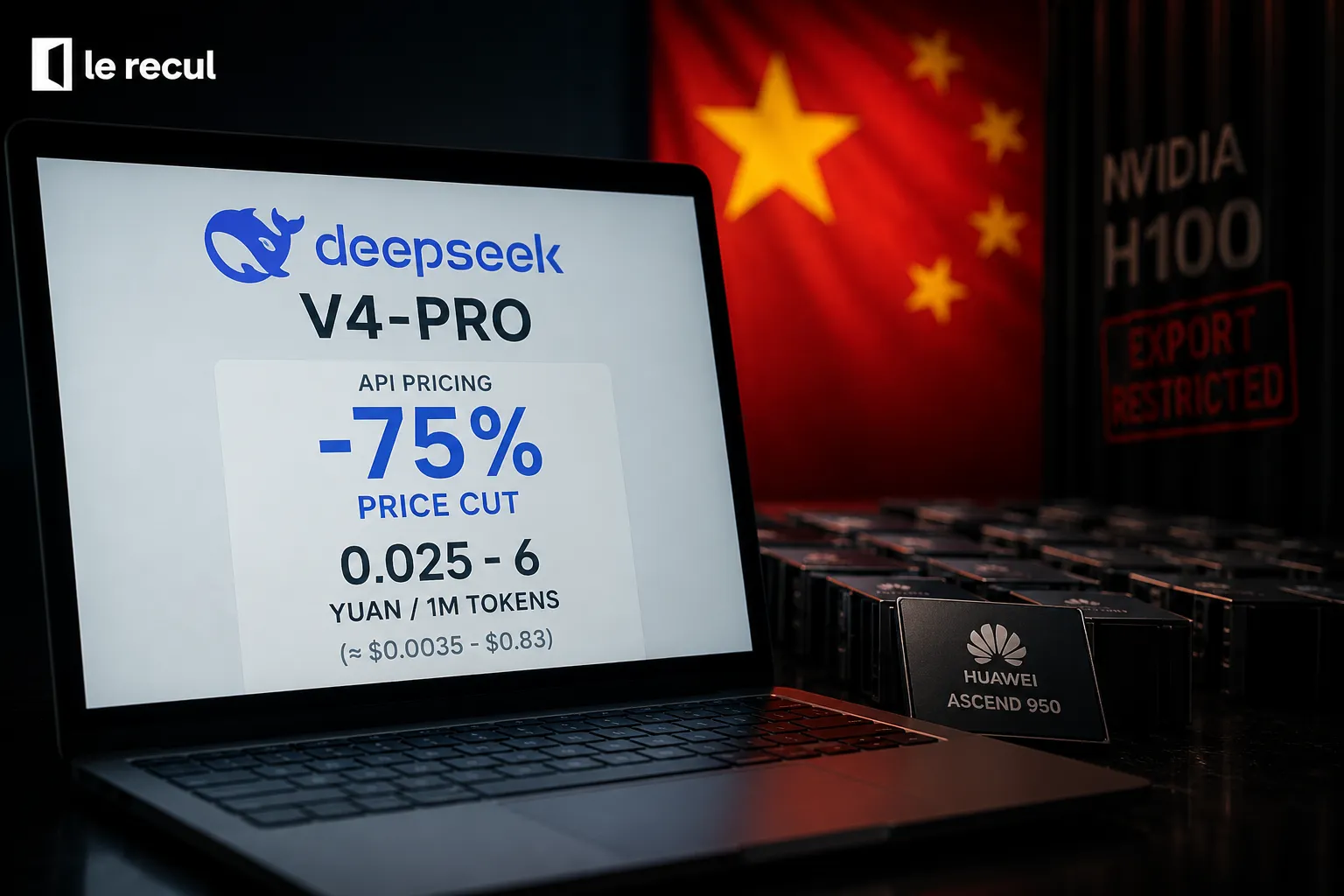
On 23 May 2026, DeepSeek made a 75% price cut permanent on its V4-Pro model.
And behind that announcement there may be far more than a simple promotion.
There is:
- the economic war between China and the United States;
- US restrictions on Nvidia;
- the rise of Huawei chips;
- and a question that is already worrying the AI market:
what is a “premium” AI still worth if a competitor becomes almost as useful for a fraction of the price?
Update, 26 September 2026. This model is no longer served. Since 14 September 2026 at 4am UTC, every request sent to
deepseek-v4-prohas been handled by V4.1 Flash, at its rate — that is 4.4 times cheaper on input than the already broken price described here. The 75% cut described in this article was therefore followed, four months later, by a far steeper cut obtained a different way: by replacing the model behind the identifier. The newcomer is stronger at agentic work and less knowledgeable. We recalculated its bills hour by hour in our DeepSeek V4.1 Flash vs GPT-5.6 Luna comparison. The analysis below remains that of May 2026: it describes the moment the price war started, not the state of the market today.
A recent model, launched in late April 2026
DeepSeek introduced V4-Pro Preview on 24 April 2026.
The model announces:
- up to 1 million tokens of context;
- a Mixture-of-Experts architecture;
- roughly 1.6 trillion parameters, of which 49 billion active;
- plus a lighter version called V4-Flash.
The positioning is clear: offer a highly competitive model, but above all one that is far cheaper than the American leaders.
A massive price cut made permanent
On 27 April 2026, Reuters reported a first promotional cut of 75% on V4-Pro.
On 23 May 2026, DeepSeek announced that the cut was becoming permanent.
API prices now move from roughly:
- 0.1 to 24 yuan per million tokens to
- 0.025 to 6 yuan.
In dollars, that represents around:
- $0.0035 to $0.83 per million tokens depending on usage.
The signal is brutal: China is no longer only trying to catch up with American models. It is trying to break the market price.
Why DeepSeek can break prices
The subject is not only about software.
It is mostly about chips.
For several years, the United States has restricted exports of the most advanced Nvidia GPUs to China in order to slow Chinese AI down.
But that pressure also produced another effect: it pushed China to accelerate its own alternatives.
Reuters reports that DeepSeek V4-Pro now relies heavily on Huawei Ascend 950 chips.
After the model launched, Reuters indicates that Chinese giants such as Tencent, Alibaba and ByteDance scrambled for those Huawei chips.
In other words: US sanctions also helped create enormous demand for an independent Chinese AI ecosystem.
DeepSeek is not necessarily “better” than OpenAI
We need to stay precise.
The subject is not:
“China has overtaken OpenAI”.
DeepSeek V4-Pro performs well, but the best American frontier models generally remain ahead on several complex benchmarks.
The real subject is elsewhere:
DeepSeek is becoming good enough to be very dangerous economically.
Because past a certain quality level, many companies mostly look at:
- cost;
- speed;
- context;
- the ability to scale.
And that is exactly where DeepSeek attacks.
What this can trigger
1. A global AI price war
The AI market was already extremely expensive.
AI agents, coding assistants, long workflows and autonomous systems consume enormous numbers of tokens.
If one player massively reduces costs, the whole economy of the sector can change.
2. Enormous pressure on OpenAI, Anthropic and Google
American models often remain better.
But if DeepSeek becomes “good enough” for many uses at a far lower cost, part of the market could switch brutally on price.
Above all:
- startups;
- AI SaaS products;
- automated workflows;
- AI agents;
- companies that consume huge amounts of API.
3. A problem for many AI wrappers
Hundreds of AI products rest mainly on a layer sitting on top of an existing model.
If models become much cheaper:
- some margins can collapse;
- some “premium” offers become harder to justify;
- and many small players could find themselves squeezed between infrastructure cost and price war.
4. An indirect win for Huawei
The most ironic point may be here.
US restrictions aimed to slow Chinese AI down.
But they also pushed China to accelerate its own hardware ecosystem.
Today, Huawei is gradually becoming a central piece of that strategy.
And if Chinese models become competitive at very low cost thanks to local infrastructure, that could transform the global balance of the AI market.
The real subject may no longer be quality
For a long time, the AI battle was mostly about:
- “who has the best model?”
- “who dominates the benchmarks?”
- “who is the smartest?”
But 2026 could bring out another question:
who can supply a good enough AI at the lowest price?
And that question is potentially far more dangerous for the market.
Because a slightly less capable but much cheaper model can become extremely attractive at scale.
What to remember
DeepSeek V4-Pro launched on 24 April 2026.
On 23 May 2026, DeepSeek made a 75% price cut permanent on its API.
Behind that cut:
- Huawei;
- US sanctions;
- the rise of Chinese chips;
- the AI economic war;
- and enormous pressure starting to bear on the whole market.
The subject is not only technological.
It may be the start of a global AI price war.
And if that war really begins, many players in the sector could discover that being “the best model” is no longer necessarily enough.
Four months later, the war had indeed begun. In September 2026, DeepSeek pulled V4-Pro from service and substituted a faster model at $0.15 per million tokens during off-peak hours — and its direct competitor on price is no longer a paid model, but the one running free ChatGPT. That is exactly the scenario described here, one notch further: we put numbers on it in our DeepSeek V4.1 Flash vs GPT-5.6 Luna comparison, and the same industrial logic explains why a European champion now hosts a Chinese model on its own platform.