

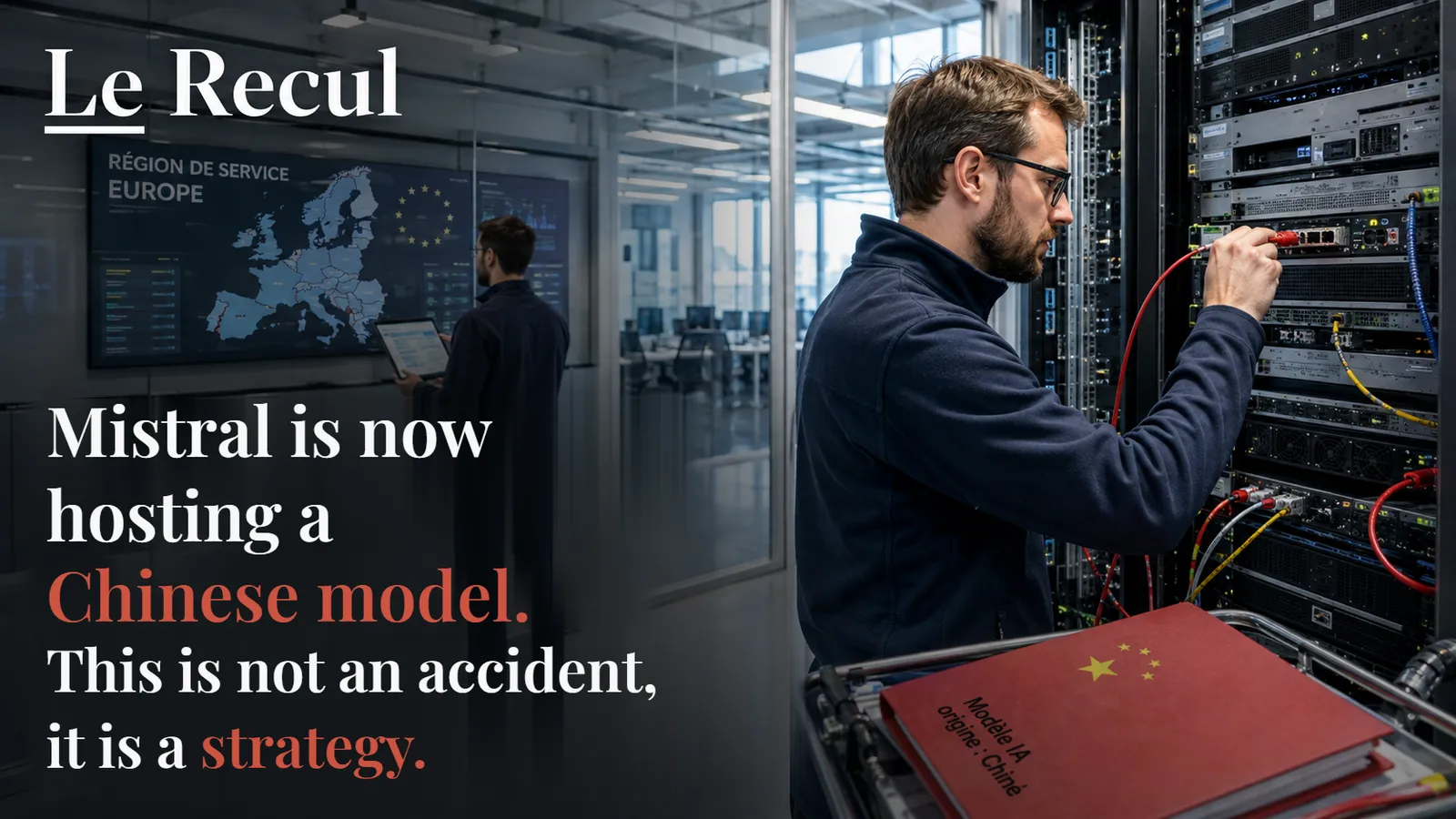
On 11 August 2026, Mistral AI announced that third-party open models would now run on its own platform. The first of them is GLM-5.2, designed by the Chinese lab Z.ai.
Put plainly: Europe’s artificial intelligence champion is running, on its servers, a model it did not design, whose architecture and learned parameters it does not claim, and which comes from the country against which Europe is supposed to be building its sovereignty.
This is not a scandal. It is a rational choice, openly made, and probably the right one commercially. But it is a change of nature that needs naming precisely, because it redefines what the word “sovereign” covers in the contracts European companies are about to sign.
What was announced, exactly
Mistral’s announcement rests on three pillars, and it is worth separating them because they do not tell the same story.
First pillar: regional control. The “Regional Endpoints” move to general availability. In practice, two distinct addresses — api.eu.mistral.ai and api.us.mistral.ai — let a customer choose the region where their inference is processed. Added to that is a Priority Tier in public preview, with a 99.5 % availability commitment and negotiated rate limits. Mistral presents itself as “the only European AI lab” offering both a choice of region and a service under contractual commitment.
Second pillar: opening to third-party models. GLM-5.2 is the first. It runs on the same infrastructure as the in-house models, with the same regional controls and the same service level.
Third pillar: pre-funded compute. Five large European accounts — Amadeus, ASML, Capgemini, Caisse des Dépôts and CMA CGM — are committing to long-term capacity. Stated target: up to 200 megawatts by end 2027 and up to 1 gigawatt by end 2030.
Read together, this is no longer a research lab’s announcement. It is an infrastructure provider’s.
GLM-5.2: why that model
The choice is not arbitrary, and it deserves defending before it is discussed.
GLM-5.2 was released on 13 June 2026 by Z.ai, formerly Zhipu AI. It is a mixture-of-experts model with 753 billion parameters, of which roughly 40 billion are active per token, a context window of one million tokens and a maximum output of 128,000. Its weights are published on Hugging Face under the MIT licence, with no regional restriction — the most permissive licence there is.
On coding tasks it leads the open-weights field: 62.1 on SWE-bench Pro, where GPT-5.5 scores 58.6. On Terminal-Bench 2.1 it reaches 81.0. All at a usage cost around six times lower than OpenAI’s model on agentic coding workloads.
Mistral’s chief technology officer, Timothée Lacroix, justified the choice without hedging: “it’s an excellent model, everybody loves it, it’s open weight, there was no good reason” not to.
He is right. That is precisely what makes the decision interesting.
The mechanism that makes this possible is one we have documented elsewhere: China does not sell its best models, it gives them away, and that free access is not philanthropy but a strategy for occupying the ground. We measured what that produces when we set the biggest open model ever published against the most expensive model on the market, in our comparison of Kimi K3 and Claude Fable 5.
Mistral is simply the first major European player to draw the logical conclusion.
The detail almost nobody noticed: it started in December
This is where the story stops being news and becomes a trend.
Mistral Large 3, the company’s flagship model released in December 2025, is a mixture of experts with 675 billion parameters of which 41 billion are active, a 256,000-token context, published under the Apache 2.0 licence.
Researchers who publicly compared the configuration files established an awkward fact: Mistral Large 3 uses DeepSeek V3’s architecture, including its latent attention mechanism. Same hidden dimension of 7,168, same number of layers — 61. The only difference noted: Mistral halved the number of experts while doubling the size of each.
Let us be precise about what that does not mean. It is not a copied model: Mistral uses its own tokeniser, which indicates training from scratch rather than reusing DeepSeek’s weights. A published architecture is meant to be reused — that is the whole principle of open research — and nobody has accused Mistral of anything illegitimate.
But it does mean this: eight months before hosting a Chinese model, Europe’s champion was already running its own flagship on a Chinese blueprint. The 11 August announcement is not a break. It is the visible completion of a movement that had already happened inside.
Architectures travel in every direction; what does not travel is the scale of the means behind them.
What “sovereign” means here, exactly
This is the most important point in this article, and the least spectacular.
Mistral’s offer guarantees a contractual locality of data: processing takes place in the chosen region. That is not nothing, and it is more than most American competitors offer.
But it is not an exclusively European supply chain either, and the company’s own documentation says so. Processing happens in the selected region “with limited and framed transfers to subprocessors located outside that region”. Read the sentence twice: the sovereignty sold here is a contractual commitment with documented exceptions, not physical watertightness.
Three other edges are worth knowing before signing:
- At launch, agent features, batch processing and file management are not covered by the regional addresses. Only base inference and function calling are.
- Zero Data Retention must be switched on separately. It is not included by default when you pick a region.
- The 99.5 % availability commitment comes with no published compensation structure. Credits and penalties in case of breach have to be negotiated case by case.
None of this is dishonest. All of it is written down. But between “sovereign” as it sounds in a political speech and “sovereign” as it appears in technical documentation, the gap is real — and it is exactly the kind of gap we measured when we compared Perplexity and Mistral’s Le Chat on what actually happens to your data.
What sovereignty costs: the exact rate
The premium has a number on it, and it is instructive.
| Option | What it gives you | Premium |
|---|---|---|
| Public rate | Standard inference, no region guarantee | baseline |
| Regional Endpoint | Processing pinned to Europe or the United States | +10 % |
| Priority Tier | 99.5 % availability, negotiated rate limits | +75 % |
| Both together | Guaranteed region + committed service | about +92.5 % |
On Mistral’s platform, GLM-5.2 is billed at roughly €1.19 per million input tokens (€0.119 for cached input) and €3.74 per million output tokens. That is in the same range as Z.ai’s own direct rate, around $1.40 and $4.40.
The business model is therefore perfectly clear, and perfectly legitimate: Mistral does not make money on the model, which is free to download. It makes money on where it runs, the guarantee around it and the invoice that comes with it. That is a hosting business, and it is a good business.
The Z.ai problem: what the American register says
This point needs making without drama, but without skipping it either.
On 16 January 2025, the Bureau of Industry and Security at the US Department of Commerce published a rule adding eleven Chinese entities to the Entity List. Among them: Beijing Zhipu Huazhang Technology, the company behind Z.ai. The reason recorded in the Federal Register is explicit — these entities advance the military modernisation of the People’s Republic of China through the development and integration of advanced artificial intelligence research. Any export, re-export or transfer of items subject to American regulation to that entity requires a licence, with a presumption of denial.
Zhipu publicly contested the decision, calling it “without factual basis”, and said it would keep competing globally without depending on American technology.
What does that status change for a European user? Legally, less than you might think. The Entity List restricts exports to the listed entity; it does not forbid using a model whose weights are published under an MIT licence. The risk lies elsewhere: it is political and contractual. It becomes real for a company subject to American obligations, or if Washington widens its net.
And that is exactly where the calendar gets interesting.
Four days later, Washington asked everyone to pick a side
On 15 August 2026, four days after Mistral’s announcement, Reuters revealed that a draft American letter was circulating among dozens of partner countries. The message: those joining a competing framework led by Beijing would be excluded from the US-led AI coalition.
That framework is Pax Silica. It is a State Department initiative launched in December 2025 to secure the whole AI supply chain — models, semiconductors, critical minerals. Seven countries signed at launch: the United States, the United Kingdom, Japan, South Korea, Singapore, Australia and Israel. By August 2026 the declaration had 25 signatories, and a separate text, the “AI Opportunity Statement”, gathered 35.
The draft letter is worded without ambiguity: signing the declaration “is not a mere subscription but a commitment”, and it “cannot be held in parallel with membership of redundant initiatives whose expectations conflict with ours”.
We should be precise about what that does and does not imply. Nothing at this stage forbids a European company from hosting a Chinese open-weights model. But the direction of travel is clear: Washington is building an exclusivity mechanism, and Europe has not publicly settled its position.
This is not a hypothetical. The other bloc is building its own structure at the same time, as we showed when Beijing launched its world AI organization — the same article that details Pax Silica’s membership and the countries that signed both.
Mistral therefore sits at the exact intersection of the two blocs: European infrastructure, funded in part by a Dutch shareholder that is the most strategic link in the Western semiconductor chain, serving a model designed by an entity on the American blacklist.
The arithmetic that explains everything
Once those elements are laid out, Mistral’s decision becomes far less mysterious. It comes down to a ratio of means.
The company closed a Series C of €1.7 billion, led by ASML, which invested €1.3 billion for 11 % of the capital and a board seat, alongside DST Global, Andreessen Horowitz, Bpifrance, General Catalyst, Index Ventures, Lightspeed and Nvidia. Post-money valuation: €11.7 billion. Announced annual contracted revenue: €312 million, on a contract volume of €1.4 billion.
Since its founding, the total raised sits, according to financial databases that do not entirely agree, between $3 and $4 billion — we take the higher end, the more favourable to the company.
A further round is also under discussion. Bloomberg reported on 12 June 2026 that Mistral was negotiating around €3 billion at a valuation close to €20 billion. Take it for what it is: preliminary talks, reported by anonymous sources, not confirmed by a closed round. The last official figure remains €11.7 billion.
Now the cost of the stated ambition. Independent estimates put the construction of one gigawatt of compute capacity at around $38 billion of investment. That is roughly ten times everything the company has raised since day one.
The concrete projects give the real measure of the job:
- Bruyères-le-Châtel, in Essonne: Mistral’s first data centre, 44 megawatts, roughly 13,800 Nvidia GB300 chips, hosted by Eclairion, operational in the second quarter of 2026.
- Borlänge, in Sweden: agreement signed on 11 February 2026 with EcoDataCenter, €1.2 billion, 23 megawatts, opening planned for 2027.
Add them up: about 67 megawatts committed against a target of 1,000. It is a serious start, and it is a long way short.
In that context, spending billions training a model that would land behind a Chinese model available free under an MIT licence is not ambition: it is a misallocation. The pivot is not a whim. It is a budget constraint turned into a strategy.
And the underlying economics are the ones we described when low-cost Chinese models arrived: when the price of the model tends towards zero, value moves to whatever stays scarce. We analysed that shift in detail in the API price war DeepSeek set off.
What our own ranking says
We maintain an AI ranking aggregated from public measurement sources. It is worth what those sources are worth — which is to say it is noisy, the same model can appear at several levels depending on the test protocol, and it should never be read as a final verdict. But the order of magnitude is instructive.
In the general-purpose category, no Mistral model appears in the first forty places. The brand’s best-placed model sits beyond eightieth. Models in the GLM family appear from around fortieth.
This is not a humiliation: Mistral publishes its models as open weights under permissive licences, which many better-ranked competitors do not, and its compact models remain very well positioned on performance per size. But it confirms the diagnosis in figures: the frontier is not there. And a company that knows this has a choice between denying it and acting on it.
To compare positions in detail, our AI ranking is updated continuously, and the open-source category is where this particular race is run.
Is this a retreat? The two readings
Here are the two cases, each at its strongest.
The retreat case. Europe wanted its own OpenAI. It is becoming the place where other people’s OpenAI runs. The promise has gone from “we build intelligence” to “we host other people’s intelligence on European soil”. That is less glorious, and above all it moves the value: whoever designs the model captures the margin and sets the rules; whoever hosts it takes an infrastructure commission and inherits someone else’s technical choices. French entrepreneur and engineer Pierre-Louis Biojout summarises the trajectory as a move from a leading European lab to an integrator of models designed by others, Chinese ones in particular.
The realism case. Adoption creates more economic value than invention. A continent that massively deploys excellent AI across its banks, its hospitals and its factories does better than a continent burning its capital chasing a technological frontier it will not reach. Shahin Vallee, a geoeconomics specialist at the German Council on Foreign Relations, argues that favouring “AI adoption rather than innovation” is “the right strategy for Mistral and for Europe”.
Both cases are solid, and they do not exclude each other. The question is not which is true, but what you accept losing by choosing the second.
What you lose is identifiable: the ability to set the model’s implicit values, its refusals, its blind spots, its cultural and political biases. A model is not a neutral component. Hosting someone else’s in Europe protects European data. It does not make European the decisions taken during its training.
What this changes in practice
If you are a European company buying from Mistral. You get one of the best coding models in the world, on European infrastructure, with an availability commitment. Check three things before signing: that your usage falls within the functions covered by the regional endpoints, that Zero Data Retention is switched on, and that the penalties for an SLA breach are written down. Check too whether your organisation has obligations under American law.
If you are a developer. Nothing obliges you to go through Mistral: GLM-5.2’s weights are public under an MIT licence. Mistral’s offer is justified if you want the region guarantee and the managed service, not if you are after the lowest raw price.
If you are simply a user. The change is invisible in the interface, and that is precisely why this article exists. When you read “sovereign AI”, ask three questions: sovereign where (the place of processing), sovereign by whom (who designed the model), and sovereign under what contract (which exceptions are written down). The three answers are now different.
What to remember
Mistral hid nothing, lied about nothing, and broke no rule. The company made a coherent industrial choice, documented it, and explained it through its chief technology officer. You can even argue it is the only rational choice with $4 billion against competitors committing ten times more.
What deserves saying clearly is what that choice implies. The sovereignty being sold in Europe today is not a sovereignty of invention: it is a sovereignty of location and contract. That is real, useful and sellable — and it is not what the word suggested in the speeches of 2023.
The only real risk would be to keep politically funding a frontier-technology ambition while in practice buying a hosting service. Those are two different businesses, with two different cost structures and two different horizons. Confusing them is setting yourself up to be disappointed by the second because the first was promised.
To place this shift in the wider calendar, the models to watch category applies the same method: separating what is measured from what is projected.
The number to remember
$38 billion against 4. The first is the independent estimate of what it costs to build the gigawatt of capacity Mistral is targeting for 2030. The second is the total the company has raised since its founding, taken at the most favourable end of the range. Between the two there is no problem of ambition, and none of talent: there is a factor of ten. And a factor of ten, in industry, is not closed by willpower — it is closed by capital, or it is bypassed by changing business. On 11 August 2026, Mistral chose to bypass it.