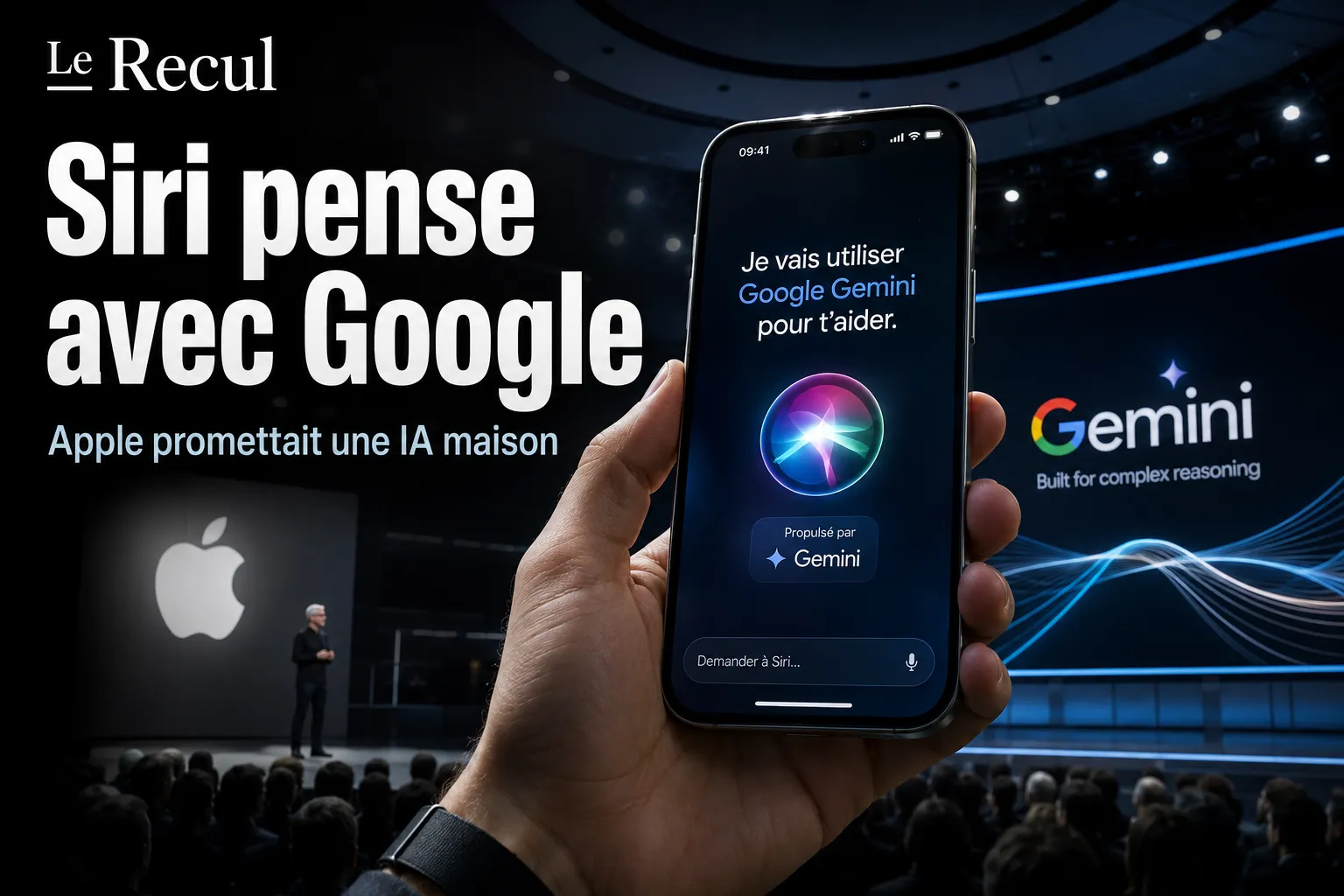
Apple promised an in-house AI. Siri now thinks with Google.
On Monday 8 June 2026, in Cupertino, Apple presented Siri AI, its biggest assistant overhaul in fifteen years.
On stage, the story was clean, polished, perfectly Apple: Siri is reborn. Smarter. More contextual. More personal. More able to act inside your apps.
But under the varnish, the awkward detail is simple.
The new Siri no longer thinks alone.
For the heaviest requests, Apple now leans on Gemini, Google’s model.
Apple promised an in-house AI. It comes back with a more powerful assistant, wired into a rival’s brain.
This is not a small update.
It is a strategic admission.
Apple did not only present the new Siri.
Apple acknowledged that it could no longer catch up in the AI assistant war on its own.
The fact
At WWDC 2026, Apple unveiled Siri AI, a completely rethought version of its voice assistant.
The new assistant is meant to work both inside the Apple system and as a standalone app on iPhone, iPad and Mac. It can answer more conversationally, understand personal context, find information in messages, emails or photos, analyse what is on screen, and carry out actions across several apps.
This is the Siri Apple had been promising since 2024.
But the engine is not as “in-house” as the pitch might suggest.
According to The Next Web and several tech outlets, the architecture rests on three tiers:
- simple tasks stay on the device, with Apple’s models;
- more complex requests go through Apple’s Private Cloud Compute;
- the heaviest reasoning is routed to Google Cloud, through a customised Gemini model.
Translation: Apple keeps the interface, the control, the privacy narrative.
But the heavy brain comes from Google.
The detail Apple would rather not shout about
Officially, Apple talks about Apple Intelligence.
That makes sense. It is its brand. Its story. Its ecosystem.
Apple wants the user to see continuity: the iPhone, iOS, Siri, privacy, local processing, the private cloud.
But the detail that changes everything is elsewhere.
When Siri genuinely has to think, reason, understand a complex request or produce an advanced answer, Apple leans on Gemini.
Not on an in-house model alone.
Not on a discreet little external component.
On Google.
The historic rival.
Google is Android against iOS.
Google is Search against Safari.
Google is Gemini against Apple Intelligence.
And now Google also becomes part of Siri’s brain.
That is what makes this announcement so uncomfortable for Apple.
One sentence sums it up
Apple keeps the voice.
Google supplies part of the brain.
It is blunt, but it is the heart of the story.
The Siri the user sees will indeed be Apple: Apple design, Apple animation, Apple integration, Apple privacy, Apple promise.
But behind some answers, the reasoning will come from a Google model.
That is not necessarily bad for the user.
On the contrary, it may finally make Siri useful.
But for Apple, the symbolism is violent.
For years, the company sold one simple idea: it controls everything better than anyone else.
The hardware.
The software.
The chips.
The system.
Privacy.
The experience.
With Siri AI, Apple keeps the packaging.
But it rents part of the engine.
What Apple showed
Siri AI is finally meant to do what users have been waiting years for.
Understand a natural request.
Find a piece of personal information.
Answer a question about what is on screen.
Launch an action inside an app.
Chain several steps.
Keep a conversation history.
Go back to an earlier result.
Adapt to context.
In short: Siri no longer wants to be the assistant that fluffs a simple question or falls back on a web search. Apple wants to make it a real AI assistant, close to the new standard set by ChatGPT, Gemini or Claude.
And that change is necessary.
Siri launched in 2011. For more than a decade, Apple kept a lead in image, but not in use. Siri was everywhere, but rarely impressive.
In 2026, Apple is finally trying to repair that gap.
The timeline of the discomfort
The important date is not only 8 June 2026.
You have to go back to June 2024.
At WWDC 2024, Apple presented Apple Intelligence and promised a more personal, more contextual Siri, able to understand the information on the iPhone and act inside apps.
That was Apple’s big answer to ChatGPT.
Except the product did not arrive as promised.
In March 2025, Apple had to admit that some major Siri features would take longer than expected.
Then the delays piled up.
Then the media pressure.
Then the legal pressure.
TechCrunch recalls that Apple accepted a 250 million dollar settlement in a class action over AI promises that claimants considered misleading, without admitting fault.
So WWDC 2026 is not a normal keynote.
It is a catch-up session.
Apple is not only presenting something new.
Apple is trying to prove that two years of promises were not hot air.
January 2026: the real turning point
The Google partnership does not come out of nowhere.
As early as January 2026, several sources reported that Apple was moving towards Gemini to power the next generation of Siri.
The figure going round is spectacular: around 1 billion dollars a year for access to a customised version of Gemini.
Another striking figure: the Gemini model used is said to run to around 1,200 billion parameters.
A caveat: these figures come from reporting, notably attributed to Bloomberg and picked up by the specialist press. Apple does not publicly confirm this kind of commercial or technical detail.
But even with that caution, the signal is clear.
Apple is not just looking for a small reinforcement.
Apple is buying time.
And it is buying that time from Google.
Apple’s most awkward billion
A billion dollars a year, for Apple, is not insurmountable.
The company can afford it.
But symbolically, that billion says something else.
It states the price of being late.
While Google, OpenAI, Anthropic and Meta were building massive models, Apple was betting on a more cautious, more local, more controlled approach.
That was consistent with its DNA.
But generative AI changed the rules.
For some tasks, small local models are not enough. For advanced reasoning, deep understanding, long requests, multimodal answers and assistants able to act, you still need considerable cloud power.
Apple has its chips.
Apple has its devices.
Apple has its system.
But for Siri, Apple goes and gets Gemini.
That is what makes this story so unsettling.
The most integrated company in the world has to outsource part of the intelligence.
This is not an isolated move on Google’s side either: we described what Google was building when it made clear that it no longer wants you to open an AI at all, but to have Gemini already there, everywhere you work. Siri is now one of those places.
The Nvidia paradox
Another awkward detail: the new Siri does not rest only on Google.
It also rests, indirectly, on Nvidia.
According to several specialist outlets, the heavy processing tied to the cloud model relies on Nvidia GPUs, notably Blackwell architectures inside cloud infrastructure.
Here again, this is not absurd.
The whole AI sector depends on Nvidia GPUs.
But for Apple, the contrast is stark.
Apple built its modern narrative around its in-house chips: Apple Silicon, M1, M2, M3, M4, M5, efficiency, control, vertical integration.
And now Siri’s most advanced AI depends on a chain that runs outside the Apple garden: Google Cloud, Gemini, Nvidia.
Apple keeps the garden.
But the brain grows elsewhere.
That local-versus-cloud tension is not unique to Apple. Google itself is pushing in the opposite direction with its small models, as we saw when Gemma 4 set out to make local AI serious enough to take on the cloud.
Europe left at the door
For French users, there is another problem.
Siri AI will not be available straight away in the European Union.
Apple points to the Digital Markets Act, the DMA, which imposes interoperability and openness rules on large platforms. The company argues that these obligations could create privacy and security risks if competing assistants were to gain access to certain data or system features.
The European Union replies that the DMA does not prohibit launching products.
AP reports that Brussels and Apple are blaming each other for the delay: Apple says the regulation complicates deployment, the Commission considers that Apple is choosing not to launch the service rather than offering a compliant solution.
The result: Americans watch Siri AI arrive.
Europeans watch the demo.
Once again, AI arrives first as a promise.
Apple’s installed base becomes a problem
Another uncomfortable figure: not every Apple device will be able to keep up.
According to Reuters, Morgan Stanley estimates that more than 850 million iPhones cannot run basic Apple Intelligence requests.
More striking still: more than 1.3 billion Apple devices would be unable to use the new Siri’s advanced features.
The reason is simple: advanced AI features demand a lot of memory, recent chips and a suitable architecture.
So the new Siri will not only be a software update.
It also becomes an argument for replacing hardware.
This is where the pitch gets colder.
Apple sells a smarter AI.
But for many users, that intelligence will require a new device.
Siri AI is not only a promise of an assistant.
It is also silent pressure on the installed base.
The market’s verdict
The stock market did not applaud.
After the keynote, Apple shares fell by around 1.9%, according to several financial outlets.
That is not a collapse.
But it is a signal.
Investors were not only waiting for Siri to catch up.
They were waiting for Apple to show a real lead.
What WWDC 2026 reveals instead is a company moving forward, but borrowing someone else’s power.
Apple did not present an “iPhone” moment.
Apple presented a “catch-up” moment.
And the market understood.
The real winner was not on stage
The big winner of this keynote may not have been Apple.
It was Google.
By placing Gemini behind Siri’s heavy reasoning, Google settles into one of the most valuable ecosystems on the planet: the iPhone.
Even if Apple keeps the interface.
Even if Apple filters the requests.
Even if Apple protects the experience.
Even if Google does not see everything.
The industrial message is enormous: to make Siri credible, Apple needs Gemini.
Google is not only winning a contract.
Google is winning a validation.
When Apple, the company of absolute control, picks your model for its assistant, you are no longer merely a competitor.
You become infrastructure.
Privacy as a shield
Apple’s defence comes down to one word: privacy.
Apple insists on local processing, Private Cloud Compute, limiting the data sent, the absence of any Google training on Siri requests, and end-to-end control of the user experience.
That is probably true in intent.
And it is probably what still sets Apple apart from its rivals.
But the problem runs deeper.
The average user will not understand the architecture.
They will not always know what stays on the device, what goes to Apple, what passes through Google, what is processed in the cloud, what is deleted, what is kept, or what is technically accessible.
Apple may have the best guardrails.
But as soon as an assistant mixes device, private cloud, third-party model and Google infrastructure, the promise becomes more complex.
And the more complex a promise is, the more trust it demands.
The trap of “Siri is finally smart”
It would be easy to sum up WWDC 2026 like this:
“Siri is finally smart.”
But that sentence is too kind.
The true sentence is harder:
“Siri is finally smart because Apple accepts that it can no longer think alone.”
That is the whole difference.
The product may be better.
The user may gain from it.
Apple may even be strategically right.
But the story changes.
For years, Apple said: we move more slowly, but better; less open, but safer; less spectacular, but more integrated.
With Siri AI, Apple is saying something else:
we do it better, but with Google.
What this says about AI in 2026
The Siri story goes beyond Apple.
It describes the real state of AI in 2026.
Even the richest giants cannot all develop, on their own, the best models, the best infrastructure, the best chips, the best assistants and the best clouds.
Modern AI has become a chain.
An assistant is no longer just a voice.
It is:
- a local model;
- a cloud model;
- a compute infrastructure;
- a GPU supplier;
- an external partner;
- a data policy;
- a security layer;
- an interface;
- a contract;
- a regulation;
- a commercial strategy.
When you say “Hey Siri”, you are no longer only talking to your iPhone.
You are talking to an architecture.
And that architecture can involve Apple, Google, Nvidia, European regulators, your device’s hardware limits and contracts you will never see.
Where each of these assistants actually stands, measured rather than announced, is what our AI assistant ranking tracks.
Le Recul
Apple did not lose the AI war on 8 June 2026.
But Apple stopped pretending it could win it alone.
That is the most important point.
Siri AI may be useful.
Siri AI may be better designed than rival assistants.
Siri AI may protect data more than other solutions.
But Siri AI also marks a fracture in the Apple story.
The company that promised a private, integrated, in-house, vertical intelligence ends up wiring its assistant into Google for the heaviest reasoning.
This is not a technical betrayal.
It is a symbolic capitulation.
Apple keeps the facade.
Google walks into the machine.
And the user will mostly see a smoother animation, a more natural voice, a smarter answer.
That may be the most troubling part.
The dependency will not be visible.
It will simply answer better.
What to take away
Apple presented Siri AI on 8 June 2026, during WWDC.
It is the biggest overhaul of Siri since its launch on the iPhone in 2011.
The new Siri becomes more conversational, more contextual, more integrated into apps, and available both as a system assistant and as a standalone app.
Apple keeps a hybrid architecture: local processing, Private Cloud Compute, then Google Cloud for the heaviest reasoning.
Gemini therefore becomes an essential part of the new Siri, even though Apple keeps the interface and the privacy narrative.
The deal’s figures — around 1 billion dollars a year and a customised Gemini model of roughly 1,200 billion parameters — come from reporting, not from direct confirmation by Apple.
The European launch is delayed, with Apple and Brussels blaming each other over the Digital Markets Act.
According to Morgan Stanley, more than 850 million iPhones cannot run basic Apple Intelligence requests, and more than 1.3 billion Apple devices would be excluded from Siri AI’s advanced features.
After the keynote, Apple shares fell by around 1.9%, a sign that the market saw catch-up rather than revolution.
The figure to remember is not only 1 billion dollars.
The real figure is zero.
Zero genuinely modern Siri without Google.
The line to remember
Apple promised an in-house AI.
It comes back with Siri.
But when Siri really has to think, it is Google thinking in the shadows.