

For two years, comparing AI video generators was a three-way affair. It is now a two-way one: on 24 March 2026 OpenAI announced Sora would shut down in two stages — consumer app closed on 26 April 2026, API stopped on 24 September 2026 — with no replacement and no timeline for a Sora 3. A good half of the comparisons available online still recommend it.
That leaves two products anyone can use today: Veo 3.1, released by Google DeepMind on 15 October 2025 and built into Gemini and Flow; and Kling 3.0, released by the Chinese group Kuaishou on 5 February 2026, accessible with nothing more than an email address. One is ranked higher than the other in independent evaluations. It is not the one that wins this comparison.
Test results: the verdict in brief
Veo 3.1 wins this comparison 4 criteria to 3, with one tie — even though Kling 3.0 is better at raw generation. That is the paradox of this category in 2026: the best-performing model is not the most usable one, and the gap has almost nothing to do with image quality.
A note for English-speaking readers. The French edition of this comparison scores it 5-3, because Kling’s native audio does not speak French and that alone rules it out for a French creator. English is one of its five supported languages, with American, British and Indian variants. That criterion therefore does not apply to you, and the score moves to 4-3 with one tie. The winner is the same — but for contractual and regulatory reasons, not linguistic ones. You deserve to know which of these arguments is yours and which is not.
| Criterion | Veo 3.1 (Google) | Kling 3.0 (Kuaishou) | Edge |
|---|---|---|---|
| Measured quality (Le Recul ranking) | 18th — 79.66 | 11th — 82.84 | Kling |
| Cost to start | €7.99/month (Veo 3 Fast), €21.99/month for Veo 3.1 — no free tier | 66 free credits/day, then ~$7/month | Kling |
| Format flexibility | 4, 6 or 8 s — 24 fps — 16:9 and 9:16 | 3 to 15 s — 60 fps — native 4K — 6 chained shots — 16:9, 9:16 and 1:1 | Kling |
| Generation speed (8 s clip) | 60 to 120 s (30 to 50 s on Fast) | 45 to 90 s | Kling |
| Audio, dialogue and languages | 48 kHz, lip sync | 5 languages including English, regional accents, per-character lines | Tie in English |
| Marking and EU compliance | SynthID on every output | No machine-readable mechanism exposed | Veo |
| Commercial rights and licence granted | Included in the subscription | Members only — attribution imposed on non-members, broad licence granted to the vendor, no refunds | Veo |
| Content policy | No sexual content, no identifiable public figures | Same limits + political use banned + discretionary blocking | Veo |
Le Recul's verdict. Veo 3.1 wins 4-3, but the score hides the essential point: these two tools are not separated by image quality, they are separated by what you are allowed to do with the file once it exists. Kling generates better, longer, faster and for less. Veo generates a file you can publish without wondering.
Kling 3.0 dominates the technical side, and the gap is not thin: clips nearly twice as long, native 4K at 60 frames per second, six shots chainable in a single request, square format on top, faster rendering, and a better place than Veo in two independent leaderboards. For prototyping, testing an idea or producing mood shots, there is no debate.
But two contractual obstacles and one regulatory one decide it. Since 2 August 2026, article 50 of the EU AI Act requires machine-readable marking, which Google applies through SynthID and Kling does not expose — and that binds anyone whose output reaches the EU market, wherever they sit. Kling's terms then prohibit all commercial use outside a paid plan and require you to display the Kling AI mark on your own videos — while granting the vendor a very broad licence over what you produce, training its models included. That is not legal small print: it is the difference between a file whose use you control and a file whose control you share.
What changed: the third contender is gone
We have to start here, because half the comparisons available online are out of date.
On 19 March 2026, OpenAI was still shipping new editing tools in Sora. Five days later, on 24 March, the company announced the product’s end in two stages: app closure on 26 April 2026, API shutdown on 24 September 2026. Users were invited to download their content before the deadlines, after which the data is permanently deleted.
No replacement was announced. The reason given is a redeployment of compute towards developer tools and enterprise customers.
In our AI ranking, Video category, Sora 2 still sits in 48th place with a score of 72.45. It is no longer an option: it is a model at end of life.

Quality: Kling ahead of Veo, and both far from the top
This is where most comparisons simply replay the vendors’ demo reels. We looked at two independent evaluations, which reach the same relative ranking.
In our AI ranking, which aggregates several evaluation sources across 140 video models, Kling 3.0 1080p (Pro) holds 11th place with 82.84, its Omni variant 13th (81.35). Veo 3.1’s best variant — Fast Preview — comes 18th with 79.66, the standard version 30th with 76.28.
In the Artificial Analysis arena, built on blind human votes, the leaderboard for models with audio puts Kling 3.0 1080p Pro at 1,111 Elo points and Veo 3.1 at 1,094. Kling 3.0 720p Standard (1,101) also beats Veo 3.1 Fast and Lite (1,090 each).
The gap is real but moderate: around fifteen Elo points, meaning a slightly more frequent human preference, not a chasm visible on every shot. In practice both produce usable clips, with different weaknesses — Kling is more comfortable with movement and complex scenes, Veo with facial coherence and holding a line of dialogue.
Price: two business models that do not compare directly
This is the criterion handled worst elsewhere, because the two vendors do not bill for the same thing.
Google bills per second, audio included by default. Official API rates as of 4 August 2026:
| Variant | 720p | 1080p | 4K | 8 s video in 1080p |
|---|---|---|---|---|
| Veo 3.1 Standard | $0.40/s | $0.40/s | $0.60/s | $3.20 |
| Veo 3.1 Fast | $0.10/s | $0.12/s | $0.30/s | $0.96 |
| Veo 3.1 Lite | $0.05/s | $0.08/s | not supported | $0.64 |
Google only bills if the video is actually produced: a failed audio generation is not charged.
Kuaishou bills in credits, on a grid running from 6 credits per second (720p without audio) to 12 credits per second (1080p with native audio). A 5-second video in 720p without audio therefore costs around 30 credits, the same one in 1080p with sound around 60. The plans: Standard around $7/month (660 credits, 1080p, no watermark, commercial use allowed), Pro at $29.99 (3,000 credits), Ultra at $59.99 (8,000 credits). Through the API, resellers charge between $0.075 and $0.112 per second.
On the Google subscription side, there are three tiers, which most comparisons skip (European prices; they vary by country):
- Gemini free: no video generation.
- Google AI Plus, €7.99/month (often €3.99 for the first two months on promotion): video generation, but with Veo 3 Fast, not Veo 3.1.
- Google AI Pro, €21.99/month: Veo 3.1 and 1,000 monthly Flow credits, or about 100 videos on Lite, 50 on Fast or 10 at maximum quality. The Ultra plan goes up to 25,000 credits.
Kling’s free tier deserves a close look, because it is its main selling point and it is systematically oversold. It gives 66 credits a day, not carried over, with duration capped around 5 seconds, a systematic watermark, low queue priority and strictly personal use. Above all, Kling 3.0 consumes noticeably more credits than earlier versions, and third-party sources diverge sharply on what those 66 credits actually allow: one to two daily generations in professional mode according to some, none according to others reporting far higher per-generation costs on partner platforms.
We do not settle that point: the Credits Policy document referenced in Kling’s official documentation was empty when we consulted it on 4 August 2026, and no official credit grid is published there. But the robust conclusion is the same under either hypothesis: Kling’s free tier lets you discover the platform, not exploit Kling 3.0 at its best. The criterion still goes to Kling, because Google offers no free video generation at all, but it is far narrower than rival comparisons suggest — and it comes with the contractual obligations detailed below.
Format: this is where Kling crushes the match
On raw specifications there is no discussion.
Veo 3.1 produces clips of 4, 6 or 8 seconds, in 720p, 1080p or 4K, at 24 frames per second, in 16:9 and 9:16 only. Two features compensate for the brevity: Frames to Video, which generates a continuous shot between a start image and an end image you supply; and Ingredients to Video, which maintains style and character coherence from up to three reference images. The Flow tool finally allows scene extension: by regenerating from the last second of the previous shot, with visual and audio continuity, you assemble sequences of 60 seconds and more by chaining 8-second clips.
Kling 3.0 produces clips of 3 to 15 seconds (5 seconds by default), goes up to 60 frames per second, offers native 4K on the Omni variant, accepts 16:9, 9:16 and 1:1, and above all allows you to chain up to six shots defined in a single request — a storyboard function with no direct equivalent at Google. In image-to-video generation, resolution automatically follows the format of the supplied image.
In practice: for a single eight-second shot, the gap is small. For a narrative sequence with shot changes, Kling does in one request what takes several generations and an assembly step at Google. On a vertical format for social media, 60 frames per second make a visible difference on fast movement. And the square format, absent at Veo, is still useful for certain ad placements.
Speed: a slight edge to Kling
A criterion rarely quantified, and yet decisive when you are iterating on a prompt.
For an eight-second clip, Veo 3.1 generally takes 60 to 120 seconds at maximum quality, and 30 to 50 seconds on the Fast variant. Kling 3.0 sits around 45 to 90 seconds depending on movement complexity, with a Turbo variant specifically optimised for speed since 17 June 2026.
We flag a divergence: some reports put Kling higher, around 90 to 150 seconds, because of the heavier processing applied to human subjects. The edge therefore goes to Kling at the low end of the range and on Turbo mode, but the gap is not clear enough to be a buying argument on its own.
Audio and languages: the criterion that does not apply to you
This is the point this comparison contributes, and where the English reader parts company with the French one.
Both models generate audio natively, at the same time as the image. Veo 3.1 produces synchronised sound at 48 kHz, including dialogue with lip sync, with no separate processing chain. That is where Google keeps a clear technical lead.
Kling 3.0 also generates synchronised audio, but in five languages only: Chinese, English, Japanese, Korean and Spanish. Within those, the model handles regional variants finely — north-eastern, Beijing, Taiwanese and Sichuanese dialects on the Chinese side; American, British and Indian accents on the English side — and, in a multi-character scene, lets you specify who says which line.
For an English-speaking creator, this is not a limitation at all — it is arguably an advantage. Per-character line attribution has no Veo equivalent, and the three English accents cover most needs. Veo keeps the edge on lip sync fidelity and sample rate; Kling keeps it on casting flexibility. We call it a tie, and we say plainly that the French edition of this comparison does not: there, a dialogue written in French is translated into English by the model, which rules Kling out entirely. Same tool, same facts, opposite conclusion — decided by nothing but which language you write in.
If your videos are mood, product or landscape shots with no dialogue — the majority of real use — the whole criterion is moot anyway.
The criterion that changed everything on 2 August 2026
Since 2 August 2026, article 50 of the EU AI Act applies. It imposes two distinct obligations that need separating.
For the system provider: generated outputs must be marked in a machine-readable format. The regulation does not name a single technology, but the associated code of practice points to a layered approach — C2PA-style cryptographic metadata, plus an imperceptible watermark that survives re-encoding. Penalties reach 15 million euros or 3% of worldwide turnover.
For whoever publishes: deepfake-type content must be flagged as such. That obligation is on you directly, whichever tool you used.
A word on scope, because it is often misread: this is not a European-creators-only problem. The obligation attaches to output placed on the EU market. If your channel, your client or your advert reaches European viewers, it concerns you from wherever you sit.
On the first limb, the gap between the two products is stark. Google embeds SynthID in all its video outputs, an invisible watermark designed to survive re-encoding and resizing, now backed by C2PA metadata. Kling is instead among the tools — with Midjourney, Seedance, Wan, Hailuo, Grok, Recraft and Ideogram — that embed nothing mandatory, or that rely on proprietary internal tracking which does not on its own satisfy the machine-readability requirement.
What that changes in practice: a Veo video carries verifiable proof of origin. A Kling video does not. Google has also announced that from August 2026, visuals generated without a detectable SynthID marker would see reduced visibility in Google Shopping — a signal that foreshadows other platforms’ positions.
Rights and licence: what you give up by generating a video
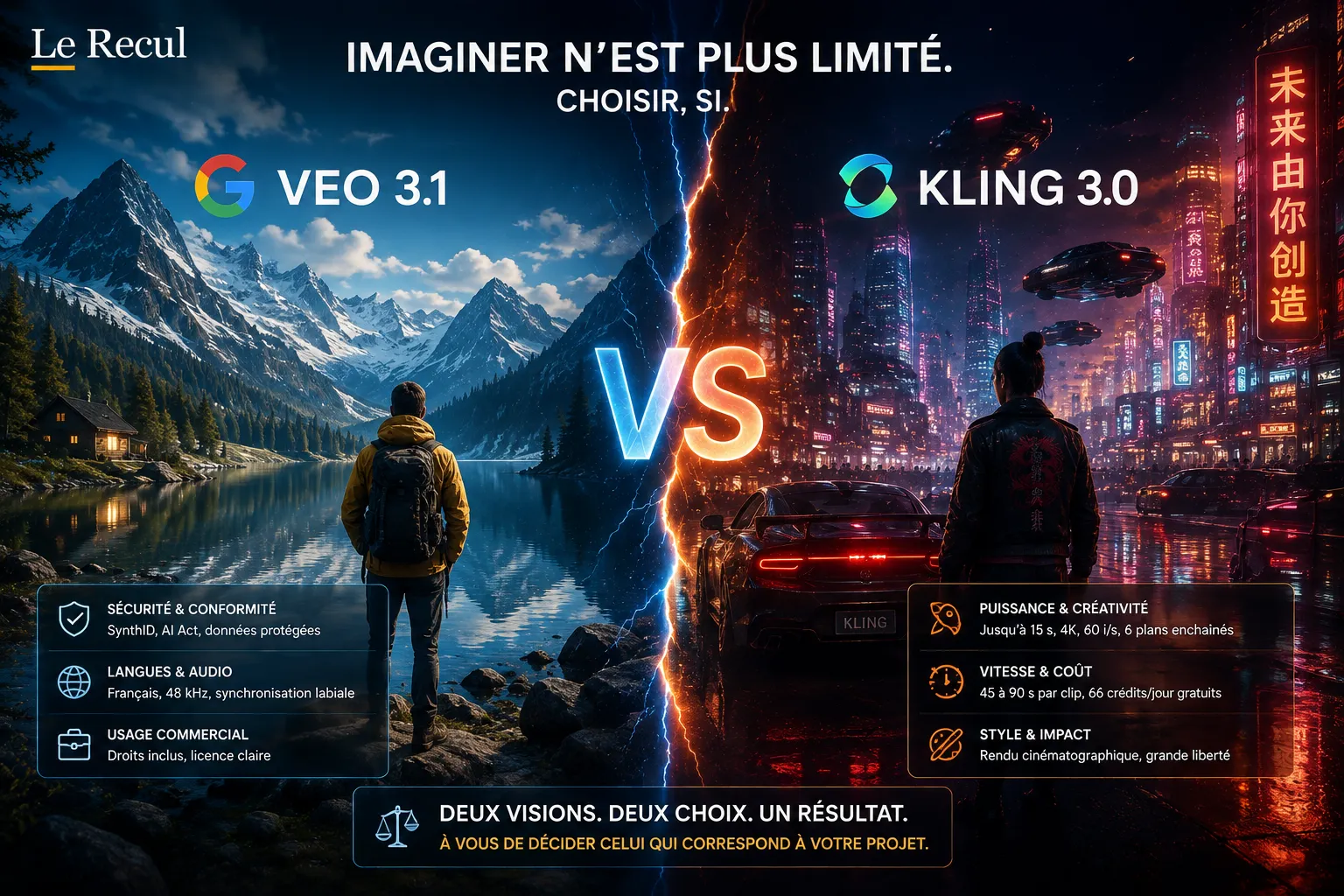
We read Kling’s official terms — terms of use and paid service terms, both in their 21 April 2026 version. They are more precise, and on some points more restrictive, than second-hand analyses report.
You remain the owner. The terms are explicit: you hold the intellectual property rights in your content, and the vendor claims no ownership. That is the good news, and it deserves saying because the opposite circulates often.
But commercial use is reserved to subscribers. The terms prohibit, without written authorisation, using, reproducing, distributing or modifying outputs for commercial purposes. The paid service terms expressly lift that restriction for members: commercial use there is “unrestricted”, with a single exception — developing or offering products or services that compete with Kling AI. Translation: without a subscription, you have no right to commercially exploit what you produce.
Non-members must credit Kling. This is the least known and most concrete clause. A non-subscribing user must display the Kling AI mark and logo on generated content; if the content does not carry the mark “for objective reasons”, they must state prominently that it was generated by Kling AI — in the title or another visible place. Watermark removal is a contractual right reserved to members.
You grant the vendor a very broad licence. By using the service you grant Kling a non-exclusive, royalty-free licence covering both your inputs and your outputs: to host, store, reproduce, modify, create derivative works, communicate to the public and distribute, on any medium and through any channel. The vendor may exploit that content or sub-license it to third parties for promotion and product development, and you undertake to claim no rights in respect of it. The terms explicitly mention using inputs to create, test, improve and train its models. This authorisation is revocable by emailing support. Finally, content you publish on the platform can be picked up by other users as reference images or to produce derivatives.
Two financial clauses worth knowing: once a paid service is activated, sums paid are non-refundable; and credits are neither transferable, nor assignable, nor convertible into money.
Add that the contracting entity is Kling AI Pte. Ltd., a Singapore company, and not the Chinese parent directly — a nuance that matters for determining applicable law, all the more so since the terms impose individual arbitration and a waiver of class actions.
At Google, commercial use is covered by the subscription, with no brand attribution requirement and no licence of that breadth over your productions. We covered the sovereignty angle of that kind of asymmetry in our comparison of Perplexity against Mistral’s Le Chat.
Content policy: two kinds of censorship, not the same kind
Both tools filter, but not the same things, and you need to know before building a project on either.
Veo 3.1 applies zero tolerance to sexual content, gratuitous violence and hate speech, and refuses to generate identifiable public figures — a limit designed against deepfake-type uses, but which also blocks legitimate parody or illustration projects.
Kling 3.0 applies the same prohibitions — its terms explicitly ban obscene, defamatory, hateful or discriminatory content — but adds two clauses absent at Google. The first bans using the service, without written authorisation, for any political purpose, including campaigning, advocacy or lobbying. The second is a general discretion clause: the vendor reserves the right to block any content it deems objectionable “at its sole discretion”.
The edge goes to Veo, not because it is permissive — it is not — but because its restrictions are enumerated and predictable, where Kling’s leave interpretive room open to the vendor. Conversely, the guardrail question is wide open at several competitors, as we examined in our comparison of ChatGPT against Grok on safety and regulation.
The point this comparison cannot leave unsaid
You are choosing between two tools that are neither of them the best on the market. That is unusual in a comparison, and yet it is what our data shows.
In our AI video ranking, the top three places go to Grok Imagine Video 1.5 from xAI (98.33), Gemini Omni Flash from Google (96.51) and Dreamina Seedance 2.0 from ByteDance (95.09). Kling 3.0 Pro is eleventh with 82.84; Veo 3.1’s best variant is eighteenth with 79.66. The Artificial Analysis leaderboard reaches the same hierarchy, with Gemini Omni Flash leading at 1,244 Elo points against 1,111 for Kling and 1,094 for Veo.
The Google case deserves highlighting, because it tells you something about Veo’s future. At Google I/O on 19 and 20 May 2026, the company did not present a Veo 4: it launched an entirely new brand, Gemini Omni. The Gemini Omni Flash model, available since 30 June 2026, generates and edits video through natural-language instructions, keeps characters consistent from shot to shot, also carries SynthID marking — and costs $0.10 per second, the price of Veo 3.1 Fast in 720p. Its current limit at the time of writing: sequences capped at ten seconds. Its 1.1 version, shipped on 27 August 2026, raised that ceiling to forty cumulative seconds — we took that claim apart, and the price that comes with it, against Wan 3.0 from Alibaba.
In other words, Veo 3.1, released on 15 October 2025, went more than nine months without a direct successor while Google built something else alongside. Worth factoring in if you are committing to an annual subscription.
So why compare Veo and Kling at all? Because they are the two products that are finished, tooled and accessible to the general public: interface, storyboard, project management, legible subscription plans. The better-ranked models are either in preview, or reachable mainly through an API, or attached to platforms with very different moderation rules. But if you want the best quality available and you accept going through an API, look at Gemini Omni Flash first.
Which to choose for your situation
You are starting out, testing, not publishing yet → Kling 3.0. The free tier lets you form an opinion without spending anything and the generation quality is higher. Keep in mind the watermark, the ban on commercial use and the fact that 66 daily credits do not go far on Kling 3.0.
You publish anywhere your audience includes the EU → Veo 3.1, through Google AI Pro at €21.99/month. SynthID marking puts you on the right side of the traceability obligation and commercial rights are included.
Your videos have characters speaking English → either, genuinely. Veo has the edge on lip sync; Kling offers three English accents and per-character line attribution. This is the criterion where an English-speaking reader gets a real choice and a French-speaking one does not.
You produce narrative sequences with shot changes → Kling 3.0 Omni, for chaining six shots in one request, native 4K and 60 frames per second, provided you take a paid plan and handle the generated-content disclosure yourself.
You want to try Veo at the lowest price → Google AI Plus at €7.99/month, often €3.99 for the first two months — knowing that this tier opens Veo 3 Fast and not Veo 3.1.
You want the best value through an API → compare Veo 3.1 Lite ($0.05/s in 720p) and Gemini Omni Flash ($0.10/s, ranked much higher), rather than Kling, whose API rates start at $0.075/s for a result now surpassed by several competitors — a price movement that follows the same logic we traced in DeepSeek V4.1 Flash against GPT-5.6 Luna.
Our full AI ranking is updated continuously, and you can line these models up yourself in our free comparator: in this category more than any other, the hierarchy shifts every two to three months.