

A robot in class, a free AI for every teacher: the hype, then the facts
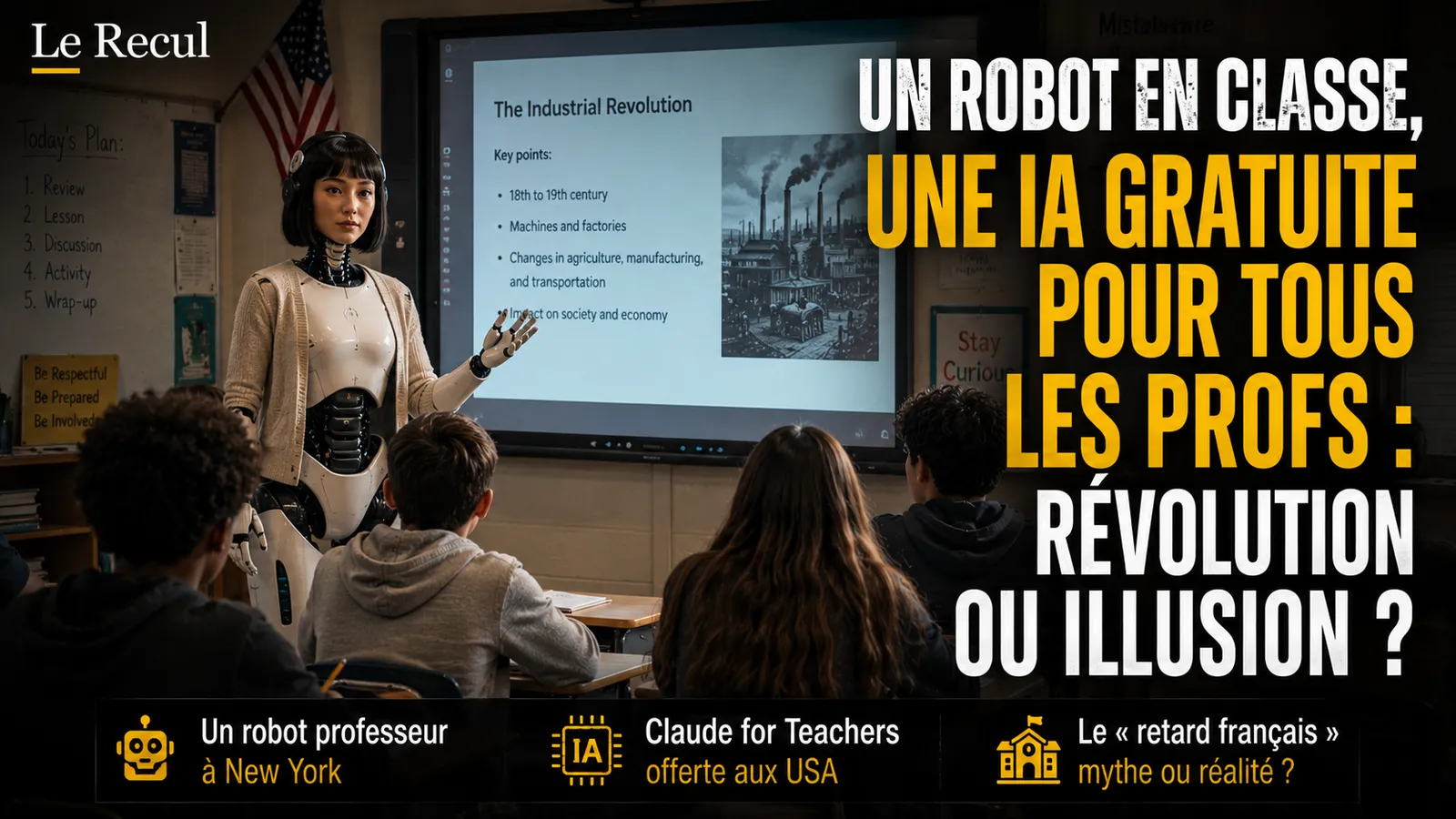
A few days apart, in mid-July 2026, two images said the same thing. In a school in New York State, a robot with an almost human face is getting ready to teach from the start of the school year. And on the scale of an entire country, Anthropic is giving its AI — Claude for Teachers — to every American teacher, free, plugged into the curricula of all 50 states. The message is identical: artificial intelligence is officially entering the classroom. That is when a French video caught fire, enthusiastic then bitter: France, despite its champion Mistral, has supposedly “done nothing”, and is going to “suffer” other countries’ sovereignty and widen its “cognitive gap”.
The emotion is understandable. But at Le Recul, the reflex is not to share it, it is to check it. Because Anthropic’s announcement is real and important — and the story being told about it is half false. The tool exists and it is notable. It is also contested by American teachers themselves. As for the robot, it replays almost word for word the same sales pitch — more on that below. And “France has done nothing” does not survive five minutes of facts. Let us untangle it, without the hype.
What Anthropic actually launched
Let us start with the facts, precisely. On 14 July 2026, Anthropic launched Claude for Teachers: free access to the premium version of Claude for verified K-12 teachers in the United States (the equivalent of nursery through to the final year of secondary school). By signing up before 30 June 2027, a teacher gets a full year of free access. One detail that matters: for now the offer targets individual teachers; a version for schools and districts is announced as “coming”.
This is not a simple chatbot under a new name. The product adds several building blocks:
- a library of teaching skills grounded in the learning sciences (preparing a lesson, differentiating by level);
- a “Learning Commons” connector linked to the standards and curricula of all 50 American states;
- access to recognised curricula such as OpenSciEd (science) and Illustrative Mathematics (mathematics);
- the Claude Code and Cowork capabilities for organising a workspace;
- nine connectors to tools already used in class: ASSISTments, Brisk Teaching, Canva Education, Coteach, Diffit, Eedi, MagicSchool, Snorkl and TeachFX.
On data protection, Anthropic is explicit. The company says that Claude for Teachers data is not used to train its models, that information about pupils falls under a “K-12 processing addendum” written to comply with the American FERPA law, and that the teacher keeps control of what they share. The message is clear: a powerful tool, with no harvesting of school data.
Finally, the social side. Anthropic highlights a partnership with the American Federation of Teachers (AFT), the main American teaching union (1.8 million members), to co-define privacy “benchmark standards”, a “train-the-trainer” programme, and an “AI fluency” course co-designed with Teach for America. A pilot is planned in the Detroit school district at the start of the next school year. On paper, everything lines up: free access, learning sciences, union on board, data protected.
It is precisely that too-smooth paper that needs turning over.
An “absolute banger”? Its own testers do not think so
The video talks about a “brilliant” tool, an “absolute banger”. But the first to pour cold water on that enthusiasm are not AI sceptics: they are teachers and education specialists who have tried it.
The bluntest is Benjamin Riley, founder of the think tank Cognitive Resonance. After testing it, his verdict is curt: the tool stands out in no way from what OpenAI or Google already offer. In other words, nothing genuinely differentiating. For a product sold as a break with the past, that is a more serious slap in the face than any “French lag”.
Dylan Kane, a mathematics teacher in Colorado, adds a deeper criticism. In his view, plugging AI into a state’s standards is nothing magical: knowing a curriculum matters less than understanding how it connects with the previous year’s — exactly what automatically generated content captures badly. Above all he points to a risk Le Recul follows closely: “deskilling”, the loss of competence. An experienced teacher will get some gains from the tool; a beginner risks becoming dependent on it before having learned to work without it. Here we meet the debate about cognitive offloading, the very one that pushed Norway to ban generative AI in primary school: by dint of delegating effort, you let it waste away.
And the automatic generation of lessons? Even when well prompted, it remains mediocre, Kane notes. The “50 states” connector is impressive in an announcement; it does not turn a general-purpose AI into a teacher.
The real blind spot: data, governance… and the union that applauds while demanding a ban
This is where the reassuring story really cracks.
First flaw, governance. Mark Racine, former technology chief of Boston Public Schools, criticises Anthropic for bypassing head teachers and districts — the very people whose job is to check and authorise a tool before it enters the classroom. By giving access directly to the teacher, the arrangement allows a teacher to upload pupils’ data without approval from their hierarchy. That is not a detail: it is a way round the rules protecting school data.
Second flaw, the legal basis of the “FERPA” promise. Amelia Vance, president of the Public Interest Privacy Center, points out something obvious that is too often drowned in marketing: a vendor cannot on its own declare its FERPA compliance. Only a school or a district can authorise certain data sharing, within a precise legal framework. “Designed to comply with FERPA” is therefore not a label; it is an intention, whose value depends on who signs what. The whole question — the one already posed by our investigation into the invisible AI in French banking and healthcare — remains open: who processes the data, where, under whose supervision?
Third signal, the most revealing. The AFT’s president, Randi Weingarten, publicly backs Claude for Teachers as a tool “built by and for teachers”. But the same leader is elsewhere calling for a total ban on pupil-facing AI in the youngest classes. Translation: the union endorses an AI that relieves the teacher of admin, and refuses an AI in the child’s hands. That split is not an inconsistency; it is the ridge line of the whole subject. Claude for Teachers is a teacher productivity tool, not a revolution in learning. Confusing it with “the AI that will educate our children” — which is what the video does — is already arguing about the wrong thing.
The real battle: capturing a classroom already saturated with AI
Why so much effort, and why free? Because the classroom has become a market. Anthropic is neither first nor alone there. OpenAI is also courting schools and works, like Anthropic, with the AFT. Google is pushing Gemini and has signed a deal with Utah to equip the state’s entire K-12 system — but stays outside the union agreement. Khan Academy is advancing with its Khanmigo tutor. It is a race for classrooms, and Claude for Teachers is its latest move.
The fuel for that race is one figure: according to Education Week, 61% of American teachers said they used AI in 2025, against 32% in 2024 — close to a doubling in a year. The technology is already in school bags; the battle does not create the usage, it tries to capture it. Giving Claude free to 1.8 million union members means locking in a habit before the competition does.
The market, for its part, is not fooled: on the announcement, the share price of Stride, a listed online education player, fell by 5.6%. When a free AI walks into the classroom, what it threatens first is existing business models. We are a long way from a pedagogical fairy tale: this is an industrial operation, with its winners and its losers.
One last point deserves naming, because it is the legitimate core of the video’s worry. The “Learning Commons” connector encodes the curricula of 50 states inside the assistant. And whoever encodes the curriculum gently influences the way it is taught: the examples chosen, the phrasing, the implicit priorities. This is not espionage; it is a form of soft power over school culture. Handing that layer to a foreign private player is not neutral — and it is true that the question would arise in mirror image if a French tool encoded France’s curricula tomorrow.

Meanwhile, a human-faced robot enters a poor school in New York
Let us come back to that robot glimpsed at the start, because it says a great deal. The case, revealed by Clubic on 16 July 2026, makes the shift tangible. In the Salamanca school district, in New York State — 1,300 pupils, 80% of whom live below the poverty line and a third of whom are Native American — a humanoid robot named Sally (made by Realbotix, silicone skin, mobile facial expressions) is to teach science and robotics from the start of the 2026 school year. Cost: around 50,000 euros, down from a list price of about 83,000, according to Clubic.
Look at its selling points: Sally assists teachers without replacing them, she is trained on the district’s curriculum, works offline, and her manufacturer says it has no access to any personal data about pupils. These are, almost word for word, the promises of Claude for Teachers — curriculum built in, no data harvesting. And the same reservations arise: one mother questions the usefulness of adding AI to the already heavy difficulties of a fragile community, and the state teaching union is calling for limits on AI and screen time. Two radically different forms — free software on one side, a 50,000 euro robot on the other — for one and the same dynamic: AI settles first where humans lack time or means. And it settles there with a well-rehearsed pitch, which, as we have seen, does not spare anyone from asking the real questions.
”France has done nothing”: that is false, and it is the most important point
Now comes the central accusation: while the United States advances, France is supposedly asleep. The facts say otherwise.
First, a tool already deployed, and for pupils this time. M.I.A. Seconde (Modules Interactifs Adaptatifs, adaptive interactive modules) is a remediation service in French and mathematics, open free to every upper secondary school since the start of the 2025 school year. It carries 24 adaptive modules and more than 20,000 exercises, designed with 14 researchers and laboratories and some forty teachers. A rare and precious fact: its effectiveness was the subject of a randomised impact evaluation in 2024-2025, carried out with the French education ministry’s digital directorate and the economics department of Sciences Po. Where Anthropic promises, France has begun to measure.
Next, a state strategy. On 16 June 2026, the “Notre IA” plan (“Our AI”) was presented, to deploy a “sovereign” AI across all public services, the education ministry included. Its concrete building block, “L’Assistant”, is developed by the DINUM (the French state’s digital directorate) with Mistral, hosted in France at Outscale (Dassault group) on infrastructure certified SecNumCloud. The interministerial trial, launched at the end of 2025, covered 10,000 public employees across 8 ministries. Finally, on the school side, a 20 million euro call for projects was launched in 2025 for a sovereign educational AI, with deployment targeted for 2026-2027, following on from the framework for the use of AI in education published by the ministry.
The real picture is therefore not “the United States acts, France watches”. It is two opposing models:
- American model: a private player, a general-purpose AI given away right now, oriented towards teacher productivity, plugged into the curricula, at the price of dependency on a foreign supplier and of contested data governance.
- French model: public steering, more targeted tools (pupil remediation, help for civil servants), sovereign hosting and a logic of evaluation, at the price of slowness and a narrower scope.
Neither of the two is free in the full sense of the word. The American model is paid for in dependency; the French model, in time and public money.
Europe has a card the United States does not: the law
One actor is missing from the video’s story, and it is the most structuring: the law. In the United States, Claude for Teachers arrives in a near regulatory vacuum — the guardrails are the ones Anthropic and the union set themselves. In Europe, the ground is quite different.
The AI Act classifies AI used in education among “high-risk” systems (annex III) as soon as it serves to assess learning, to decide on access or admission, or to monitor an exam. Concretely, that places obligations on the institution deploying the tool: human oversight, logging, monitoring of the system and informing the people concerned. This is not an administrative detail: it is a reversal of the burden. A tool that, in the United States, installs itself simply because a teacher signs up would, in Europe, have to be governed by the institution.
An honest clarification is needed, because the subject is moving. The “Digital Omnibus”, approved in June 2026, pushed back the compliance deadline for annex III high-risk systems from 2 August 2026 to 2 December 2027. But — and this is the key point — the obligations themselves have not changed: only the date from which non-compliance bites has moved. The transparency duties of article 50 (knowing that you are interacting with an AI) are still expected for 2 August 2026. We set out this shifting timetable in our follow-up on what the AI Act really changes.
One nuance remains that Le Recul does not want to smooth over: an assistant that merely prepares lessons probably escapes the “high-risk” label; it is the moment it touches the assessment of the pupil that European law applies. In other words, what the video reads as a “lag” is also, in part, a choice: making educational AI accountable before making it ubiquitous. Does it protect pupils, or does it merely slow adoption? The question is open. But it is a card the United States does not hold.
The video’s false dilemma
The video locks the viewer into a binary choice: “either we give up our sovereignty to have a high-performing tool, or we keep falling further behind”. That is a reasoning trap.
One: the tool is not the marvel announced — its own testers describe an AI with no differentiator, useful for admin, mediocre at building a real lesson. Two: France does have a tool for pupils, scientifically evaluated, which Claude for Teachers does not yet. Three: a free AI from a foreign private company is not the opposite of a “sovereignty risk” — it is one. That is exactly the mechanism we described about the AI quietly settling into our essential services: dependency does not announce itself, it installs itself through free access and convenience.
That does not mean the underlying worry is illegitimate. The real risk for France is not having “missed” Claude for Teachers — an American product, unavailable here, and contested over there. It is staying midstream: trials that never scale, a sovereign AI talked about more than deployed, and teachers who, for want of a home-grown tool, will use the American chatbots anyway — ChatGPT, Gemini, Claude — on their own, with no framework. The lag, if it exists, is not in the missed announcement. It is in scaling up.
And concretely, for a French teacher today?
Let us bring the debate back to reality, because that is where the video loses its viewer. A French teacher cannot use Claude for Teachers: the offer is reserved for the United States. The subject is therefore not “how do I get access”, but “what do we do instead”.
The honest answer is that a teacher under pressure does not wait for sovereignty before equipping themselves. They already use, often alone and without any framework, the same general-purpose assistants we follow in our ranking of conversational AI and our general ranking: Claude, ChatGPT, Gemini. That is what is called “shadow AI”: real adoption, invisible to the institution, with no confidentiality rules and no traceability. The real French risk is not missing an American product; it is letting that clandestine use flourish for want of a home-grown tool and clear instructions.
For the pupil, the public alternative exists and already works — M.I.A. Seconde — but it targets remediation, not lesson preparation. For the teacher, the sovereign tool remains largely still to come. Between the two lies a gap, and an urgency that goes beyond school: in a labour market that AI is reshaping — a movement we follow on the side of layoffs and reorganisations — knowing how to use these tools is becoming a basic skill. Training for it without a framework means taking the worst of both worlds: dependency and no rules.
Le Recul’s reading
Claude for Teachers is neither the video’s “banger” nor a non-event. It is a well-executed strategic move: capturing, through free access and an allied union, an already widespread teaching practice, and occupying the ground before OpenAI and Google. The product is solid on integration, weak on differentiation, and fragile on data governance — to the point where American experts and its own partner union are setting guardrails.
The story of the “French lag”, for its part, mixes up two things. It is wrong on the facts: France has tools, a sovereign strategy and, notably, a culture of evaluation still missing on the other side of the Atlantic. It is right on the intuition: without scaling up, French teachers will default to foreign AI, and sovereignty will remain a slogan. Those are two different observations; confusing them turns a real question of public policy into a lament.
Our position is consistent: neither panic nor wonder. The right question is not “for or against AI in school”, nor “American versus French”. It is: who controls the tool, who controls the data, and who decides how we teach — while AI, for its part, is already walking into classrooms, with or without our stepping back.
What to remember
- What. On 14 July 2026 Anthropic launched free access to Claude for verified K-12 teachers in the United States, plugged into the curricula of all 50 states; sign up before 30 June 2027 for a free year. Reserved for individual teachers; district version “coming”.
- The catch. Its testers judge the tool to have no real differentiator (Riley), to be risky for beginning teachers — deskilling (Kane), and to bypass district governance (Racine). FERPA compliance cannot be self-declared by a vendor (Vance).
- The union paradox. The AFT backs the tool for teachers, but calls for a ban on pupil-facing AI in the youngest classes. It is a productivity tool, not a revolution in learning.
- The race. OpenAI, Google (deal with Utah) and Khan Academy are targeting the same classrooms. 61% of American teachers were already using AI in 2025: the battle captures a usage, it does not create it.
- France. “We have done nothing” is false: M.I.A. Seconde (pupils, free since 2025, evaluated), the “Notre IA” plan and “L’Assistant” from DINUM and Mistral hosted in France, €20m for a sovereign educational AI. A different model, not the absence of one.
The figure to remember: 61%. That is the share of American teachers saying they used AI in 2025, against 32% a year earlier. AI is already in classrooms; the only open question is who will supply the tool, under what rules — and whether France will deploy its own before the answer is settled for it.
Our verdict. Claude for Teachers is a fine piece of ground-occupying, sold as a revolution it is not yet. The real issue for France is not having missed an American product unavailable here: it is choosing, knowingly, between free access that makes you dependent and sovereignty that demands paying the price. To watch: the release of a “schools/districts” version, the European reaction, and above all France’s ability to move its tools from pilot to real.